Showing posts with label Looksmart. Show all posts

Thursday, 17 October 2019

1/43 Model Review: 2019 Ferrari SF90 (Looksmart)

Looksmart have continued to produce excellent Ferrari's again, being priced around £100, more than the resin Minichamps cars. These SF90s are based on the Chinese GP, the so-called 1000th F1 race.

Looksmart LSF1019

Looksmart LSF1020

BBR BBRC225B

I will compare it to the BBR model that has already been released. The first thing to notice for me is that the BBR car is longer, with the rear wing endplate having at more of an inclined angle (more akin to the 2018 rules). The detailing looks of similar high quality from both model makers, and besides the length, proportionally both cars are very similar. 

The front ends of both cars look of very similar high quality, there's good definition of the front wing elements and the turning vanes on the underside of the nose. The complex bargeboard and sidepod leading edge section is well modelled by both brands. The Looksmart car does come with a driver figure, though the helmet remains the same basic one that they've been using for years - it could do with updating. 

The rear of the BBR car seems more defined, from the mini T wing, to the slots in the rear fin.
The only thing that I'm not too keen on is the red on the Looksmart model. It is matte compared to the previous year's model, but I think it needs to be a little less pink. Still, a very nice model.
Score: 8/10

Race Specific Versions

Looksmart LSF1022

Looksmart LSF1021

Looksmart have released a pair of Canadian GP versions of the SF90, where both cars were classified on the podium, with Vettel being penalised after finishing first on the road. The model includes all the changes from the Spanish GP update package, the most noticable being the gap on the shark fin.

Looksmart LSF1023

This is the Belgian GP version, Leclerc's long awaited first victory in F1 and for Ferrari. It was a bitter sweet weekend, with the death of F2 driver and fellow Frenchman, Antoine Hubert. It was only fitting that one of his friends and rival whilst growing up took victory in his honour.

Looksmart LSF1024

This is the Italian GP version, where Leclerc is the latest Ferrari driver to win at the team's home race to emotional scenes. There was a great battle for the lead with Leclerc fending off the World Champion to claim a popular victory. 

Looksmart LSF1026

This is the Singapore GP version of the car, where Leclerc did everything right to earn victory, but Vettel got the favoured pit strategy and leapfrogged into the lead to seal his only win of the season. 

Wednesday, 31 July 2019

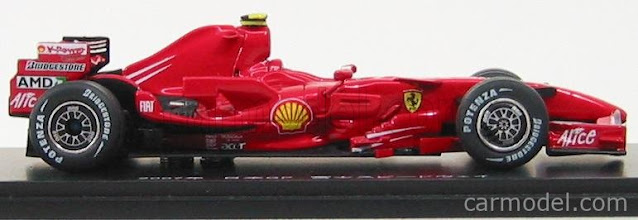
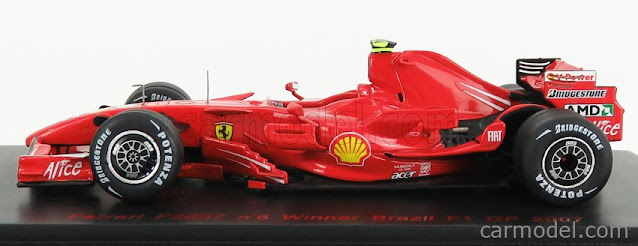
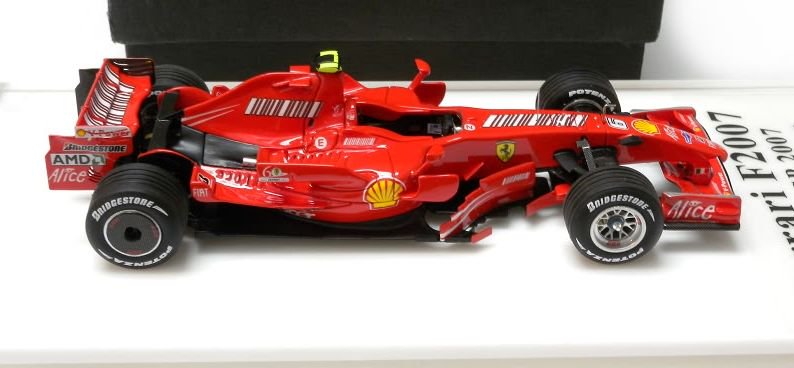
1/43 Model Review: 2007 World Champion Kimi Raikkonen (Ferrari F2007)

Background

Following Schumacher's first retirement, Raikkonen was signed as his replacement and won at the opening race in Australia. The two Ferraris and the two McLarens would battle intensely for both titles, with McLaren and their drivers holding the upper hand as the season developed. Ferrari and Raikkonen seemed out of the title race, but at China, Hamilton's McLaren had worn his tyres out and slid off into the gravel when entering the pit-lane, and Raikkonen took his fifth victory, reigniting his title campaign leading into the final race, though still 7 points adrift. It was Ferrari's 200th victory and 600th podium, which this model commemorates. In Brazil, Massa dominated the weekend, though out of contention for the title, whilst Hamilton was battling a number of issues on the way to seventh place and Alonso was powerless against the Ferraris in third. Massa let Raikkonen through to win the race and the Drivers' Championship by a point from both Alonso and Hamilton.

Interestingly, Massa revealed in the F1 podcast that it was at the Belgian GP where it was decided that the driver ahead at the end of that race would be the backed driver for the Championship. Coming to the prior race at Monza, it was the Brazilian who had the advantage but for reliability to strike and Kimi took a podium and the initiative for the remainder of the season.

Hot Wheels


The Hot Wheels car is presumably based on the race opening Australian GP, with the Marlboro red and the straight engine cover trailing edge. Hot Wheels continue with their generally good proportions, mixed with bulky appendages, but even the bargeboards are getting more detail, as is the front suspension and sidepod winglets. The helmet is a let down, but oeverall, not a bad little model. 
Score: 6/10

Mattel Elite


The Mattel Elite car is based on the Chinese GP, where Kimi earned his 5th victory of the season, the 200th Ferrari win, the 600th podium, the penultimate race of the season. From the Monaco GP, the F2007 ran in a darker metallic red, which I personally loved. The car features more refined details than the Hot Wheels car, though the exhaust looks clumsy. With the wheel covers front and rear masking any difficiencies, this turns out to be quite a nice model. The cockpit has a nice steering wheel too. 
Score: 7/10

Formula 1 Car Collection / Ixo 


As usual, the model is the Mattel Elite car, but this is dubbed as the Australian GP, even though the shape is clearly based on the end of the season (for a start, the rounded fin on the engine cover). The front rims are terrible, and you don't get a nice sticker for the steering wheels. For the lack of attention to detail, I have to award this a lower score than the Hot Wheels car. 
Score: 5/10

Redline

Redline RL140

Redline have produced a number of quality models, starting with Australian GP version. Good attention to detail on the track specific parts, the bright red colour scheme, no front wheel rim covers and the straight engine cover. Nice holes in the rear wing endplates, lovely bargeboards, good mirrors, very nice details, a great model.

Redline KBR002

We also get two late season versions, firstly the Japanese GP version above.

Redline RL148

And the Championship winning car from the Brazilian GP. Again you get lovely details on this model, along with good proportions throughout, including a nicely modelled nose cone.
Score: 8/10

Looksmart

Looksmart LSF-ES1707
There are a limited number of Looksmart versions around, but I believe it's the same as the Redline model but with a driver figure, this one from the Chinese GP as a special limited edition run of 200. It's a shame that the helmet looks little better than the Hot Wheels attempt, but don't let that take away from the rest of this beautiful model.
Score: 8/10

BBR

BBR BG311
This is the BBR model based on the Australian GP. The BBR car looks too long and low, which is a shame, because as usual, BBR do put some nice detail into their cars. But it's the poor proportions that let this down for me, even though the contours all look pretty accurate.
Score: 6/10
BBR BG344
BBR produced a mid-season version based on the British GP. The colour looks fantastic on this factory built model, and so does some of the details on the bargeboards, the cockpit and the exhaust area. I think the nose is a little too long for my liking, but overall, the proportions are much improved from the early season model.
BBR EX26
And we get a late season version based on the Chinese GP. Ignoring the slightly elongated nose in my opinion, this has slightly finer details than the Redline car and so I think I marginally prefer this one.
Score: 9/10

Tameo

Tameo TB010


Tameo have similarly done a selection of F2007s from the season, overlapping with other manufacturers, this model being the Australian GP car.

Tameo TMK367
And here is one from the Spanish GP, though this is Felipe's car.

Tameo TB015

The Chinese GP Version has full tobacco sponsorship rather than the barcodes,

Tameo TB011

Whoever made this Brazilian GP model obviously forgot to put the Shell V-Power decal on the rear wing endplate, but this is a beautiful recreation of Kimi's Championship winning car. It should have been Massa's race to win, but he let Kimi win and thus clinch the Championship by a point, and amazingly Ferrari's last champion. Tameo continue to set the standard for 1/43 scale F1 models.
Score: 10/10

Monday, 22 July 2019

1/43 Model Review: 1995 Ferrari 412T2

Background

The 1995 Ferrari challenger was a development of the 1994 car, the Ferrari 412T1, and this would be the last V12 powered Ferrari in Formula One. The car was reasonably competitive, scoring several podiums throughout the year, but was not on par with the Williams or Benetton of that year. They competed for victories at various Grand Prix, such as European and Italian GP, but it was Jean Alesi who would score the only win of the year at the Canadian GP, his only win in Formula 1. They finished 3rd in the Constructors' Championship.

Minichamps

Minichamps 430950027

The Minichamps car sits very far forward in the box. I really like this model from Minichamps. I thought that the shape is pretty generic and simple, but as we will see from other model makers (and my own first attempt at modelling the car for GP4), it's perhaps not as easy as it seems. Anyway, the proportions are great on this car, the front wing has the turning vanes behind it, the rear wing and its stepped double winglets are nicely done. It's a shame that the helmet was so large and for some reason looking down at his legs. For a model of its time at a reasonable budget, I think this is a little gem.
Score: 8/10


Onyx

Onyx 237

Onyx and Minichamps produced the same car back in 1995 offering us a direct comparison. The Onyx car is based on earlier in the season whilst the Minichamps car was based on the mid-season. So just a two element front wing, a sticker for the hole in the engine cover, and only one set of winglets near the rear wheels on this model. The cockpit sits a little far forward, and so the engine cover is elongated as a result to compensate. The model also seems like it was made on a ball rather than a flat surface, with the front of the car pointing down and the rear of the car similarly pointing down, with the middle of the car slightly raised. Because of that, the shape of the nose needs to be higher around the suspension area, and so that looks weird as well. For me, this isn't really that good a model from Onyx.
Score: 4/10

Mattel Elite/Ixo

Mattel T6286

The Mattel car is based on the European GP the exiting race in mixed conditions where Alesi's great car control allowed him to put slick tyres on earlier than anyone else. He was leading the Grand Prix until the final stages when Schumacher forced his way past on a chicane that Schumacher had an input in designing.


The Ixo car is not based on any particular GP. In other blog posts, I've split the two, but as we've noted on multiple occasions, they used the same moulds, so I've combined them in this review. I was hoping for more, considering modelling had come on since the mid-90s, but I was left really disappointed with this model. The car is in general way too tall, particularly that giant airbox. The Mattel car features better decals,  but their attempt at the late season version of the rear wing winglets is laughable, it's truly terrible in how shallow it is. It's all because the sidepod does not taper down at the rear so the modellers couldn't produce an accurate winglet because the rest of the model is so ill-proportioned. The plus side is that the cockpit of the Mattel version is quite nice (of the budget cars I've reviewed so far) and the vents at the rear of the car are nicely detailed and painted.
Score: 5/10


True Scale Models / Fujimi / Looksmart

TSM TSM11FJ012

From what I can tell, these three brands have all released the same version of the model, and I can't really tell them apart. Here is the TSM/Fujimi car above.

Looksmart LSF_ES1701 
Looksmart produced a special limited edition run of 1000 for the Japanese market, this one based on the Canadian GP. The car seems too small for the wheels and tyres or vice versa. I find the nose and monocoque area a little too bulbous and not enough nuance to the actual shape. The front and rear endplates look oversized, with the rear wing so tall it looks like it was still made for the 1994 rules. The camera's are nicely done, the suspension has nice details, the bargeboards are well done and have nice chrome supports. The sidepod is really nice, particularly around the rear of the car and the rolloever bar is really nicely done too. The cockpit detail is nice, and within itself, the proportions are great, but it's a shame they are let down by the rest of the car. The vents at the rear of the car are a little over emphasised for my liking but the diffuser details looks nice. There are parts of the car I'd like to give a 10/10, but the let downs are almost as bad as some of the budget models above.
Score: 8/10

BBR

BBR Met47


This is the Italian GP version, and you can also get the Brazilian GP and Canadian GP versions as well. I do like the Italian GP specific car as it's got a stripped back front wing and rear wing, which are all nicely done on this model. Proportionally, this is of a similar standard to the Minichamps car, nicely done. There's some better details, as you'd expect from BBR on this car, but I feel it could do with a bit more attention to detail and refinement. The shape of the nose is fine, but could be better. The rear vents don't have any detail, but you do get a nice cockpit and seat. Overall, it is better than the Minichamps car as you'd expect and especially for the price, but I suppose I was expecting and hoping for more which would have propelled my mark to a 9.
Score: 8/10

Tameo

Tameo TMK193

Tameo TMK202

The first picture is the Brazilian GP version and the second is from the Canadian GP. I love the Ferrari 412T2 and it's a shame I've spent so much time modelling it, that I'm left deflated by many of the models, with the original mid-90s Minichamps version being a strong contender for my favourite of the lot so far. But trusty old Tameo have knocked it out the park again on their model. For me, it's not perfect, but it's close enough for the scale. The front wing is a masterpiece, the nuances of the front fins, nice separated front wing elements and turning vanes, the nose is spot on. The cockpit is really nice, and all the minor bumps on the headrest and airbox is nicely done too. The opening of the sidepod could be better from top-down view, but that's only a very minor point. The rear of the car is beautifully done, the rear wing and diffuser area is lovely, though, again, I think they could have put a bit more detail into the vent on the engine cover/rear sidepod.
Score: 9/10

Tuesday, 19 March 2019

Winners of the 1st Race vs Champions (1990 - 2019)

We just witnessed a reinvigorated Valterri Bottas dominate the Australian Grand Prix. He was close to Hamilton in qualifying, but snatched the lead convincingly at the start and drove away to win by over 20 seconds. Granted that Hamilton's car was damaged, it was still an impressive margin of victory. Verstappen had to overtake cars in front of him to finish where his pace deserved and Ferrari's pace had vanished this weekend having to settle for 4th and 5th, unable to find a good set up and use the tyres properly.

But, as they all say, this is Australia, and it throws up some odd results and can give false readings as to how the season will pan out. Melbourne has hosted the opening round of the F1 World Championship since 1996, though Bahrain opened the season a couple of times in 2006 & 2010. There used to be a trend where the winner of the first Grand Prix usually goes on to win the World Championship. I've gone back and looked through race winners compared to champions from 1990 through to today to see how true it is.


1990s

Only twice in the 90's did non-champions win the first race.

1997 David Coulthard

Minichamps 530974390
Here is Coulthard's McLaren in pre-season testing livery. Coulthard would win another Grand Prix that year, as McLaren and Mercedes were starting to become more competitive, but they weren't title contenders. That would come in 1998, but it would be Hakkinen who would win the Championships.
Villeneuve was taken out by Eddie Irvine's Ferrari on the first corner of the season and retired, opening up the opportunity for McLaren to take their first victory since Senna won in Adelaide in 1993.

1999 Eddie Irvine

Hot Wheels 24626
1999 was meant to be the season that Michael Schumacher finally won the title in a Ferrari, but a broken leg half way through the season put an end to his challenge. So Ferrari rallied behind Irvine, kind of, to take the challenge to Hakkinen and McLaren. Hakkinen should have ran away with the title that year but mistakes from him and the team made it much more difficult. And Ferrari? Well I think they'd rather wait a year than break their duck with Irvine to be honest. Hakkinen retired from the first race with throttle problems, whilst Schumacher had issues before the start of the race that meant he started at the back of the grid and finished outside the points.


2000s

Similarly in the noughties, only twice did the race winner not go on to win the title.

2003 David Coulthard

Minichamps 530034305
Coulthard makes the list again in 2003. Ferrari were so dominant by now that they started the season with the previous years car and were still competitive. Having said that, McLaren did the same for 2003 and ran the updated car for the whole year. Schumacher damaged his car whilst battling with Raikkonen, whilst Montoya spun out of the lead, leaving Coulthard to pick up the pieces and win the race.

2005 Giancarlo Fisichella

Minichamps 400050006

Remember F1 went through a phase of single shot qualifying, where drivers took one turn each to set a qualifying time? It comes unstuck if the weather changes half way through, which it did in Australia 2005. Alonso qualified in 14th position whilst team mate Fisichella took pole. Fisichella showed the potential of the Renault car by taking victory at the opening round. But it would be his team-mate who would take the title, whilst Fisichella faded into the number 2 driver role.


2010s

However, when you enter the last decade, 6 times, more than half of the winners of the first race has not gone on to win the World Championship. Before we delve into why that is, let's have a look at the each case first.

2010 Fernando Alonso

Mattel Elite T6289
Alonso's debut with Ferrari ended with victory at the Bahrain Grand Prix. The car wasn't that quick, but a late season charge meant that he was in contention for the championship going into the final round, but a strategy error cost him the title to Vettel

Minichamps 530104311
Australia was the 2nd race that year and Jenson Button justified his decision to leave the team whom he won the Championship with, to go to Hamilton's team and prove himself. Button took an opportunistic victory at Melbourne, making the best strategy calls in a race with changeable conditions. But over the course of the season, Button was not able to mount enough of a challenge to defend his title.

2012 Jenson Button

Minichamps 537124303
Button won in Australia again in 2012, but the first half of 2012 was about the teams trying to get their heads around the new Pirelli tyres, which saw seven different winners in the first seven races. It wasn't until mid-season when Vettel gained the upper hand on the Championship despite a plucky challenge from Alonso in a much slower Ferrari.

2013 Kimi Raikkonen

Minichamps 410130107
Kimi Raikkonen started off the 2013 season with a win, having won at the tail end of the 2012 season as well. Whilst the car showed flashes of pace, it was not quick enough to mount a serious title challenge.

2014 Nico Rosberg

Minichamps 413140644
Mercedes were miles ahead when the 2014 season started in the new turbo hybrid era, but it was Rosberg, not Hamilton who would take the first victory of 2014. Hamilton was on pole, but engine issues meant he was third in the first corner and fifth at the end of the first lap before retiring. The battle between the two teammates ran to the final Grand Prix where Hamilton was triumphant.

2017 Sebastian Vettel

Looksmart LSF107
With a major change in regulations, Ferrari built a competitive car, though it wasn't quite on par with the Mercedes, but Vettel made good use of it, leading the championship for more than half the season - not the important half though. After mid-season, mistakes and misjudgments were costly and their challenge fizzled out. At the Australian Grand Prix, again Hamilton took pole position, but Vettel remained close in 2nd. When Hamilton pitted early, he was held up by Verstappen who was yet to stop, allowing Vettel to come back out ahead of Hamilton after his stop.

2018 Sebastian Vettel

Bburago 18-36808V
2018 started so promisingly for Ferrari. Though Hamilton aced qualifying, an opportunistic pitstop by Ferrari under Virtual Safety Car propelled the German to first place. By half way through the season, Vettel was leading the championship, and in a strange case of deja-vu, Vettel's challenge faded in much the same way it did in 2017.


So what can we conclude? Formula 1 is a lot less predictable than it used to be and whilst it's not as competitive as we'd like, it's still in a better place than it was. We still moan that it's only ever going to be one of two, possibly three, teams who can win the title, but there were seasons in the past where one driver dominated for much of the season.

Is Bottas going to win the title, challenge for the title, or was this a one off? Time will tell, but all the predictions for Melbourne turned out to be wrong, as Ferrari were slow and Mercedes were well ahead. Nobody gave Bottas a chance, but the reality is, if the Mercedes can be competitive throughout the season, Bottas has all the tools to challenge. But his team-mate is five-times World Champion, Lewis Hamilton, and when he was on it, he was unstoppable last season. However we haven't seen that kind of form throughout an entire season yet, and he has been beaten before, but that took Rosberg using everything at his disposal to throw Lewis off his game, personally, I can't see Bottas doing that this season. Hamilton has been on pole 8 times in his career, and has won 4 of the last Championships, but has only won this race twice and only one of those times in a Mercedes.

Thursday, 21 February 2019

1/43 Model Review: Sebastian Vettel's career in models

In the build up to the 2019 season, I've traced back over the careers of potential title-challengers, and this is the third in that series of posts.

Sebastian Vettel is a four times World Champion, and that commands respect in itself. Arguably there are more fitting drivers who deserve that accolade, but they haven't and its Vettel who has earned them.

Having earned his championships at Red Bull, Vettel is out to emulate his hero, Michael Schumacher, by winning in a Ferrari. Ferrari haven't created a car capable of challenging the championship since 2008, with only the outstanding driving of Alonso dragging it into contention in 2010 and 2012. 2017 showed promise, and the 2018 Ferrari, at times, was the fastest car, but the Championship eludes this partnership still.

Now we nearly half way through testing for the 2019 season, and Ferrari are near the top of the timesheets and the mileage charts. Could this be the year that Vettel secures the title with the Scuderia? Or is it time for Ferrari to throw their backing behind his new hot-shot teammate, Charles Leclerc?

Only once in Vettel's career has his team-mate been convincingly beat, and that was 2014 when he raced with Daniel Ricciardo. After four seasons at the top of his game, and with a disappointing engine leading to an uncompetitive car in 2014, its arguable that Vettel was simply going through the motions and wasn't performing at his peak. It's a shame the partnership only lasted a season, I personally think a reinvigorated Vettel would have performed better had they had another season together.

But Vettel has been known to make unforced errors and lashing out. At the 2009 Australian GP, he clashed with Kubica's BMW with a few laps to go, then attempting to continue without a front wing, went straight into the barriers at the next corner (as did Kubica!). In 2010, he moved into Mark Webber after completing a pass on his team-mate causing him to crash out of the race. Later that year in Belgium, he crashed into Jenson Button whilst battling together. In 2011, he crashed into the 'Wall of Champions' in Canada in practice (not a huge mistake, but it's funny that he's another victim). In 2016, at the Mexican Grand Prix, Vettel lost it over the radio at race director, Charlie Whiting.
In Azerbaijan 2017, he deliberately drove into Hamilton's tyres at slow speed, venting his anger at what he thought was brake-testing antics from Lewis. Oddly, he crashed into the back of Stroll's Williams on the slow down lap in Malaysia 2017. In Singapore, an unnecessary swerve at the start led to a multi-car crash. In 2018, he crashed into Bottas in France, crashed out of the lead at his home race in Germany, had multiple spins when battling other cars, and lashed out at the weighbridge in Brazil.

No human is perfect, and you need passion to push yourself, and sometimes exceed your capabilities. However, Vettel needs to control that in 2019 and minimise his mistakes if he is in a tight championship battle. He needs to keep a calmer head sometimes, but there is no denying his talent and speed and hunger for winning, as we saw when he disobeyed team orders to overtake Webber to win the Malaysian GP in 2013.

I may come to eat my words, and I believe the hype surrounding Charles Leclerc, but I don't think Vettel is going to be quite so easily pushed aside by his new team-mate, especially if a Championship is there for the taking.


2007 BMW Sauber F1.07 - US GP

Minichamps 400070110
Vettel began his career in a BMW Sauber at the USA GP and filled in for Kubica after his horrific looking accident in Canada that year. Vettel had already made some Friday Free Practice appearances in 2006. Vettel impressed at the USA GP and claimed his first points, the youngest driver to do so at the time. Surely a bright future lay ahead for the young German.
Minichamps re-released this car with a special cardboard overlay recently, but prior to that, this model was worth around £100.

2007 Toro Rosso STR2 - Chinese GP

Minichamps 400070119
Vettel replaced Scott Speed in the Toro Rosso at Hungary for the rest of the season and results started to pick up for the team. At the Japanese Grand Prix, which was ran in very wet conditions, he was running in third when behind the safety car, he ran into the back of future team-mate Mark Webber's Red Bull, taking both of them out of the race. Toro Rosso earned a double points finish in China, a 4th place finish for Vettel, when he started in 17th position.
This model isn't particularly easy to find, although it doesn't command a high value.

2008 Toro Rosso STR3 - Italian GP

Minichamps 400080115
In the era when Red Bull found a loop hole so that the lead team and Toro Rosso were able to run essentially the same chassis, but the Toro Rosso had a stronger Ferrari engine to the sister team's Renault. The STR3 wasn't introduced until the Monaco GP. From there, Vettel in particular, was a consistent points finisher, and at a wet Monza, showed his potential when he got pole position and won the race, becoming the youngest pole-sitter and race winner. The team finished 6th in the Constructors' Championship.


2009 Red Bull RB5 - Chinese GP

Minichamps 400090115
Vettel was promoted to the senior Red Bull team having driven for Toro Rosso and embarressed the senior team by scoring either teams first victory, regularly out-performing the Red Bulls and finishing ahead in the Constructors' Championship in 2008. 2009 saw new rules and regulations and Red Bull had a promising pre-season. But it was Brawn who dominated the first half of the year, helped by their double diffuser design. But a rain-soaked Chinese Grand Prix brought Red Bulls first victory and 1-2 finish with Vettel winning, which this model commemorates. As Red Bull introduced the double diffuser, the potential in the car was finally displayed as the balance of power shifted to the Red Bulls, with three further victories for Vettel and two for Webber. Red Bull with Adrian Newey designed cars, and Sebastian Vettel would dominate the next four seasons with the foundations based on the RB5.
This model comes with a standing figure in a Minichamps tall box. Another Vettel model, and more wet tyres. Hamilton is praised as a wet-weather master, and that is true, but Vettel showed early in his career that he can win in wet and mixed conditions too.


2010 Red Bull RB6 - Abu Dhabi GP

Minichamps 410100105
This is the Red Bull RB6 which Sebastian Vettel drove to victory in the 2010 Abu Dhabi Grand Prix. Sebastian clinched the 2010 title at Abu Dhabi to become the sport’s youngest ever Drivers' World Champion. It was a fine victory, with Seb leading much of the race. His main championship rivals, Fernando Alonso and Mark Webber, pitted too early, and found it difficult to make progress up the order. Frustratingly, Alonso and Webber finished in seventh and eighth respectively, after getting caught behind the Renault's of Petrov and Kubica. This allowed Seb to clinch the title by a mere four points, earning his first of four World Championships to date. 


2011 Red Bull RB7 - Japanese GP

Minichamps 410100305
Sebastien Vettel in the Adrian Newey designed Red Bull RB6 with exhaust blown diffuser powered him to a dominant second consecutive World Drivers' Championship and Constructors' Title for the team. He scored podium finishes in 17 of the 19 races, winning 11 of them. Mastering the best out of the new Pirelli tyres, he took 15 Pole Positions, led from the start and controlled the race to victory. This is the second of his four consecutive titles to date.


2012 Red Bull RB8 - Brazilian GP

Minichamps 410120101
Having had the quickest car in the field since the middle of 2009, the RB8 did not start the season as the quickest, being hurt by rule changes that banned exhaust blown diffusers of which the previous cars were heavily designed around. Vettel still won at Bahrain and scored strong points finishes as seven different winners won the first seven races. In Valencia, Red bull brought an upgrade package that saw him dominate only for an alternator failure to occur just after a safety car period causing him to retire from the lead. It wouldn't be until Singapore that Vettel would have the strongest car again, when designer Adrian Newey and his team perfect the Coanda effect, which used exhaust gases to gain more downforce. Vettel delivered four wins in a row, reminiscent of the previous season. Vettel had the lead of the championship going into the season finale at Brazil. With changeable conditions, he was caught out with a crash with Bruno Senna's Williams, and the RB8 was lucky to continue, so the race swung to Alonso's favour and then Vettel's and so swung between the two as the laps went on. But despite Alonso finishing second, Vettel did just enough to clinch the championship by 3 points. It is his third championship in a row, becoming the youngest triple world champion, and demonstrated once more what a great racing driver he is.
This lovely Minichamps model comes with damaged sidepod and floor along with intermediate tyres and Vettel's raised fist.


2013 Red Bull RB9 - Indian GP

Minichamps 410130901
Red Bull signed off this era of Formula One rules with a crushing domination over their rivals. The beginning of the season saw them hide their true pace with delicate tyres, but when Pirelli returned to 2012 style constructions on their tyres, along a few updates on the RB9's exhaust blown diffusers, Vettel took 9 straight victories and claimed his fourth Drivers' and Constructors' Championship in a row.


2014 Red Bull RB10

Similar to Hamilton's off season in 2011, Vettel had an off season in 2014, so I bought a couple of Ricciardo models instead. 


2015 Ferrari SF15-T - Malaysian GP

Looksmart LSF101
After a dismal 2014 season for Ferrari, it was clear change was needed, even after Marco Mattiacci was brought in as new team principal in 2014, his job, as well as Ferrari Chairman, and the head of the engine department were all given to new men. Star driver, Fernando Alonso also departed, so a new star was brought in, four-time World Champion, Sebastian Vettel. It was a gamble, having been comprehensively beaten by Daniel Ricciardo in 2014, but a fresh challenge was what was required and Vettel would earn 3 Grand Prix wins, the only non-Mercedes car of 2015 to do so. Kimi Raikkonen would score half of the points of his rejuvenated team-mate.


2016 Ferrari SF16-H - Australian GP

Looksmart LSF104
After an encouraging upturn in form for 2015 with three race victories, expectations were high coming into 2016. The SF16-H (the H for Hybrid), sported a new colour scheme with a white rollover bar, harking back to the 312T of the 70s and the F93A of 1993. Signs at the first race were encouraging, when Vettel stormed into the lead and looked likely to secure the victory but for a poor strategy call. However, the promise turned to disappointment after disappointment. With Ferrari president, Sergio Marchionne, taking a more hands on approach, the first victim was highly rated head designer, James Allison. a frustrated Vettel became known for his colourful language on the radio, mainly at backmarkers but also at Race Director, Charlie Whiting at the Mexican GP, and Raikkonen complaining to be a victim of Verstappen's strong defensive driving. The team slipped behind a rejuvenated Red Bull into the third best team.


2017 Ferrari SF70H - Australian GP

Looksmart LSF107
After a disappointing 2016 campaign, winter testing showed Ferrari compared well with the Mercedes and sure enough the car was competitive when it showed up at Australia, with Vettel winning the first race. Vettel lead the championship by the summer break with four wins and four second place finishes. But a first corner shunt at Singapore between Raikkonen, Vettel and Verstappen ended their races, an engine problem meant Vettel started at the grid in Malaysia and another engine failure 4 laps into the Japanese Grand Prix essentially put an end to Vettel's championship challenge. At Baku, Vettel deliberately banged wheels with Hamilton behind the safety car when he thought the Mercedes driver brake tested him. The Ferrari featured unique high sidepod inlets at a more efficient perpendicular angle with cleverly integrated aerodynamic wings to abide by the new sidepod geometry rules. The car was more user friendly than the Mercedes car, and more often than not was able to get the Pirelli tyres in the perfect operating window when others struggled.


2018 Ferrari SF71H

Bburago 18-36808V
2018 was the battle between two four-time World Champions seeking to gain their fifth title. The season began brightly for Vettel in the Ferrari, with their strongest car in a decade, Vettel once again seized the lead of the championship for the first half of the season. The turning point came when Vettel crashed out of his home race in Germany. Wet weather in qualifying at the Hungarian GP, when Ferrari were quicker, allowed Hamilton to snatch victory. In Italy, Raikkonen had a more favourable qualifying strategy that earned him pole, and Vettel spun whilst being overtaken by Hamilton on the first lap. He also spun in Japan battling with Verstappen, and in USA when battling with Ricciardo. He also damaged the weighbridge in qualifying for the Brazilian GP. All momentum had swung Mercedes and Hamilton's way by this stage, and Vettel finished a distant second.
I haven't completed my 2018 collection as of yet, and the Ferrari isn't one that I have purchased yet.


Below are links to my other 2019 challenger career in models articles:
Lewis Hamilton
Max Verstappen

For more about World Champions, click here: https://fongugp4.blogspot.com/p/f1-world-champions.html