Showing posts with label Ferrari F310. Show all posts

Thursday, 30 May 2019

F1 2013: 1996 Ferrari F310 walkaround part 4

Whilst I have the F1 2013 version of the 1996 Ferrari F310 in Zmodeler, I thought I would do a bonus article having a look at their car. As mentioned in my previous post, the car is made by professionals who probably had access to more source material than I would personally have time to find myself. They also had less to worry about in terms of polygon count so they could throw much more resource into the car that we are limited to in GP4. So the cars in F1 2013 are incredibly accurate, and more detailed than what GP4 might be able to handle.


This is the low nose version of the car, and you can see how the nose itself is slightly raised from the front wing as mentioned in my previous posts. The front wing as added detail on the vanes with a joining support wire. This model has 3D bodylines, as my cars also do. You can see that there is more detail on the suspension and the wheel hub. The smaller bargeboard hidden in the suspension is beautifully done, as it's not quite straight, but looks almost warped, a nice touch.


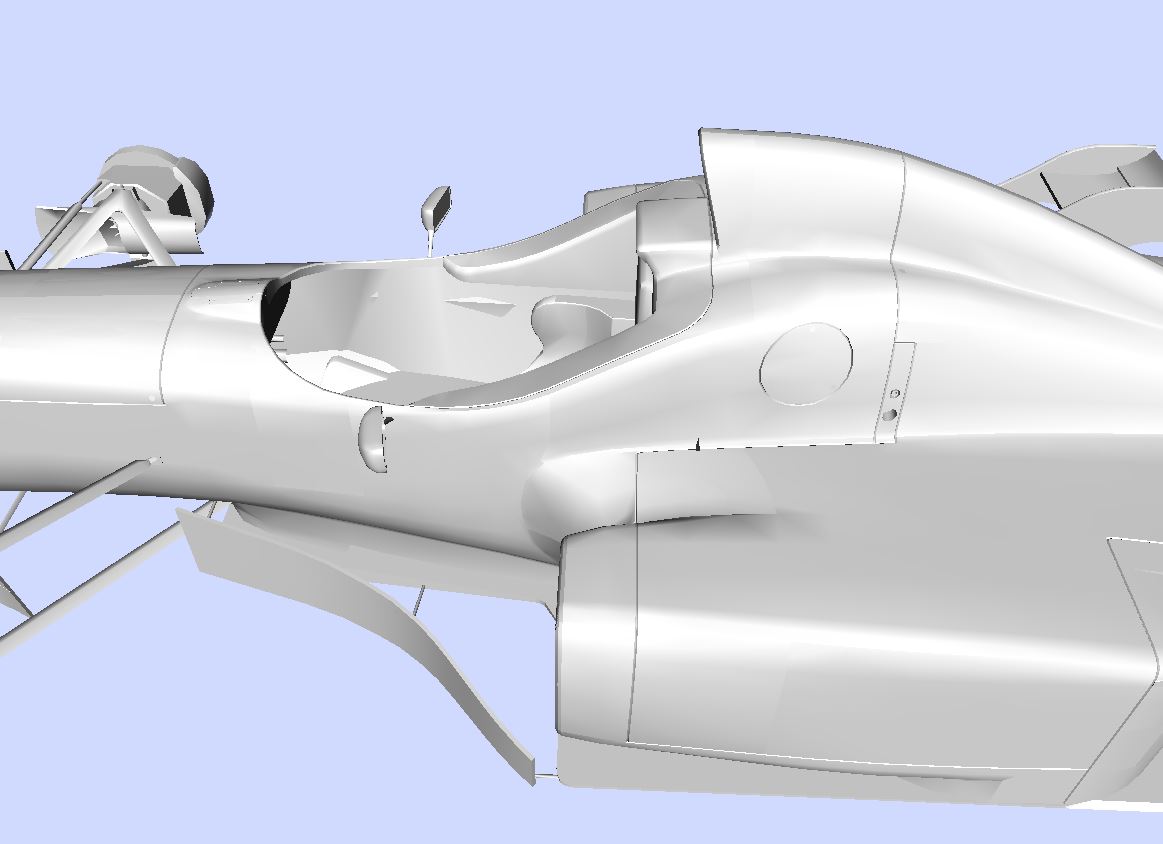
The nice work on the bodylines can be see in this shot above. The integration of the rear of the side head rest protection is nicely done, with the front part being quite flat, whilst it is much more curved by the fuel cap and rearwards from there. The head protection itself is wonderfully detailed. The seat is nicely recreated, though there's not too much else in the cockpit worth mentioning.


The rear of the car has some lovely details and I wanted to show the wireframe so that you can see some of the details and modelling techniques used to create them. One of the things I try and do is to make sure all my polygons face the same way, |\|\|\|\|, where as there's some difference on this car around the rollover bar.

There's some nice detail on the hump at the rear of the engine cover, and the suspension pickup points. The rear fin has some nice detail as does the rear wing itself.


When I said the GP4 car took a few liberties in the diffuser region, it was to this car I was comparing it to, which from what i can tell from pictures is much more accurate and well proportioned. You can see some of the complexities of the rear suspension from this angle and how tightly packaged it all is, something you don't necessarily appreciate unless you try and make it yourself.


Finally here's a nice shot of the car where you can see the detail on the seat, the hump in front of the cockpit with bodylines on it, must have taken a while to get that right. The conversion to 3DS format has knocked the normals a bit, so the sidepods don't look as smooth as it does in game.


I think it looks great in game. If this car was to make it into a newer game, I'd expect to see more polygons and more details than before, particularly on the insides and the cockpit which are lacking a little in detail in F1 2013. I hope you enjoyed this slight detour from my regular postings, but I always try and follow modern techniques to further improve myself and my modelling.

Wednesday, 29 May 2019

GP4: 1996 Ferrari F310 walkaround part 3

For the third part of the walkaround, I will be looking at the cockpit, the rear of the car, and some of the internal parts of the 1996 Ferrari F310 created by Nick Ovey and Ebi Attard. If you missed the first two parts, you can read them here, part 1 and part 2.


The cockpit is pretty basic, at a time in GP4 when there wasn't really much attention put into making cockpits accurate, as the in cockpit view used a generic model for all cars. Some nice touches are the onboard camera, as placing the camera on top of the rollover bar started to become the norm in 1996.


The wireframe is shown on the shot above, so that you can compare some of the techniques used on this car compared to some of my cars of a later period. The same philosophy applies with more polygon usage around curved regions, whilst large polygons are used for flat surfaces.

The Ferrari were one of the teams caught out with the side head-rest protection regulation, new for 1996. They had the highest of all the teams, something that affected the flow to the airbox above the drivers head, and it was common to see Schumacher and Irvine to drive down the straights with their head as over to the side as they could manage.


Moving onto the rear of the car and this is an area where perhaps artistic license ruled over accuracy, though it is not bad by any means.


There have been some lovely photos of the car with its engine cover off, so it was good to see that faithfully recreated on this car. whilst it is basic and a lot of it covered by the radiators, it's good enough for you to get an idea of what is there. Ferrari were quite unique in that they didn't run a black airbox, with the prancing horse featuring prominently on it.


Here is a shot of the inside of the car from the rear. For comparison, I have a screenshot of the F310 created for F1 2013. It's a shame that the car doesn't make it into the classic part of the 2018/19 game.


As you can see, the 2013 model uses many more polygons and attempts far more detail but the proportions are pretty similar. What I'm saying is that though the GP4 car, created by amateurs and aiming for less detail, have done a fantastic job and holds up well against the F1 2013 version which was created by professionals with probably better source material to work from.

Tuesday, 28 May 2019

GP4: 1996 Ferrari F310 walkaround part 2

Welcome back to part 2 of my 1996 Ferrari F310 GP4 car walkaround. This car has been beautifully recreated by Nick Ovey and Ebi Attard.


The high nose created by the Ferrari is very reminiscent of the Minardi high nose adopted in 1995, with the bulbous undersection and the angled supports. Personally I loved the look. The front wing is simple but accurate, Ferrari running three elements, which wasn't unique or new, but most other teams ran simple two element front wings.


New rules for 1996 meant that the front wing endplates must be rounded to avoid punctures on collision. Ferrari's version is notably quite rounded. You can see the vanes underneath the front wing and the undercut at the rear of the endplate, something they had developed on their 1995 car. The nose should have been easy to integrate, but I had to make a slight adjustment to the top of the nose and the angle to make sure the high nose was not too low. The textures are nicely integrated with the shape with the bodylines and how the suspension connects with the monocoque.


Moving towards the cockpit, there is the small bump in front of the cockpit. This I believe is to do with a regulation with the steering wheel, that as the steering wheel turns, the wheel must not exceed the height of the monocoque.

You can see the bargeboards on the F310 and the floor as it guides the air underneath the sidepod and towards the diffuser.


Here is a close up of the underneath of the sidepod, nicely done by Nick and Ebi. The curvature of the top of the sidepod is spot on for me.


Here is the front of the sidepod, again I think this is beautifully done and kept at a very low polygon count, whilst keeping lovely smooth normals.

You can see the original car in Nick Ovey's page http://njovey.com/3d/ferrari-f310/

Monday, 27 May 2019

GP4: 1996 Ferrari F310 walkaround part 1

Next up in my walkaround series from the GP4 1996 mod is this one. The Ferrari F310 I wasn't really involved in, the main shape and work being done by Nick Ovey and Ebi Attard. I only got involved with helping them get the car in-game and creating the high nose, so that will be the car that I will review. If I remember correctly, this car was released years after the original McLaren, but a little before the Benetton by Oggo. So in my review, it's not for me to judge it according to the standards of some of my later works when I was pushing the boundaries of accuracy.


The car has good proportions overall, and is a pretty accurate shape. The car has lots of nice source photographs so that you can get some really good reference shots for modelling. What I did forget to update on this car was the rear winglet endplate, which should have been updated from the early season version.


If you notice from my other cars from the front and rear views is that everything lines up nicely, the width of the front wings, the sidepods etc. Sadly on this car the rear winglets exceed the width of the rest of the car. 


The John Barnard designed Ferrari for 1996 season was known as the truck, because of how it handled, perhaps not fitting for the arrival of double World Champion Schumacher. Somehow, he managed to eek out three victories in a car that didn't deserve to be challenging the Williams at all. 


The car started out the season with a low nose, though the nose itself was slightly raised giving more surface area to the front wing. This concept was ditched by the Canadian Grand Prix. There was no change to the main chassis to accommodate this, so the high nose had to be raised from the bulkhead forwards, which led to the slightly awkward bulbous shape. Compare this to the F310B for the 1997 season when nose and chassis were designed together in a more tightly fitted and slender and sleek shape.


Barnard also returned to a raised sidepod, something similar to the double floor concept tried (and failed) on the 1992 car. From this angle, you can see the sidepod is completely separated from the floor until the very rear.

As usual, you can read about how the car fared in my model review found here: https://fongugp4.blogspot.com/2019/03/143-model-review-1996-ferrari-f310.html

Thursday, 21 March 2019

1/43 Model Review: 1996 Ferrari F310

Background

Reigning Double World Champion, Michael Schumacher made a big money move to Ferrari for the 1996 season, which led to him eventually winning 5 titles in a row. The John Barnard designed F310 was not on the level of Adrian Newey's Williams, and the F310 was nicknamed "the truck" for how it handled. However, Schumacher was able to bring home 3 victories, the first in the F310 in extremely wet conditions in Spain.

The car was unreliable particularly in the hands of Irvine having 8 consecutive retirements. The highlights of Irvine's season came at the opener at Melbourne where he finished in third place.

The car ran unique high sidepods, reminiscent of the 1992 car which attempted a double floor concept. I suppose it's a very early version of the sidepod undercut, similar to modern day cars. Ferrari also ran one of the highest side head protections out of all the teams.

Minichamps

Minichamps 430960002
Irvine's car comes in a bright red box rather than the original Minichamps chequered flag box. The model with the early season nose is a nice accurate model.


Minichamps 510964311
Schumacher's cars from 1996 are all a part of the Michael Schumacher Collection. This one, from the Spanish Grand Prix, is still quite a rare and valuable model, even though the model itself is pretty much the same as the standard car, though the number has moved from the rear wing to the winglet in front of the rear wheels. A nice detail is the slightly different helmet shape that Schumacher ran during the 1996 season - he used to always run his head to one side of the cockpit on the straights to help the air get into the airbox.

Minichamps 510964321
Ferrari finally returned to a high nose concept from the Canadian Grand Prix with the F310/2. I always liked the angled front wing supports, similar to the Minardi ones. This model also featured an onboard camera. It would have been nice to have the updated rear wing winglet. The high nose Ferrari brought Schumacher victories at the Belgian and Italian Grand Prix.
Score: 7/10

Ixo/La Storia/Altaya


The Ixo version of the low-nose F310 is not a bad one shape wise, but there have some off-putting versions, like the La Storia one having a red floor, and having the numbers on both the rear wing and the winglet, and not painting the area around the front suspension red. It also lacks much of a diffuser. It's a shame, as if they made a few small changes, it would be quite a nice model to collect.
Score: 6/10

BBR

BBR BG90


This BBR model is from the Australian GP. Besides the rear diffuser being quite small on this model as well, it's otherwise a very nice model. The front wing end plate could be a little larger, but of the 1996 models by BBR, this is one of the highlights for me.
Score: 9/10
BBR Met73

We also get the high-nose version from BBR from the Belgian GP. At both the Belgian and Italian Grand Prix where high speed and low drag set ups were required, Ferrari lost their winglets, running a more traditional rear wing endplate. My problem with the high nose version is that the nose is too long and so the front wing is too far in front of the rear wheels.
Score: 8/10

Tameo

Tameo TMK418

Tameo have produced this excellent model from the Spanish Grand Prix with excellent wet tyres. It has lovely proportions and excellent details throughout. The treatment of the upper rear wing elements is lovely too.
Score: 10/10

Tameo TMK431

The high-nose version is from the Italian Grand Prix, losing the upper element from the front wing and running a miniscule rear wing. It also has an updated diffuser. Again, hard to find any fault with this model, it's re-created the car perfectly for me.
Score: 10/10


To read more reviews from the 1996 season, click here: https://fongugp4.blogspot.com/p/1996-model-review.html

Thursday, 24 January 2019

1/43 Models: Michael Schumacher's 50th Birthday Tribute

Statistically, Michael Schumacher is the greatest Formula 1 driver ever. Though the Ferrari domination days were not a very exciting spectacle, and though his return to Mercedes was a little underwhelming, I respected that I was watching a living legend. He had many high points, a his fair share of controversial low points too. I'm a bit late with this, but to celebrate his 50th birthday, I wanted to post some of my favourite Schumacher models (as there's not enough room to post them all) and celebrate some of his F1 achievements that have been faithfully reproduced .


1991 Jordan 191 Ford - debut at Belgian Grand Prix

Minichamps 433910032
Perhaps one of the most beautiful and elegant Formula 1 cars ever, the Jordan 191. It was Jordan's first year in the sport, and when regular Belgian driver was jailed prior to the his home race, Jordan searched for a driver with funds for his cash-strapped team. Along came Mercedes-backed Schumacher. Whilst much of the story in the build up to the weekend was about their imprisoned driver, the after qualifying was about the debutante who qualified 8th (promoted to 7th on the starting grid) and ahead of his team-mate. Sadly, the clutch failed before he got to Eau Rouge (and Radillion). 

It was enough for Bernie to take an interest from a commercial aspect to move him to a top team, and Benetton team boss Flavio Briatore saw a cheap driver who was clearly very fast to invest in and begin to build his team around, and a move away from Jordan was engineered as soon as the next race as Eddie Jordan had not tied Schumacher down to a contract.

Minichamps released an updated model in 2011, appearing in this limited edition model and also in the 20 years since his debut alongside the Mercedes W02 (see below). 
Score 8/10

1992 Benetton B192 Ford - first win at Belgian Grand Prix

Minichamps - 517924318
In the last couple of years, Minichamps released a resin version of the B192, and in the 25th Anniversary Collection, Schumacher has his arm raised as he crossed the line in victory. This is a stunningly accurate and beautiful model and so gets high marks from me.
Score 9/10


1993 Benetton B193 Ford - Portuguese Grand Prix

Spark S4774
In 1993, Schumacher was a regular podium visitor, but his only visit to the top step came in Portugal. Spark released their nice version of this car around 2015. Spark's disappointing proportions take away from the nice detail they've added, so a pretty average score I'm afraid.
Score 7/10

1994 Benetton B194 Ford -  First World Championship

Minichamps 447941605

I have written a separate blog post with many versions of the B194 in and a bit more of the story behind the season. For all the controversy surrounding that season, Schumacher was the stand-out driver over the course of 1994 - his drive at Spain, whilst stuck in 5th gear, in particular was truly special.

The most recent model from Minichamps in my collection is of the Australian Grand Prix model, a resin remake of the B194 and it is a beaut.
Score 9/10


1995 Benetton B195 Renault - Second World Championship

Minichamps 431952701
Benetton secured the standard setting Renault engines by the craftiest of means. Williams had blocked Benetton securing Renault engines to maintain their advantage, but Ligier also ran the Renault engines. Briatore saw an opportunity to buy the Ligier team and then transfer the engine deal across to Benetton, genius! The result was that the 1995 Ligier looked nearly identical to the B195, but the Benetton was a great car. Williams had also produced a great car, but their drivers made too many mistakes, whilst Schumacher dominated with 9 wins from 17 races. 

Though Minichamps have re-released this model a few times in recent years, and Spark have released their version too, my favourite is still this original one, the Alesi taxi version from the Canadian Grand Prix. 
Score 7/10

1996 Ferrari F310

Minichamps 510964311
 Schumacher moved to Ferrari in 1996, but it would take several years before he would be winning championships again. The F310 was not a great car, it was even nicknamed 'the truck'. Yet Schumacher managed 3 victories, in a class by himself in the wet in Spain, a glorious victory in front of the Tifosi in Italy and an opportunistic win at Belgium where Williams messed up their pit strategy behind the safety car.

I liked the bolted on high-nose conversion that appeared from the Canadian Grand Prix onwards, but it's the Spanish Grand Prix model by Minichamps that I want to put here. It was a very rare model for many years and commanded quite high prices, but I managed to snatch a bargain price for this one.
Score 7/10

1997 - 1999 Ferrari F310B, F300 and F399

In 1997, Schumacher famously crashed into Villeneuve and earned a disqualification from the Championship, ruining a great campaign in a car that was clearly 2nd best and showing many fantastic drives such as Monaco and Belgium.
In 1998, McLaren were so far ahead, thanks to the new regulations and the arrival of Adrian Newey, and Schumacher did wonders to make a fight out of it. The win in Hungary stands out, as well as finishing the British Grand Prix in the pit-lane.
In 1999, Schumacher had a brake failure on the first lap of the British Grand Prix and broke his leg, ending his Championship hopes. Had that not happened, he would surely have been champion.

Hot Wheels (Mattel) took over an exclusive model making contract in 1999, but their mass-produced, budget cars lacked the quality of its rivals. But there were two models, both from the 1998 season by Minichamps, that I quite liked, the black test car, and the 'tower wing' version.

Minichamps 510984300

A nice model from Minichamps. 
Score 7/10


Minichamps 510984333
I'm trying to be objective and not be swayed by the ugly tower wing, so I'll stick with the same score.
Score 7/10

2000-2004 Ferrari F2000, F2001, F2002, F2003GA, F2004

The battles with Hakkinen in 2000 were intense and fantastic to watch and when Schumacher won the race in Japan, with three years of missing out on the championship fresh in mind, he clinched his first Championship at Ferrari, who themselves had not won a Driver's Championship since 1979. The Japanese Grand Prix was flat out all the way through, both drivers and teams pushing to the peak of their abilities, and on that day, Schumacher clinched the race and the title. For the next 4 seasons, Schumacher and Ferrari and Bridgestone dominated Formula 1 and records began to tumble. 
I've grouped these together because the models by Hot Wheels were not particularly great. Not even those that were released under the 'Mattel Elite' series made much improvement. But at least they made an effort with some special releases, this of the 2000-2002 series of cars with arms raised and dirty cars remains in my collection today.
Hot Wheels B7022
Score 6/10

The 2003 and 2004 cars are the standard cars.
Hot Wheels B1018
Score 6/10
Hot Wheels B6206
Score 6/10


2005-2006 Ferrari F2005, F248-F1

For 2005, the FIA had so set the regulations that it favoured Ferrari's rivals, and in particular, the Michelin tyres ran by their main competitors. Shockingly, Ferrari were a mid-field team for 2005, and only have one race win that season at the USA Grand Prix due to a problem with the Michelin tyres forcing all their cars to withdraw from running the race. In 2006, Schumacher and Ferrari competed for victories again, though Renault still had the faster car. 
Schumacher retired at the end of the season, and produced a fantastic drive at his final race in Brazil where he fought his way back through the field after starting 10th, then had a puncture battling with Fisichella, and then fighting through the field to finish in 4th place. 

Again, these are the standard Hot Wheel cars for 2005 and 2006. There are slight improvements from the earlier Ferrari models, but if you compare them with the Minichamps cars of the same era, I can't score it any higher.

Hot Wheels G9731
Score 6/10
Hot Wheels J2967
Score 6/10


2010-2012 Mercedes W01, W02, W03

When Felipe Massa was injured at the Hungarian Grand Prix in 2009, Schumacher was keen to substitute for him, but for neck problems to put a halt to it. Brawn, who had been with Schumacher at Benetton and Ferrari, took the opportunity to sign the German to a three year deal at Mercedes. The 2009 World Champions did not have the finances nor the infrastructure to compete in these three years, and they were largely building years that laid the foundations for the current Mercedes domination. 
Schumacher did not beat Rosberg in overall points and mistakes came too often that had looked to tarnish Schumacher's reputation. However in hindsight, Rosberg was close to Hamilton in pace and even beat him to a World Championship, so Rosberg was a quick driver, if not a little under-rated. Schumacher had days he would demonstrate his old pace and was at times a match for Rosberg, like qualifying fastest in the 2012 Monaco GP and a podium finish at the European Grand Prix, but he was nowhere near as consistent as he was in the first part of his career. But I appreciated that he came back, that even though these were no longer his glory days, he was a living legend nonetheless and at times there were 5 World Champion on the grid (Schumacher, Alonso, Hamilton, Button & Vettel).


Minichamps 410100003

Minichamps added to the Michael Schumacher Collection, but they also released a number of special versions. The 2010 car here is with Mercedes packaging.
Score 8/10

Minichamps 412912011

In 2011, they released a Spa special with a 2 car set, one from his debut 20 years previous, and his 2011 car with the golden helmet he wore for that race.
Score 8/10
Minichamps 410120407

In 2012, Minichamps released his final Grand Prix where he took a flag around on his final tour, with 'Thank you, Goodbye Michael' on the car.
Score 8/10