Showing posts with label Heritage Formula. Show all posts

Wednesday, 10 July 2019

Updated 1/43 Model Review: 1994 McLaren MP4/9 Peugeot

I bought a Heritage Racing McLaren MP4/9 this week and I was pleased when I received it that the car was of a better quality than I expected (I suppose I wasn't expecting much). Having assumed that it was one of the better Onyx cars of the time, I realised after looking at it in a bit more detail that this is infact a Minichamps car in an Onyx style box. I suppose that is why there is no serial number visible. And so I've snapped up a bargain, as the Minichamps version of this car usually fetches a bit more than I paid for this one. The only problem is that the car does not sit very tightly on the base and does move very easily.

So I've updated my original blog post about this car.
https://fongugp4.blogspot.com/2019/01/143-model-review-1994-mclaren-mp49_19.html

But I thought I would post a few more pictures of the car from a few more angles than usual.


You can really see how sleek and slender this car is with its minimal sidepods, angled like a dart perhaps a bit like the 1983 Brabham BT51.


The Onyx cars would usually have a single axle between the two front wheels, but Minichamps have found a way to do realistic suspension, with all elements attached to the main monocoque. The front wing includes the early season extensions that go behind the front wheel. These were banned mid-season as one of the measures to reduce speeds. Minichamps also use brown for their visors, where as Onyx tend to use a grey. Minichamps have also made the sidepod and airbox openings as actual holes in the car, whereas on Onyx cars of that time had stickers for the airbox.


You can see the front suspension more clearly in the overhead shot, and also the shape of the sidepods is nicely done. They have even modelled the small inlet just in front of the rear wing.


Minichamps also did some good bodylines, with the chassis having indents for the engine and suspension covers. There's also nice detail around the front of the cockpit, which is slightly more raised than the side of the driver's helmet.

Tuesday, 12 February 2019

1/43 Model Review: 1994 Ferrari 412T1

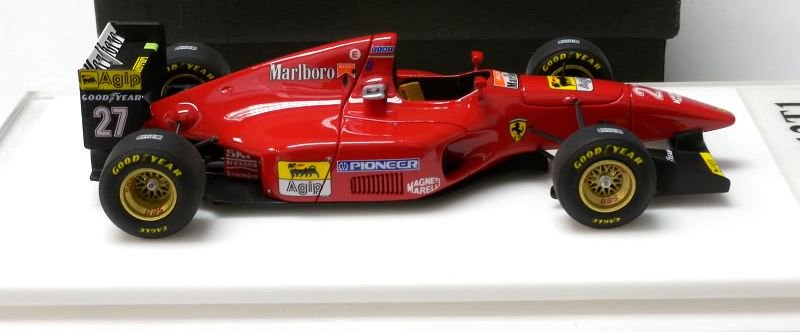
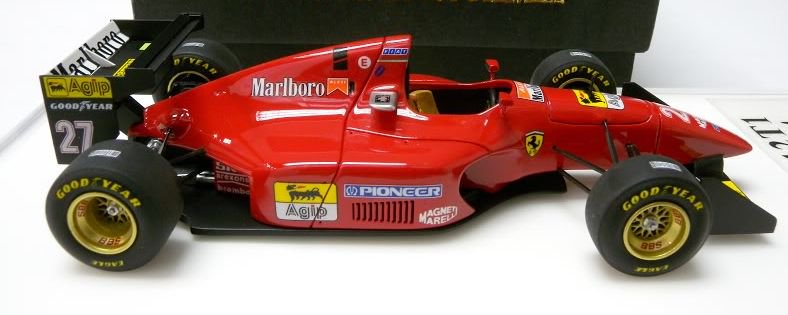
My 1994 Model Reviews has come full circle, finishing off where I began, with the Ferrari, this time the early season 412T1 with its distinctive, beautiful and short-lived tear-drop sidepod openings. I've already reviewed their season in my previous post, so let's get straight into looking at the models.

Onyx / Heritage Formula

Onyx 190

The Onyx model gives us a fairly nice shape compared to its other offerings for the 1994 season. I prefer it's nose-front wing attachment treatment over Minichamps. The rear end also has a nice treatment. However, the car looks quite long, the engine cover in particular is too long - I know it houses a V12, but it's not that big! It fails to capture the curvature just in front of the cockpit. But it does come with nice BBS wheel rims.
Score: 6/10

Minichamps

Minichamps 430940027
Minichamps have only produced the early season version of the car, and it was a nice model. The proportions are nice, the shapes and curves are close to the real thing, a really nice model for the budget range at the time. It would have been nice to have the barcodes rather than blank space for the tobacco advertising.
Score: 7/10

Tameo

Tameo TMK177

Tameo, to my knowledge, have come out with two versions, the first from the Brazilian Grand Prix, similar to the models above. The model in the screen below is particularly well made, probably my favourite from all the 1/43 412T1 models. 
Score: 8/10

Tameo TMK188

In Spain (running into Canada), Ferrari experimented with opening up their sidepod inlets, something they would revise altogether for the 412T1B. Presumably they were not getting enough cooling. The Tameo model from the Canadian GP includes the openings on the engine cover, which were also deemed an illegal interpretation of the rules a few races in. 

Score: 8/10


BBR

BBR Met19


BBR's version of the 412T1 is nice, but for the price to accuracy ratio, I think I prefer Minichamps version on this occasion. I'm not a particular fan of the tear-drop sidepods on this model, though the engine cover and nose/monocoque sections are lovely. 
Score: 6/10


To read my review of the 412T1B, click here: 412T1B
For more 1994 model reviews, click here: 1994 Model Reviews

Friday, 8 February 2019

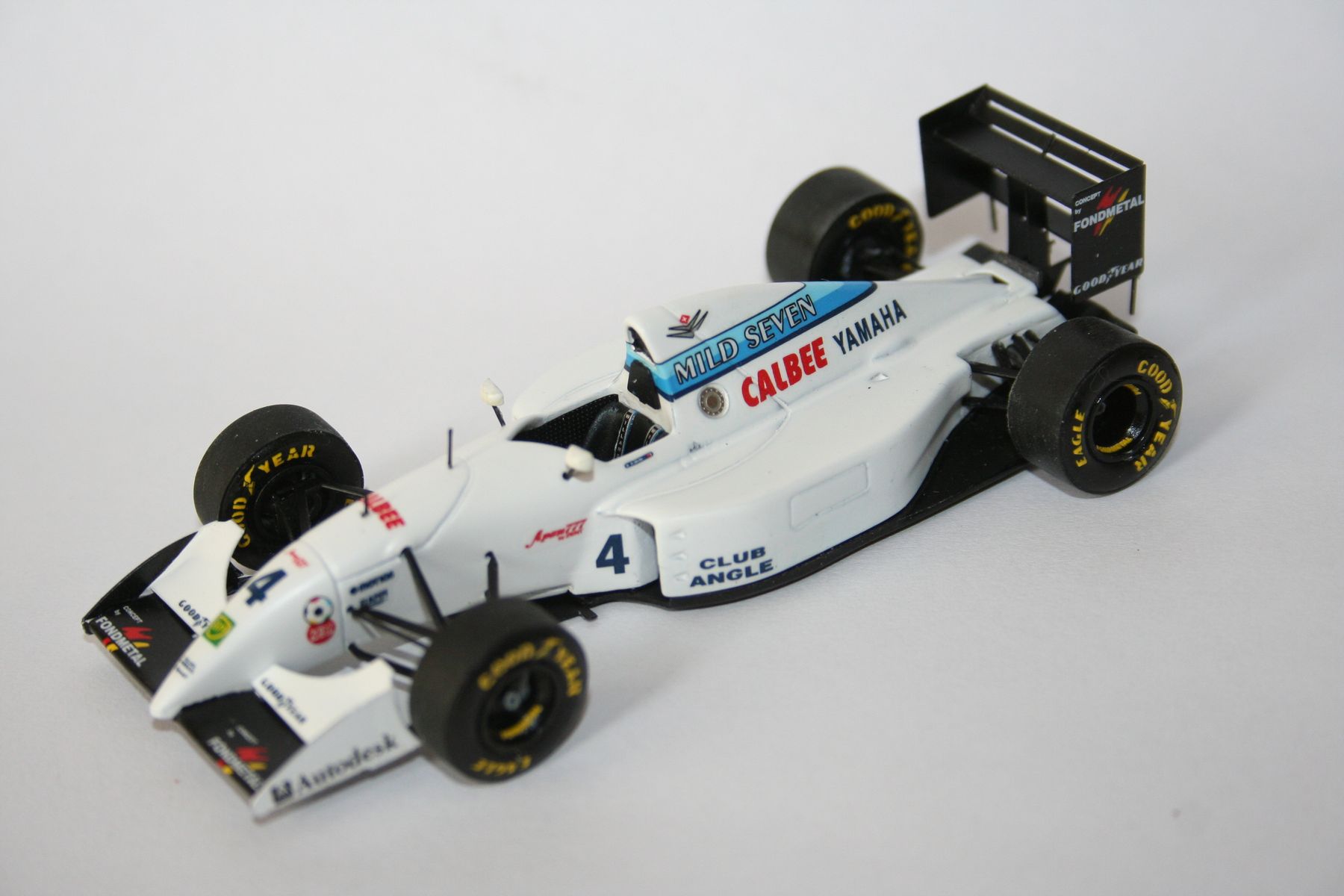
1/43 Model Review: 1994 Tyrrell 022 Yamaha

Background

The Tyrrell team competed in the 1994 F1 Championship with Ukyo Katayama being joined by Mark Blundell. They were contenders for points finishes, but poor reliability hampered their progress. Katayama was generally the quicker of the two, often qualifying in the top 6, but he retired from 12 of the races, including whilst running third at the German Grand Prix. The highlight came for Mark Blundell when he took an excellent podium finish at the Spanish Grand Prix. This would be Tyrrell's final podium finish.

Onyx / Heritage Formula

Onyx 207
The Onyx version of the Tyrrell is another instance of Onyx putting the livery on a 1993 car - the McLaren MP4/8. So the less said about this car the better really.
Score 2/10

Minichamps

Minichamps 430940004

So to the Minichamps car, which at least made an attempt to look like the actual car, but to be honest, this was quite a poor attempt from them. I don't feel it really captures the essence of the car at all.
Score 5/10


In recent years, Minichamps updated their model with new tyres and driver body and decals and released it in this limited edition tall box, but it's still the same old disappointing original shape, so I'm not tempted in the slightest with this one.
Score 5/10

Spark

Spark S1597
This is the first of the Spark models released for the 1994 season and I think there are very nice details on this car. However, those jumbo tyres don't do it any favours, and I think the engine cover is too small vertically, and the helmet also looks tiny. It's a shame the proportions are so out, because this is a step up in quality from the Onyx and Minichamps offerings.
Score 6/10

There is a limited Japanese edition (for Racing On magazine) where the car was updated to the Japanese Grand Prix, and the updates look lovely, onboard cameras included. They've made some sort of a quick attempt at the diffuser from the late season, but they could have done a much, much better in all honesty.

Score 7/10

There's an even rarer version from the Monaco Grand Prix knocking around as well that has lovely high downforce front and rear wings.

Score 7/10

Tameo


Tameo TMK185
Here is a picture of Tameo's kit from the British GP which offers a mix of good proportions and nice details.
Score 9/10

BBR

BBR Met12
The BBR version in the picture above is from the San Marino GP. Maybe its the angle of the photo, but the cockpit seems too far forward, which makes the nose section seem squished and the sidepods/engine cover section seem elongated.
Score 6/10


In conclusion, I'm not particularly happy with any of them, I don't think they really capture the essence of the car, the Tameo kit probably being the best of them. The nose is very narrow at the tip, which is always difficult to do in 1/43 scale. They also ran quite a few variations of rear wing throughout the season.

For more of my 1994 model reviews, click here: https://fongugp4.blogspot.com/p/1994-model-review.html

Wednesday, 6 February 2019

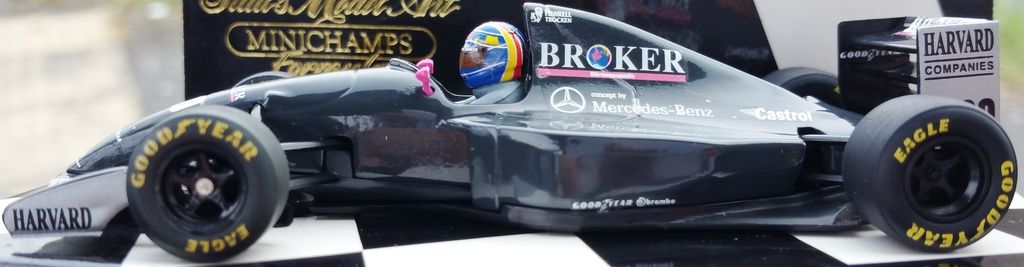
1/43 Model Review: 1994 Sauber C13 Mercedes

It was announced last week that the Sauber name will depart from the sport for the first time since 1993. It's sad to see the heritage of the name be completely replaced by Alfa Romeo, as welcome as they were was when it was introduced for the 2018 season. Even through the BMW days when the team was entirely owned by the manufacturer, they were still called BMW Sauber. So I for one will be sad to see the name go. But here is a reminder of one of the more eventful seasons of their history.

Background

Following an impressive debut season, the 1994 season would again see Sauber challenge for the lower points scoring positions. After a huge accident at Monaco to Karl Wendlinger, the race after that weekend at Imola, the team developed higher cockpit sides to protect their driver. This development would be mandatory from the 1996 season. Andrea De Cesaris would fill his seat from the Canadian GP onwards, his 200th GP, but Wendlinger was due to come back for the final two GP's but that did not go ahead. The team tried to contact De Cesaris, but were unable to get a hold of him on holiday, so JJ Lehto who drove for them in 1993, freshly dropped by Benetton, filled the seat and De Cesaris retired. The team finished 8th in the Constructors' title.

Heinz-Harold Frentzen drove the entire season for the team, his debut year. He had a fan in Frank Williams early on, with reports he was going to be called up to Williams after Senna's tragic death, but the German decided to stay with Sauber, earning a Williams seat in 1997.

1994 saw the team run Mercedes-Benz engines, though they were rebadged Ilmor engines, but they received full manufacturer backing, harking back to their successful sports car partnership earlier that decade. However it only lasted for one season, with McLaren snatching the deal from 1995 through to 2009 when Mercedes became a full constructor once more, and I'd say they're doing pretty well.

Onyx / Heritage Formula

Onyx 193A

The car started the season with Broker sponsorship, and ran a black livery very similar to their 1993, except for silver endplates front and rear. The shape itself is a bit basic, it's recognizable enough, but at the same time it's not particularly accurate either.
Score 4/10

Onyx 193B

When De Cesaris arrived from Jordan to run for the team at the Canadian Grand Prix, his 200th race, Sauber celebrated with this one off livery. The nice livery bumps up the score from the early season version.
Score 5/10

Onyx 194B
By the French Grand Prix, the Broker logos were replaced by Tissot ones and at the German Grand Prix, this lovely livery with white spots and a large watch in front of the driver ran till the end of the season. The only thing to note is the lack of change in the shape from Onyx, as was common at that time.
Score 4/10

Minichamps

Minichamps 430940030
Minichamps released their own version of the three liveries seen that year. The shape of the car is an improvement on the Onyx shape, much closer to the real thing.
Score 6/10
Minichamps 430940129

At the Canadian Grand Prix, Sauber introduced their raised cockpit sides solution - still in bare carbon fibre at that time. Minichamps at least made an effort to add this to their model.
Score 7/10
Minichamps 430940229

Minichamps also released their updated cockpit sides with the late season livery, specifically from the German GP. However there are no further changes to the shape inline with the regulations from that part of the season. The late season Sauber also had barge boards and rounded sidepods along the top edge, rather than the indent they ran on the early season car - but again this is not reflected in this model. We also don't have a release with Lehto in the car.
Score 6/10

BBR

BBR Met13/Met26
BBR released both versions of the Sauber, with correct shapes for both parts of the season. There's a nicely built version of the late season car in this link:
https://www.racingdioramics.us/1994_Sauber.html
The BBR version, is in my opinion, the nicest of the lot.
Score 9/10

Tameo

Tameo TMK192

Tameo have also released their version of the late season shape, pictured here in the De Cesaris Canadian GP livery. The Tameo kits are always of the highest standard, but I think the BBR car just edges it for me in its resemblance to the real car.
Score 8/10

For more 1994 model reviews, please click here: https://fongugp4.blogspot.com/p/1994-model-review.html

Tuesday, 5 February 2019

1/43 Model Review: 1994 Pacific PR01 Ilmor

Background

The first Pacific Grand Prix car which raced in 1994 was the PR01. It was initially designed for the 1993 season, but due to financial problems had to amend and race the car a year later. It was significantly slower than the other cars, often failing to qualify. When it did, it failed to finish any races. The team would last another season, in which it fared a little better, but these small teams trying to punch above its weight is why we love these cars. Bertrand Gachot and Paul Belmondo were its drivers. By all accounts it was all pretty rubbish, and there's a humourous parody Twitter account that you can find here:
https://twitter.com/PacificRacingF1?lang=en

Pacific had issues with the high nose, and tested with closing the gap under the high nose which they did with duct tape! They eventually went to a low nose solution, not that it helped them get on the grid.


There's a great article written below about how the origins of this design done by Adrian Reynard was the basis for the worst car of the grid, this Pacific PR01, and the for fastest car on the grid, the Benetton B194 (albeit several iterations on).

www.unracedf1.com

Onyx/Heritage Formula

Onyx 199
The shape is clearly the Benetton B192 shape by Onyx, and bearing in mind the cars had the same origins, who could blame Onyx for doing so. 
Score 4/10

There are no alternative models of this car. I found a 1/20 Tamiya decal set for the Benetton B192 shape, but that is as close as I have got.

So if any of the current manufacturers decided to make this car, I suspect they would be snapped up quickly and their value instantly go up.

For more 1994 Model Reviews, click here: https://fongugp4.blogspot.com/p/1994-model-review.html

Friday, 1 February 2019

1/43 Model Review: 1994 Lotus 107C and 109 Mugen Honda

Background

The Lotus 107, designed for the 1992 season, was in its third year of racing, having been competitive if not unreliable in 1992 and a points scorer in 1993. In 1994 Mugen Honda engines were being used but the team were struggling with their finances. The team were able to introduce the Lotus 109 mid-season, although it was heavily based on the 107C.

The Lotus 109 was debuted at Spain for Johnny Herbert, but it wasn't until France that both drivers had a 109. The team lacked the cash to develop the car and so it bore little gains, but at the Italian Grand Prix, Herbert looked competitive with an upgraded Mugen Honda engine, qualifying in fourth place before colliding on the first lap with Irvine. He had to switch to the spare car for the restart with the old engine. The team confirmed they were in receivership a day later and the team stopped racing at the end of the year. It was a sad end to the legendary Team Lotus name. They did merge with Pacific GP for the 1995 season but they too exited the sport at the end of 1995.

Johnny Herbert had signed a long term deal with Lotus, but with such an uncompetitive season, Herbert considered retiring from the sport altogether. That was until the Italian Grand Prix where he shone all weekend until that first lap crash. He was bought out of his contract by Ligier, before moving to Benetton the race after that.

Alex Zanardi was injured in a crash in 1993 and Pedro Lamy filled the seat for the final four races and retained the seat for the 1994 season. However his crash in testing a few races saw him end up in a spectator tunnel, sidelined Lamy with an injury for the remainder of the year.

With Lamy out, Zanardi, now recovered, took his seat. Philippe Adams earned enough funds to buy himself two races in the Lotus. At the Belgian Grand Prix weekend, Adams won a support race, but retired from the F1 race in his Lotus.

Eric Bernard arrived in a swap with Herbert, but he struggled to impress at Ligier and was promptly dropped after one race at Lotus. Pace not withstanding, Lotus really needed pay drivers at this stage, and so Mika Salo raced in the final two Grand Prix.

There are some interesting livery variations from the Brazilian Grand Prix, and even from pre-season testing. The design was tweaked again when the 109

Pre-Season Testing, Estoril Circuit, 20th January 1994


Running two different cars and slightly different liviries at the Canadian GP:


Onyx/Heritage Formula - 107C

Onyx 192
Onyx produced this version of the 107C with the livery from the Monaco GP if I'm not mistaken. The car is shape is perhaps a little bit short, but I quite like the job they've done on the decals which kind of makes up for it. My only real complaint is the radiator opening at the front of the sidepods does not angle forward at the bottom, it's straight on this model. Still, quite a decent effort from Onyx on this model.
Score 6/10

BBR - 107C

BBR Met11
I got myself a BBR version of the 107C (built by someone else) which, on the box is based on the Brazilian GP. As mentioned above, this is not the livery they ran for the first two Grand Prix, and it looks like this is from the San Marino Grand Prix. In fact when you look at the instructions it does indeed state it is from the San Marino Grand Prix. I've seen better built ones online, but I'm not sure this is one of BBR's best efforts. The car looks a bit too low, which makes the car look a little stretched.
Score 7/10

Spark - 109

Spark S1670

For nearly two decades, you could only get the 109 kit car by Tameo (see below). Spark finally released their 109 in recent years, and it came with versions with all the drivers who drove the 109. 
  • #11 Zanardi - British GP
  • #11 Adams - Belgian GP
  • #11 Salo - Japanese GP
  • #11 Bernard - European GP
  • #12 Herbert - Belgian GP
I went for the Herbert version and also Salo's Japanese GP because I quite liked  the sponsor set. My complaint about Spark cars of the 90's is that the tyres are too big. The rollover bar is a bit small, and needs to be a bit taller. I think the front wing is sitting too high as well. I like the clear visors, but I'm generally left disappointed with the helmet shape overall. Otherwise this would be a really lovely model, but I feel the proportions let it down. 

Spark S1780
Score 7/10

Tameo - 109

Tameo TMK181 
I've not owned this model, but this Tameo offering is lovely. Proportions are good, and this one is beautifully put together. It's the Australian Grand Prix version with the extra rear wing elements by the rear tyres. I also think the curves around the front of the cockpit is better than the Spark version.
Score 9/10

For more 1994 Model Reviews, click here: https://fongugp4.blogspot.com/p/1994-model-review.html

Thursday, 31 January 2019

1/43 Model Review: 1994 Ligier JS39B Renault

Background

The 1994 Ligier was a 'B' spec car of the 1993 Ligier JS39. The car was not as competitive as the previous year, but the highlight came in the German GP when the cars scored a double podium finish. The car was reliable when reliability was not a given, and the car remarkable only failed once all season. So at Germany, they were aided by multiple incidents in the early part of the race, including 10 cars being taken out at the first corner, and following retirements to several front runners through the GP, they held on for a strong finish. The team ended the year 6th in the Constructors' Championship.

Oliver Panis was a driver who was also caught out by the plank-wear rule introduced part way into the season, the other notable occasion this occurred was Schumacher at the Belgian Grand Prix. Panis was disqualified from the race where he finished 9th on the road.

Johnny Herbert was bought out of his long-term contract with Lotus prior to the European Grand Prix and raced for Ligier for one race before moving to Benetton - the only driver I know in the history of F1 to race for 3 teams in 3 consecutive races. Herbert qualified 4 tenths of a second quicker than Panis and started 4 places higher up, finishing the race in 8th place ahead of his teammate.

With Herbert moving on, Franck Lagorce, the team's test driver, filled the seat for the final two races.

The team were struggling financially, and ended up selling the team to Flavio Briatore and Tom Walkinshaw, both with Benetton at the time. As noted in the Schumacher tribute blog, Briatore used this to his advantage to gain the standard setting Renault engines to his Benetton team. Tom Walkinshaw was the one who concentrated on running the Ligier outfit.

Also Schumacher tested the Ligier after the end of the season, incidentally he also drove the Ferrari 412T1B shortly after leaving Benetton. In a head to head, Schumacher was a second faster than regular driver Panis, though Panis would get within a tenth on a subsequent day.

You can read more about Briatore's ownership and Schumacher's test here: www.unracedf1.com


Onyx/Heritage Formula


Outwardly speaking, the 1994 JS39B was very similar to the 1993 JS39 car, so I will include some pictures of that car below for comparison. I was about to let rip into the inaccuracies of the shape and how it had gotten worse rather than better with the changes from the 1993 car. But then I remembered that there were times when Onyx would reuse an old shape and pass that off as a different car (e.g. the 1995 Forti is actually the 1996 Tyrrell). It was then that I noticed that they had reused the 1993 Williams FW15 car and put a Ligier livery on top.


I'm not saying that re-using an old shape is right, but they may have well just stuck with the 1993 JS39 rather than the Williams. So ignoring the shape, I think the blue is wrong, it was much darker in real life. The cars were hand made and it was really variable how well they had been applied, the rear wing end plate on the one pictured seems too big for the car.
Score: 2/10


BBR

BBR Met14

A nice offering from BBR of the German GP version of the JS39B.
Score: 8/10

Spark


Spark S7406
Spark have in 2019 released their 1994 version, including the Schumacher test model. This is the late season model with the extra winglets by the rear wheel, the curved lower rear wing and the hole in the engine cover. I was pleasantly surprised when I got the model and reviewed it. Besides my usual gripes about the size of the tyres and the driver helmet, I think the rollover bar should be straighter vertically from front view, making the airbox a little more bulbous like the real car. The front wing looks a little blocky, and I think could be better refined. If I was really nitpicking, the upper rear wing element should be deeper whilst the middle element should be shallower. Sadly the car features the early season diffuser. Despite these points, I still  like the model, it has nice details throughout, it would just be nice if it was slightly more refined. 
Score: 7/10
Some other versions released:

Spark S7400

The Panis version is from the Canadian GP, with the engine cover hole a the top and has no barge boards.

Spark S7401


This is the French GP car of Eric Bernard. The engine cover has the hole in a slightly different position, and it has straight rear wings.
Spark S7402

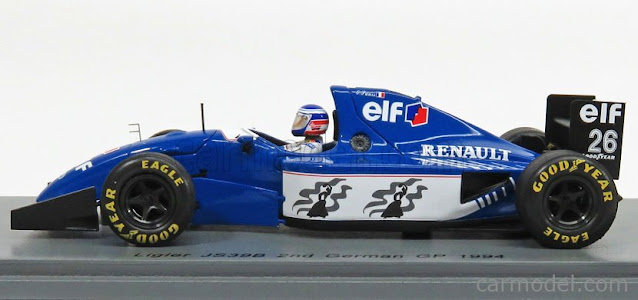
Both Panis and Bernard finished on the podium at the German GP where many cars retired. It's a shame they didn't bother with a low downforce spec when they had spent time updating the engine covers.
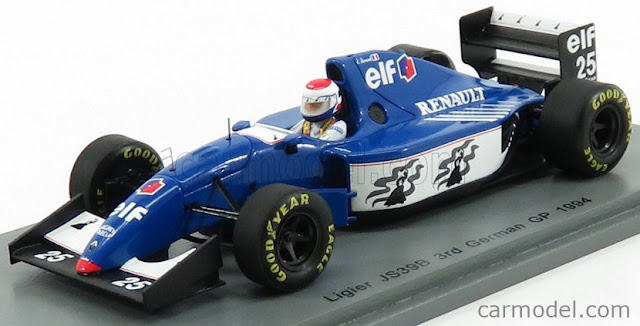
Spark S7403 - Bernard German GP

Spark S7404

Though Herbert only had one outing at the European GP, he does get a model. Herbert's helmet also has a dark visor, which for me works much better. For some reason, Europe is missing the last 'e' on the case, which I'll put down as a typo.
Spark S7405

Franck Lagorce got a couple of races at the end of the season and this model is based on the final round in the Australian GP.

Minichamps

Minichamps 417940026

Minichamps have released limited editions of Bernard and Panis car, just 330pcs each in September 2019. The first thing I noticed was that the nose is way too long, and the front wing endplate just a bit too big, a real disappointment for me - it's the right height, just horizontally stretched. The bumps on the front suspension cover could be more pronounced on this resin model. The other thing that jumped out at me was the driver seems to have no neck. Thankfully, the car gets much better after that, owing to the simplicity of the bargeboards and sidepods on the real car. The engine cover is nicely modelled, I prefer it to Spark's slightly, and the rear wing with all the different elements I also prefer. The car has a proper late season diffuser also and that rear end is fantastic. It's just such a shame that nose and front wing is so ill-proportioned.
Score: 7/10

Minichamps have now released their resin version of the JS39B soon as part of the Michael Schumacher 25th Anniversary Collection.
Minichamps 517944399


For more 1994 Model Reviews, click here: https://fongugp4.blogspot.com/p/1994-model-review.html

Monday, 28 January 2019

1/43 Model Review: 1994 Jordan 194 Hart

Background

The ban on driver aids seem to aid the competitiveness of the Jordan team as they recaptured some of their debut season form as well as the new 194 car aesthetically looking similar to the 191. Whilst Barrichello came 4th in the season opener, Eddie Irvine was to blame for a four car crash and eventually banned for three races. Aguri Suzuki took his place in Aida, where Barrichello earned the team's first podium at that race, the Brazilian being second in the Championship after two rounds. Barrichello was lucky to come away with his life after a kerb made the car airborne and smashed into the barriers. Andrea De Cesaris also raced for the team in place of Aguri Suzuki earning 4th place at Monaco. Barrichello also earned the team's first pole position, making use of drying conditions at the Belgian Grand Prix. Both Barrichello and Irvine continued to score points throughout the season, finishing 5th in the Constructors' Championship, with Rubens finishing 6th in the Drivers' Championship. Irvine was hampered by reliability issues, causing many of his races to end early.

At the French Grand Prix, Jordan put the score of the Republic of Ireland's victory over Ireland in the FIFA World Cup to celebrate that achievement, only for Minardi, at the following race, to respond with "Italia IN - Ireland OUT" in larger letters on their engine cover.

Onyx

Onyx 196A
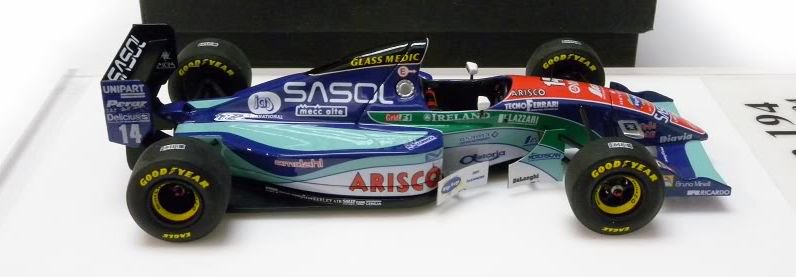
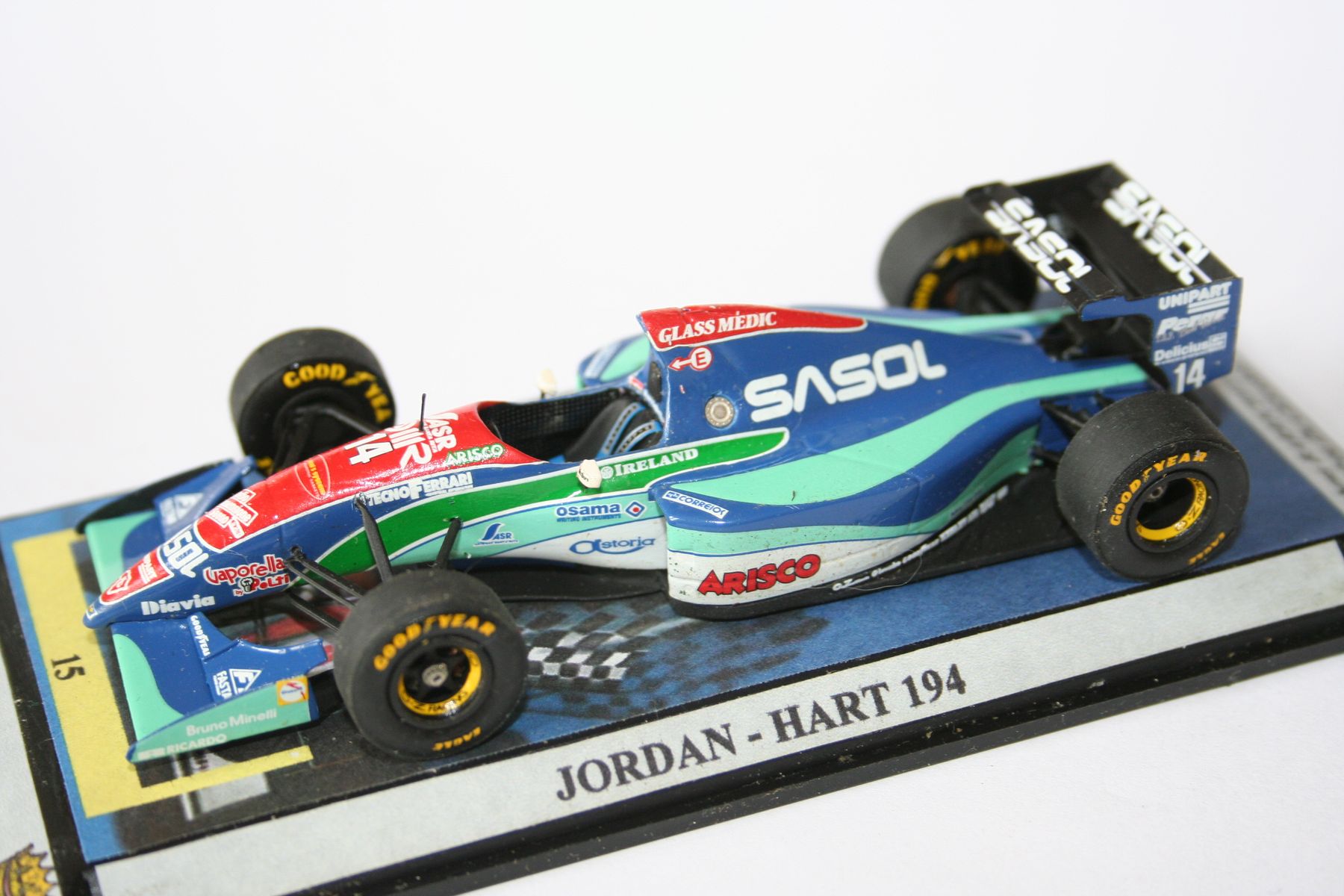
Only Onyx made a model in 1994, producing this early season version of the 194. For a budget model at the time, this was a good representation of the car, with the drooping front wing, the angled head rest, and the triple plane rear wing. My only real complaint would be the sidepods. Onyx attached the front wheels with a central axle, as if it was a toy, but
Score 6/10

Minichamps

In 2001, Minichamps released a set of twin car sets to celebrate 10 years of Jordan GP. They created and updated all the Jordan cars to make the set, some previously not made before, the 194 being one of them.
Minichamps 402109394
This lovely car is of the late season car, with the updated diffuser and barge-boards with the livery from around the German Grand Prix. To me, the cockpit is a little bit too far forward, meaning the engine cover and sidepods are a little too long and stretched, and also the nose is a little scrunched up. There's a couple of photos from a slightly skewed angle that suggest these proportions, but I'm a little skeptical. I also would have preferred the triple plane rear wing. However, this is a lovely model from Minichamps, I think the colours and decals are spot on and it's got some nice details like the hole in the engine cover, and the vent just in front of the rear wing. It's got nice suspension and wheels that had moved on from the cars they produced in the mid-90s. Its a shame that it doesn't come in other versions with a driver figure.
Score 7/10

Other Versions

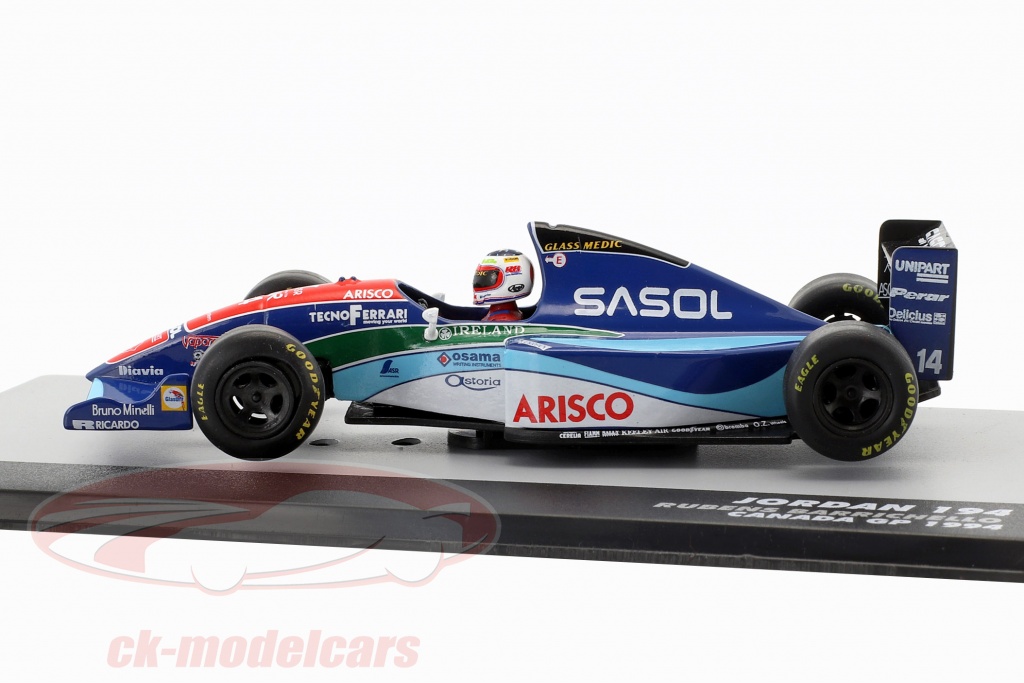
There are kit versions from Tameo and BBR around that look nice and accurate, particularly the Tameo offering. In recent years, in the Brazilian market, they have released an IXO version (Eaglemoss) of Barrichello's car but these are not models that I have ever owned.
Tameo TMK183
A lovely model, great proportions, lovely detail, great decal set of this late season version of the car.
Score 9/10
BBR MET15
A nice model, but compared to the Tameo, it just doesn't quite have the same level of accuracy in terms of proportions. Still, it's nice to have the early season version. 
Score 8/10

A really nice budget model from IXO, a shame it's not included in the Formula 1 Car Collection that I'm aware of. 
Score 7/10

Overall, I'm quite happy owning the Minichamps version of this beautiful car, even despite my nitpicking. I think it benefits from being made some 6 years later and model accuracy had improved, but I can only dream on of a resin remake of this car. I may have to keep an eye out for a built Tameo version.

You can read more of my 1994 model reviews here: https://fongugp4.blogspot.com/p/1994-model-review.html