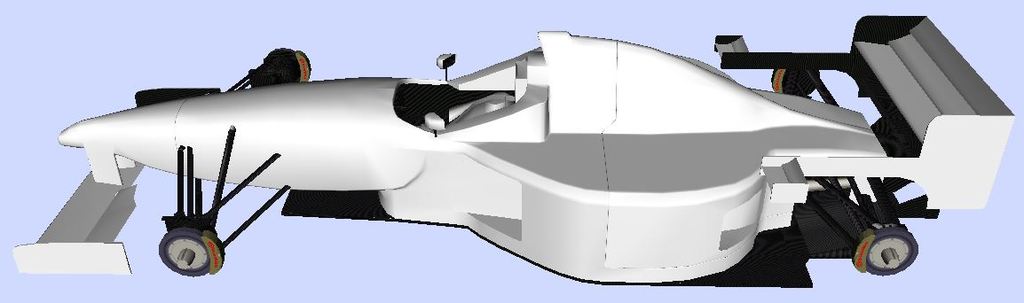
I was looking back at my old screenshots of this car before it was painted and found this photo:
The white parts are all the newly created parts, the yellow from the existing 1995 car.
Starting off at the front of the car, I remodelled the nose cone quite heavily from the 1995 car which was very low-poly. This is a lot smoother. Unfortunately there is shadow painted on the front wing supports that shouldn't be there, but I think it's a mapping issue.
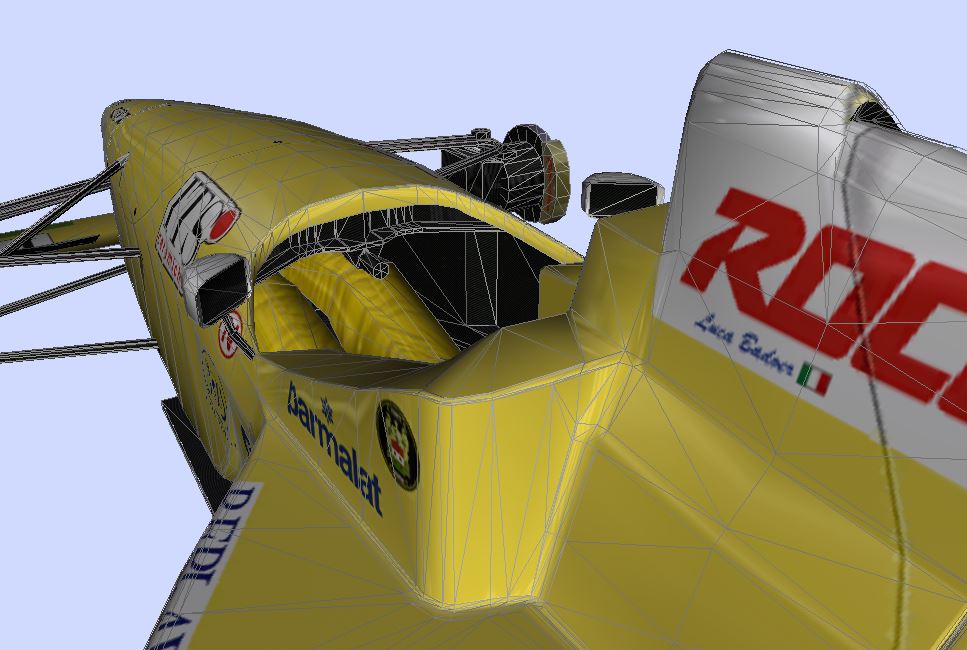
I've shown the wireframe for this shot so that you can see I started working on smoothing the curve where the nose joins the the side of the cockpit. If I was doing that again today, I would put more polygons to smooth the curve even more.
I found one blurry shot of the cockpit which has this ledge on it. I'm not sure what it was for, maybe you could put your cup of tea there or something. I'm not too happy with the rear of the head rest, but I am pleased with how it joins to the chassis.
I'm quite pleased with how the sidepod turned out, that's one of my favourite parts of my work on this car. There is massive gap for the rear suspension elements which can't have helped the aero.
I like how in GP4 that you can crash the car and parts will fall off, and reveal some of the work going on underneath. The 3D body lines give a bit of depth to the nose.
I'm not sure why Celinho decided to paint his own body lines that don't follow the 3D ones. The hole at the rear of the engine cover (by the Ford logo) is painted on, and it's nicely done. The 1995 rear wing does not look out of place, and the new rear wing endplates fit on very well.
There aren't too many shots of the rear, so its difficult to model this accurately, but from what I could tell, with a little artistic licence, you can see they had a unique approach, with the central part looking more like an extended turning vane than a diffuser. You can see a lot of the gearbox/rear suspension and engine exhausts through the rear of the car.
Here, the car is without its engine and sidepod covers revealing the internals of the car. They are taken from Oggo's BenettonB196 (with permission), hence it comes a Renault engine logo. GP4 doesn't do shadows from the car onto itself, so whilst its nice to have nice textures on engine and a lovely shiny exhaust, in race conditions its usually under shadow and black.
I hope you enjoyed the walkaround of the Forti. It's not the best looking car (not really my fault!), and it's not one of my best models (compared to the rest of the 1996 grid), however many lessons were learned from this car that I developed into the other cars.
I'll come back that when I look back at the 1995 cars. So my starting point, similar to the MinardiM195B, was the 1995 mod version of the FG01 that I created.
1995 Forti FG01 from the GP4 1995 mod
I started off thinking I would re-use parts of the 1995 car, but eventually I would remake it all, with perhaps only the wings making it onto the FG01B.
Putting the two cars next to each other, you can see that there is a lot more detail and effort gone into the 1996 car, owing much to my own learning curve in modelling cars. The shape of the nose is a lot smoother, the sidepods are a lot more realistic and the engine cover is much closer to the real model. The side-head support looks like an after thought, just tacked on for the sake of the regulations, which was what the team did in real life.
The diffuser is pretty basic too, especially when we start looking at the other 1996 cars where teams had started to develop them since the major change in diffuser regulations during the 1994 season, Forti were left behind in this region.
The FG01B was just a stop gap whilst the team prepared for their actual 1996 car, the FG03 (which is beautifully made by Soulbringer in GP4). Like the Minardi, the suspension and damage model are taken from the 1995 mod.
Overall, the car is a step up from the models in the 1995 mod, but its probably the most clunky in terms of my shaping ability in the 1996 mod. I like the work on the nose and the sidepods, but the cockpit sides and the area just in-front of the sidepods I'd would do differently today.
The textures were done by Celinho and so my thanks go to him for painting it, though there are areas of the texture I'd like revisiting if I was around to give feedback when it was created. So below are a few shots without the textures applied.
I was still perfecting my technique of how to make a model with nice smooth normals around the curves and this was my first attempt at bodylines. In fact, the method I adopted for the Minardi for bodylines is the same that I use today, but this was my first attempt at them. You can see where the polygon lines are denser as to where I tried to make a smooth shape with the light bouncing off it correctly.
You can see from this angle from the rear how the engine cover was hastily amended to incorporate the driver side head rest protection. I can't imagine the wake coming off that and how draggy it would have been and probably would have made the rear wing much less effective.
Without the wireframe, you can see how the light bounces off each surface smoothly (ish). The bodylines are also clearly seen here, though looking back, I forgot to create the front suspension cover.
Click here for part 2, where I will look at some of the details of this car.
Below is a video of a converted version of my car in rfactor 2.
Forti joined Formula 1 largely due to backing from Pedro Diniz's family, but when Diniz left after the first year and took his sponsorship with him, the team struggled with finances. Already having a particularly uncompetitive car, condemned to the rear of the grid in 1995, the 1996 saw new rules introduced where cars must qualify within 107% of the pole position time. Basically the rule was brought in because the Forti cars were so slow and getting lapped so often during Grand Prix.
The lack of finances meant they ran an upgraded version of their 1995 car, the FG01B, for the first few races. One FG03 was ready for Imola and qualified comfortably within the 107% limit and 0.7s behind the next fastest car. Prior to the Spanish GP, a deal was done to sell the team to Shannon Racing, and the car turned Green, losing the yellow and blue colour that ran in memory of Ayrton Senna. But the money never materialised, the car, though having promising pace, retired with poor reliability, and as debts to Cosworth rose, there were no new engines to run.
At the British GP, they only managed a couple of laps in practice, in Germany, the cars remained unassembled in the garage with no engines. The team decided to bow out of the sport, whilst a court case was in progress over who owned the team. Eventually, Shannon Racing won the case in September, but Forti had already left F1. Both entities folded from any further racing activities.
Sadly only Onyx have produced any Forti models, there's not even one of the 1995 car. Even worse, they didn't even bother creating the shape either, it's a rehashed Tyrrell024 (see Tyrrell below for comparison)! Fans of Formula 1 from the 90's will inevitably be fans of the underdog teams, and I'm no exception, so I would really love a proper Forti model.
Onyx 290
At least we get both liveries of the Forti. In fact the yellow livery evolved through the year, earning a green stripe when the Shannon Racing was first announced, before donning the green, white and red livery for a couple of races before their demise. Sadly no bright green rims on these cars.
Onyx 276
So to the score, it's a case of is it better to have something that's not great, or to have nothing at all. I gave it a 2, because it could be worse, but there's much to be improved on. Score: 2/10 To read more reviews from the 1996 season, click here: https://fongugp4.blogspot.com/p/1996-model-review.html
Simtek Research, set up by Nick Worth and Max Mosley, had been around for a few years, designing parts for Ligier and helping the FIA. In 1990 they designed a car for BMW, but they decided to concentrate on Touring Cars, so the design was sold to the Andrea Moda team for the 1992 season. They were going to design a car for the new Bravo Grand Prix team, but for the sudden death of one of their backers.
Wirth entered his own team in 1994, with Roland Ratzenberger recruited alongside David Brabham, son of Jack Brabham, a shareholder in the team. Ratzenberger didn't qualify in Brazil, finished 11th, but last in Aida. In Qualifying for the San Marino GP, he knocked his front wing in an off, but eager to set a lap time, did not get it changed. In the 190mph Villeneuve corner, the wing failed, and crashed heavily into the concrete wall taking his life. He would be the first death in the sport in 12 years, but was overshadowed when the very next day, Ayrton Senna also lost his life in the race.
Only Minichamps, to my knowledge, have created a Simtek model, and it is a nice once from them. This is the early season version, although it has bargeboards which only appeared later in the season. Score 7/10
Minichamps 430940032
I'm not entirely sure when, but Minichamps released an updated model some years later under the same item code. You can tell as it lacks the barge boards, and it has an updated driver model and helmet. The colours have also been nicely tweaked, a really lovely model. Score 8/10
Only the two drivers were released by Minichamps, all from the early season, though they had six drivers in total that year.
In a departure from my usual GP4 cars and model reviews, I wanted to write a quick article about one of the crazy aspects of the 1994F1 season, the large number of serious crashes.
The new 1994 regulations that banned 'driver aids' was rather rushed in, and the rules were particularly ambiguous (vague), which meant that the FIA had the casting vote to rule in any specific case as to whether parts of the car were legal or not. These days, the rules tend to be better thought out, and teams can consult the FIA, Charlie Whiting in particular, as to the legality of its parts before they participate in a Grand Prix. But in 1994, it wasn't short of teams who were 'trying it on', chancing parts would be legal on the basis of the ambiguity in the rules.
The drivers, who had been used to high levels of grip from driver aids, and fat rear tyres in previous seasons, were regularly caught out by the combination of high speeds and a lack of grip of its newer models. The result is that there were a number of large crashes at the beginning of the season, that should have given the FIA warnings to make changes before there were any serious injuries. Interestingly, Senna was quoted as saying that without any changes to the speeds of the cars, it would be "a season with a lot of accidents". Unfortunately, that would be true and it would be the deaths of Roland Ratzenberger and Ayrton Senna at Imola, and Karl Wendlinger's crash at Monaco that led to a host of changes to cars and tracks that began a renewed drive of improvement on safety in F1.
Frank Dernie explains that flat bottom cars are inherently unstable, and that active suspension was one of the things that helped bring stability, so by banning the system it made the cars unstable, and thus unpredictable. Aerodynamics that work fine in wind-tunnel are subjected to slides, and quick changes of directions, to roll and pitch and changes in wind and other factors that can cause loss of downforce, so when a car is so heavily dependent on its downforce, to suddenly lose it means it will cause high-speed accidents beyond the control of the driver.
I wanted to highlight the number of big accidents that happened, some lucky near-misses whilst others with memorable losses of life:
Shortly after signing for Benetton for the 1994 season, Lehto was testing on a damp Silverstone track in a 1993 car when he went off backwards at Stowe and injured his neck. The injury meant he sat out the first two Grand Prix, having yet to drive the B194. You can read more from his interview with Motorsport Magazine here:
At the Brazilian Grand Prix, Eddie Irvine, in his Jordan, and Jos Verstappen (deputising for Lehto in the Benetton) were battling as they came to lap Eric Bernard's Ligier, along with a slowing Martin Brundle, who had an engine failure in the McLaren. Irvine chopped across the track to overtake Bernard, without taking into account Verstappen was pulling alongside. Verstappen was left with no choice but to go on the grass, and spun as they braked for the corner. Verstappen's car went airbourne and his rear tyre hit Brundle's helmet, causing it to crack. Brundle was lucky to walk away from this accident (who also had another near fatal accident in the wet at the Japanese Grand Prix later that year, not too dissimilar to Jules Bianchi's accident some 20 years later).
Irvine was slapped with a fine and a one race ban, and after an appeal, the ban was extended to three races.
After the Brazilian Grand Prix, Jean was testing his Ferrari412T1 at Mugello, when he also went backwards into a barried and he also injured his neck, that caused him to miss two Grand Prix.
Rubens Barrichello had been on a roll, after finishing on the podium at the previous race in Aida. Barrichello entered the Variante Bassa some 15kph faster than the previous lap, went wide and hit the kerb on the chicane which sent the Jordan airbourne before hitting the barrier above the tyre barrier. Thankfully, this was not a fatal accident,
Roland Ratzenberger - Qualifying at San Marino Grand Prix
A front wing flap came off from the car, causing major suspension damage, which failed at 180mph sending Roland into the barrier in a fatal crash. A photograph, linked below, sees Roland tangling with the Footwork of Fittipaldi, which may have been the cause for the failure that led to him loosing control of his car.
JJ Lehto - Start at San Marino Grand Prix
Lehto returned from his accident into the cockpit of the Benetton for the third race in Imola, but he has since admitted that he returned too soon (more in the Motorsport Magazine link above). "When I came back I was sick and in pain; Flavio didn’t give me any testing."
Perhaps unfamiliar with the B194, the Finn stalled his car on the start as the rest of the field raced past him. All except Pedro Lamy in his Lotus who collided with the stationary Benetton, and debris, including a tyre, was sent into the crowd, injuring four spectators and a policeman.
Ayrton Senna - San Marino Grand Prix
Senna's accident, after the safety car period to clear up the start line crash, is still a topic of debate, and the cause remains not fully known. His WilliamsFW16 car is seen to hit a bump at the Tamburello corner and bottom out, with sparks seen from Schumacher's onboard camera, which was unlike previous laps. Perhaps behind a slow safety car, the tyres were not up to full pressure? The car then slides, with Senna seeming to over correct and he heads for the barriers to the right. We know his steering column was hastily modified before the race and it was found to have failed, but it is not known whether it was the cause or a consequence of the accident. The end result, though, is that Senna lost his life in this accident.
A touching point was that an Austrian flag was found folded up in his cockpit, with Senna hoping to dedicate the win to Roland Ratzenberger.
Michele Alboreto had just pitted, and back then, there was no pit-lane speed limit. His rear wing failed on his Minardi, and the accident caused his to lose a wheel which caused injuries to some of the Ferrari pitcrew. Alboreto's car came to a halt just outside of the pitlane. This incident caused the pit-lane speed limit to be introduced.
Karl Wendlinger - Practice at Monaco Grand Prix
Karl Wendlinger lost control of his SauberC13 on the downhill approach to the chicane. The accident put Wendlinger into a coma. Sauber responded by raising the cockpit sides of the car, something that was eventually implemented on all cars for the 1996 season.
Pedro Lamy - Testing at Silverstone
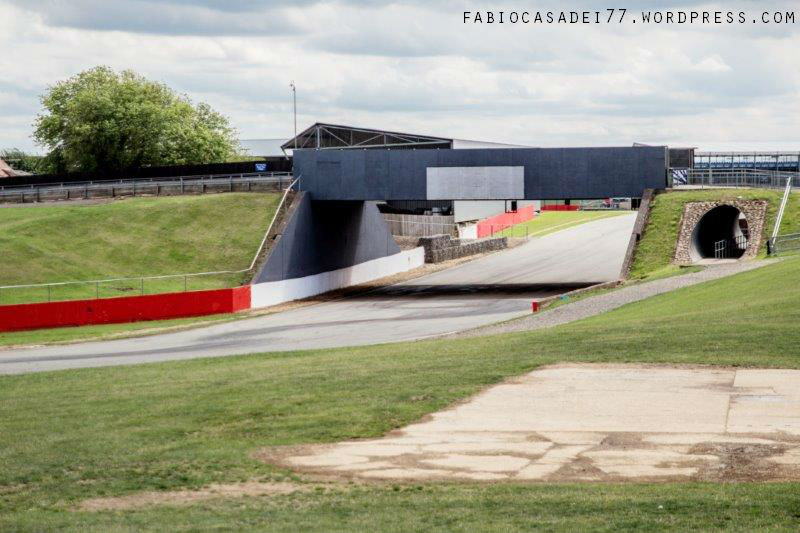
The FIA had begun to react by this stage, and a change to the diffusers were hurried into the regulations. This caused a spate of rear wing failures, with both Williams and Ligier reporting cracks on their assemblies. A rear wing failure on Lamy's Lotus caused an accident that strangely saw the car end up in the spectator tunnel at Bridge corner at Silverstone, pictured below. I've walked through this tunnel and it is small, so who knows what happened for the car to end up in there, but he managed to hit a barrier, clear a safety barrier and end up in the tunnel! Lamy's injuries to his leg would take nearly a year to recover from.
Reading Johnny Herbert's autobiography, he said he was a few hundred metres behind his teammate and as he rounded the fast left hander, all he could see was the engine and gearbox from the rear of Lamy's car strewn across the track. He looked further to see a hole in the fence, but still no sign of his car. A small flame caught his attention from the tunnel and there, Lamy was in his monocoque, partially exposed, sitting at an odd angle.
Simtek only ran one car out of respect at the Monaco Grand Prix. Andrea Montermini, who was suffering from a virus at the time, took up the second seat for the Spanish Grand Prix, although he never made it to the Grand Prix thanks to a massive accident on the last corner of the Barcelona track in practice. Thankfully, he only had injuries to his foot and a facial wound, but yet another massive accident in a season that has already had its fair share of them.
The aftermath
By the Monaco GP, F1 was under a lot of pressure from sponsors and manufacturers to get on top of these accidents, threatening to pull out of F1 and endangering the series altogether. It's debatable if Senna had never lost his life at Imola, whether the FIA would have felt the need to make so many changes despite the 10 other serious incidents.
A wide range of changes to the car were announced, though not all of them made it into the regulations before the end of the season, many of them phased in over the following Grand Prix. It meant that the teams at the lower end of the grid, already struggling with their finances, had to spend extra resources to simply show up and race legally. So the late season driver merry-go-round saw an influx of pay drivers racing in various seats towards the end of the season. Changes to tracks included temporary tyre barrier chicanes installed in Spain, Canada and Belgium.
1994, perhaps unsurprisingly, saw the most driver changes of any Formula 1 season, with 46 drivers taking part at some stage over the season, that's 40 driver changes! You can read about all the changes here:
Every now and again, I test myself on quiz website Sporcle to see if I can remember all the drivers from the 1994 season, only to usually miss out on one or two: www.sporcle.com