Showing posts with label Irvine. Show all posts

Monday, 20 January 2020

1/43 Model Review: 1997 Ferrari F310B

Background

When Schumacher joined Ferrari, he declared he would win 3 races in 1996 and challenge for the Championship in 1997, which he fulfilled. The season began with the Williams taking an early lead, but by mid-season, Schumacher fought his way up to lead the battle and carried a one point advantage to the final race at Jerez, the European GP for that season. Schumacher's car developed a cooling leak whilst leading, and Villeneuve eagerly wanted to pounce straight after the pitstop. Famously, as Villeneuve passed down the inside, Schumacher swiped at the Williams, but rebounded off into the gravel trap, as the Canadian brought the car home to claim his only Championship. Schumacher, however, was disqualified from the Championship for this move, though the team kept the points. Despite the costly momentary lapse, this was an impressive season from the German with five wins in total, including fine wet drives to victory at Monaco and Spa stand out to me in particular.

Irvine in his second year with Ferrari, partnered Schumacher in the last of the John Barnard designed Ferrari's. Irvine drove a better year than his first, chasing Villeneuve hard to second place in Argentina, and would have gifted a win to his team-mate at the Japanese Grand Prix to help him fight for the championship. Ferrari finished 2nd in that year's Constructors' Championship.

Minichamps

Minichamps 510974305

Minichamps 430970006
Though this Ferrari is dubbed the B spec version of the F310 from 1996, it bears very little resemblance to the 'truck'. Much more refined shape, much less bulky, much more conventional aerodynamics from the outside made this car quite a nice looking car. Sadly this was the first Marlboro red car, departing from the traditional scarlet red, which takes away from the beauty of this car for me.

Minichamps produced another nice model of this car, featuring two shape variants, well different rear wings at least. There are French GP variants of the non-tobacco livery, and the barcode version ran at other races.
Score: 7/10

Tameo

Tameo TMK430
I've found two versions from Tameo, this one above is based on the car that won the Monaco GP, with rain tyres. Tameo have done another excellent job in recreating this car, from the intricate shape of the front wing end plates, to the cockpit and the extra rear wing elements, this is another find model.

Tameo TMK349
The other version is based on the Japanese GP, which comes with removable engine cover, showing some nice detail underneath of the engine, radiators, gearbox and rear suspension assembly. They've updated the airbox which is a nice detail, as well as a more boxy shaped front wing endplate, and of course the rear wing. A fabulous model.
Score: 9/10

Monday, 1 July 2019

1/43 Model Review: 1999 Ferrari F399

Background

Although Ferrari were behind the pace of the McLarens, the team were consistent points scorers. The McLarens suffered from reliability issues and a number of driver errors, giving Ferrari an opportunity to challenge for the World Championship. Schumacher broke his legs after a brake failure at the start of the British GP half way through the season, leaving Irvine to challenge for the Championship. But Irvine complained of lack of support and developments to the car following Schumacher's recovery, who was at times outpaced by Schumacher's replacement, Mika Salo, but when the German returned at the inaugural Malaysian Grand Prix, they scored a one-two. They were disqualified for a barge-board infringement, but the pair were later reinstated with both titles on the line at the final round in Japan. Irvine was four points ahead of Hakkinen, and just needed to finish in front of the Finn, whereas the Finn would need a win to guarentee victory. Schumacher chased Hakkinen home, with Irvine finishing third with a lack of pace giving the Finn his second consecutive Drivers' Championship. However Ferrari were able to clinch their first of six Constructor's Championship in a row, their first since 1983.

Hot Wheels (Mattel)

Hot Wheels 24626
The Hot Wheels car has a good base shape, the front end is very nice, the sidepods are nicely done with the large undercut, Irvine and Schumacher had different helmet shapes, and I like their multi element rear wings. For a basic budget model, this is not that bad.
Score: 7/10

Ixo / Formula 1 Car Collection


Ixo's car is very similar, but not exactly the same as the Hot Wheels car. The rollover bar is different, as are the exhausts. Ixo were able to get finer detailing on the front and rear end plates and the barge boards and the little flip  up on the sidepod is also more refined. It's nice that the Formula 1 Car Collection version is of Salo, though it would have been nice to have a driver figure and the Belgian GP decals with the F1 logo on it.
Score: 7/10

BBR

BBR Met85

This is the BBR version of the San Marino GP and its factory built, and so I'm left quite disappointed with this model. In terms of the shape and proportions, I much prefer the Ixo and Hot Wheels models. For all the nice details on the suspension, cockpit, exhaust and rollover bar, I can't help to unsee the proportional inaccuracies. There is a Monaco GP version which is similarly plagued with proportion issues.
Score: 6/10
BBR Met99
However there is a Malaysian GP version and I think this is more like it from BBR. The shape of the nose is much more refined and the front wing sits better. They have the controversial changed bargeboard, and lots of vents for cooling on the top of the sidepod. The rear wing is brought further forward making the proportions much better. There is a Make Up Co version of the Japanese GP car which is similar in quality.
Score: 9/10

Tameo

Tameo TMK273

Schumacher's Monaco GP winning car from Tameo is absolutely stunnning. The lines are very clean and defined, the cockpit detail is great, and the multi-element rear wing is a thing of beauty. I would have liked to have seen a little bit more detail on the exhaust and the vents on top of the sidepod, but these are all very minor points to what is an excellent model
Score: 10/10

Thursday, 30 May 2019

F1 2013: 1996 Ferrari F310 walkaround part 4

Whilst I have the F1 2013 version of the 1996 Ferrari F310 in Zmodeler, I thought I would do a bonus article having a look at their car. As mentioned in my previous post, the car is made by professionals who probably had access to more source material than I would personally have time to find myself. They also had less to worry about in terms of polygon count so they could throw much more resource into the car that we are limited to in GP4. So the cars in F1 2013 are incredibly accurate, and more detailed than what GP4 might be able to handle.


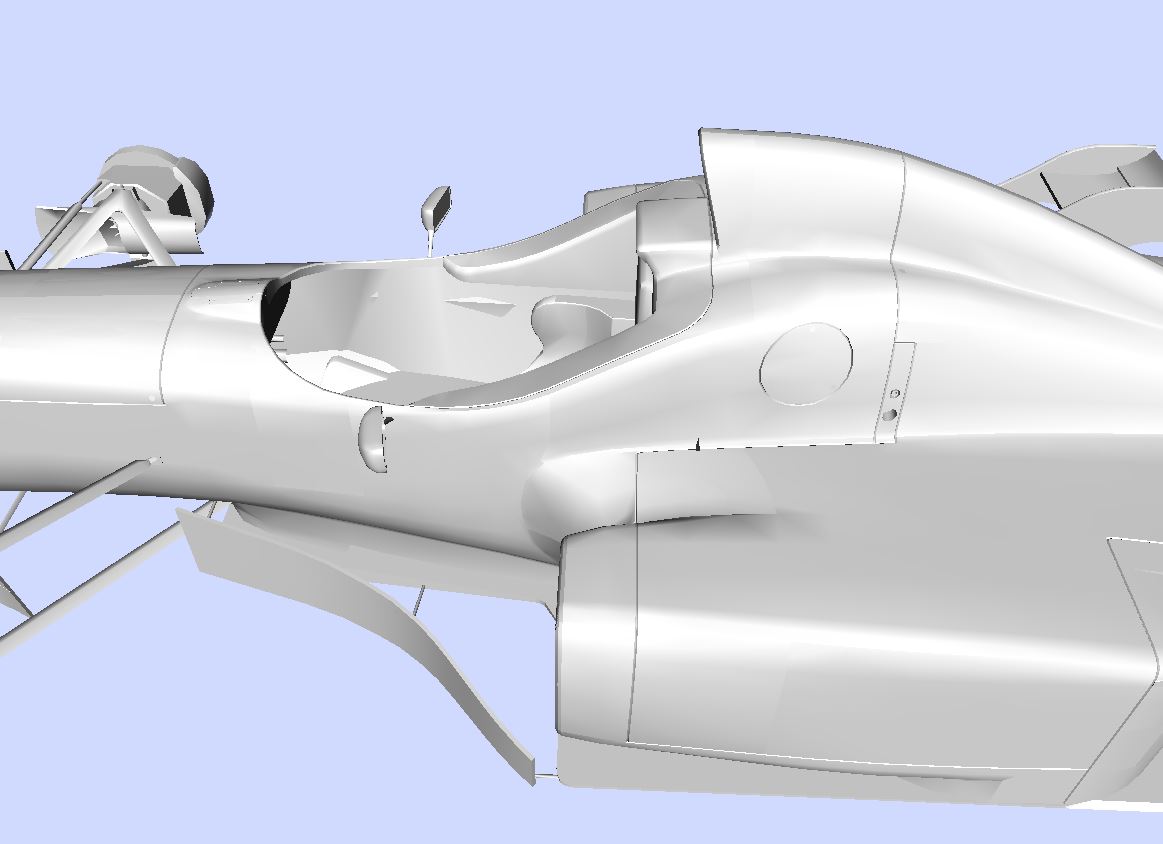
This is the low nose version of the car, and you can see how the nose itself is slightly raised from the front wing as mentioned in my previous posts. The front wing as added detail on the vanes with a joining support wire. This model has 3D bodylines, as my cars also do. You can see that there is more detail on the suspension and the wheel hub. The smaller bargeboard hidden in the suspension is beautifully done, as it's not quite straight, but looks almost warped, a nice touch.


The nice work on the bodylines can be see in this shot above. The integration of the rear of the side head rest protection is nicely done, with the front part being quite flat, whilst it is much more curved by the fuel cap and rearwards from there. The head protection itself is wonderfully detailed. The seat is nicely recreated, though there's not too much else in the cockpit worth mentioning.


The rear of the car has some lovely details and I wanted to show the wireframe so that you can see some of the details and modelling techniques used to create them. One of the things I try and do is to make sure all my polygons face the same way, |\|\|\|\|, where as there's some difference on this car around the rollover bar.

There's some nice detail on the hump at the rear of the engine cover, and the suspension pickup points. The rear fin has some nice detail as does the rear wing itself.


When I said the GP4 car took a few liberties in the diffuser region, it was to this car I was comparing it to, which from what i can tell from pictures is much more accurate and well proportioned. You can see some of the complexities of the rear suspension from this angle and how tightly packaged it all is, something you don't necessarily appreciate unless you try and make it yourself.


Finally here's a nice shot of the car where you can see the detail on the seat, the hump in front of the cockpit with bodylines on it, must have taken a while to get that right. The conversion to 3DS format has knocked the normals a bit, so the sidepods don't look as smooth as it does in game.


I think it looks great in game. If this car was to make it into a newer game, I'd expect to see more polygons and more details than before, particularly on the insides and the cockpit which are lacking a little in detail in F1 2013. I hope you enjoyed this slight detour from my regular postings, but I always try and follow modern techniques to further improve myself and my modelling.

Wednesday, 29 May 2019

GP4: 1996 Ferrari F310 walkaround part 3

For the third part of the walkaround, I will be looking at the cockpit, the rear of the car, and some of the internal parts of the 1996 Ferrari F310 created by Nick Ovey and Ebi Attard. If you missed the first two parts, you can read them here, part 1 and part 2.


The cockpit is pretty basic, at a time in GP4 when there wasn't really much attention put into making cockpits accurate, as the in cockpit view used a generic model for all cars. Some nice touches are the onboard camera, as placing the camera on top of the rollover bar started to become the norm in 1996.


The wireframe is shown on the shot above, so that you can compare some of the techniques used on this car compared to some of my cars of a later period. The same philosophy applies with more polygon usage around curved regions, whilst large polygons are used for flat surfaces.

The Ferrari were one of the teams caught out with the side head-rest protection regulation, new for 1996. They had the highest of all the teams, something that affected the flow to the airbox above the drivers head, and it was common to see Schumacher and Irvine to drive down the straights with their head as over to the side as they could manage.


Moving onto the rear of the car and this is an area where perhaps artistic license ruled over accuracy, though it is not bad by any means.


There have been some lovely photos of the car with its engine cover off, so it was good to see that faithfully recreated on this car. whilst it is basic and a lot of it covered by the radiators, it's good enough for you to get an idea of what is there. Ferrari were quite unique in that they didn't run a black airbox, with the prancing horse featuring prominently on it.


Here is a shot of the inside of the car from the rear. For comparison, I have a screenshot of the F310 created for F1 2013. It's a shame that the car doesn't make it into the classic part of the 2018/19 game.


As you can see, the 2013 model uses many more polygons and attempts far more detail but the proportions are pretty similar. What I'm saying is that though the GP4 car, created by amateurs and aiming for less detail, have done a fantastic job and holds up well against the F1 2013 version which was created by professionals with probably better source material to work from.

Tuesday, 28 May 2019

GP4: 1996 Ferrari F310 walkaround part 2

Welcome back to part 2 of my 1996 Ferrari F310 GP4 car walkaround. This car has been beautifully recreated by Nick Ovey and Ebi Attard.


The high nose created by the Ferrari is very reminiscent of the Minardi high nose adopted in 1995, with the bulbous undersection and the angled supports. Personally I loved the look. The front wing is simple but accurate, Ferrari running three elements, which wasn't unique or new, but most other teams ran simple two element front wings.


New rules for 1996 meant that the front wing endplates must be rounded to avoid punctures on collision. Ferrari's version is notably quite rounded. You can see the vanes underneath the front wing and the undercut at the rear of the endplate, something they had developed on their 1995 car. The nose should have been easy to integrate, but I had to make a slight adjustment to the top of the nose and the angle to make sure the high nose was not too low. The textures are nicely integrated with the shape with the bodylines and how the suspension connects with the monocoque.


Moving towards the cockpit, there is the small bump in front of the cockpit. This I believe is to do with a regulation with the steering wheel, that as the steering wheel turns, the wheel must not exceed the height of the monocoque.

You can see the bargeboards on the F310 and the floor as it guides the air underneath the sidepod and towards the diffuser.


Here is a close up of the underneath of the sidepod, nicely done by Nick and Ebi. The curvature of the top of the sidepod is spot on for me.


Here is the front of the sidepod, again I think this is beautifully done and kept at a very low polygon count, whilst keeping lovely smooth normals.

You can see the original car in Nick Ovey's page http://njovey.com/3d/ferrari-f310/

Monday, 27 May 2019

GP4: 1996 Ferrari F310 walkaround part 1

Next up in my walkaround series from the GP4 1996 mod is this one. The Ferrari F310 I wasn't really involved in, the main shape and work being done by Nick Ovey and Ebi Attard. I only got involved with helping them get the car in-game and creating the high nose, so that will be the car that I will review. If I remember correctly, this car was released years after the original McLaren, but a little before the Benetton by Oggo. So in my review, it's not for me to judge it according to the standards of some of my later works when I was pushing the boundaries of accuracy.


The car has good proportions overall, and is a pretty accurate shape. The car has lots of nice source photographs so that you can get some really good reference shots for modelling. What I did forget to update on this car was the rear winglet endplate, which should have been updated from the early season version.


If you notice from my other cars from the front and rear views is that everything lines up nicely, the width of the front wings, the sidepods etc. Sadly on this car the rear winglets exceed the width of the rest of the car. 


The John Barnard designed Ferrari for 1996 season was known as the truck, because of how it handled, perhaps not fitting for the arrival of double World Champion Schumacher. Somehow, he managed to eek out three victories in a car that didn't deserve to be challenging the Williams at all. 


The car started out the season with a low nose, though the nose itself was slightly raised giving more surface area to the front wing. This concept was ditched by the Canadian Grand Prix. There was no change to the main chassis to accommodate this, so the high nose had to be raised from the bulkhead forwards, which led to the slightly awkward bulbous shape. Compare this to the F310B for the 1997 season when nose and chassis were designed together in a more tightly fitted and slender and sleek shape.


Barnard also returned to a raised sidepod, something similar to the double floor concept tried (and failed) on the 1992 car. From this angle, you can see the sidepod is completely separated from the floor until the very rear.

As usual, you can read about how the car fared in my model review found here: https://fongugp4.blogspot.com/2019/03/143-model-review-1996-ferrari-f310.html

Thursday, 21 March 2019

1/43 Model Review: 1996 Ferrari F310

Background

Reigning Double World Champion, Michael Schumacher made a big money move to Ferrari for the 1996 season, which led to him eventually winning 5 titles in a row. The John Barnard designed F310 was not on the level of Adrian Newey's Williams, and the F310 was nicknamed "the truck" for how it handled. However, Schumacher was able to bring home 3 victories, the first in the F310 in extremely wet conditions in Spain.

The car was unreliable particularly in the hands of Irvine having 8 consecutive retirements. The highlights of Irvine's season came at the opener at Melbourne where he finished in third place.

The car ran unique high sidepods, reminiscent of the 1992 car which attempted a double floor concept. I suppose it's a very early version of the sidepod undercut, similar to modern day cars. Ferrari also ran one of the highest side head protections out of all the teams.

Minichamps

Minichamps 430960002
Irvine's car comes in a bright red box rather than the original Minichamps chequered flag box. The model with the early season nose is a nice accurate model.


Minichamps 510964311
Schumacher's cars from 1996 are all a part of the Michael Schumacher Collection. This one, from the Spanish Grand Prix, is still quite a rare and valuable model, even though the model itself is pretty much the same as the standard car, though the number has moved from the rear wing to the winglet in front of the rear wheels. A nice detail is the slightly different helmet shape that Schumacher ran during the 1996 season - he used to always run his head to one side of the cockpit on the straights to help the air get into the airbox.

Minichamps 510964321
Ferrari finally returned to a high nose concept from the Canadian Grand Prix with the F310/2. I always liked the angled front wing supports, similar to the Minardi ones. This model also featured an onboard camera. It would have been nice to have the updated rear wing winglet. The high nose Ferrari brought Schumacher victories at the Belgian and Italian Grand Prix.
Score: 7/10

Ixo/La Storia/Altaya


The Ixo version of the low-nose F310 is not a bad one shape wise, but there have some off-putting versions, like the La Storia one having a red floor, and having the numbers on both the rear wing and the winglet, and not painting the area around the front suspension red. It also lacks much of a diffuser. It's a shame, as if they made a few small changes, it would be quite a nice model to collect.
Score: 6/10

BBR

BBR BG90


This BBR model is from the Australian GP. Besides the rear diffuser being quite small on this model as well, it's otherwise a very nice model. The front wing end plate could be a little larger, but of the 1996 models by BBR, this is one of the highlights for me.
Score: 9/10
BBR Met73

We also get the high-nose version from BBR from the Belgian GP. At both the Belgian and Italian Grand Prix where high speed and low drag set ups were required, Ferrari lost their winglets, running a more traditional rear wing endplate. My problem with the high nose version is that the nose is too long and so the front wing is too far in front of the rear wheels.
Score: 8/10

Tameo

Tameo TMK418

Tameo have produced this excellent model from the Spanish Grand Prix with excellent wet tyres. It has lovely proportions and excellent details throughout. The treatment of the upper rear wing elements is lovely too.
Score: 10/10

Tameo TMK431

The high-nose version is from the Italian Grand Prix, losing the upper element from the front wing and running a miniscule rear wing. It also has an updated diffuser. Again, hard to find any fault with this model, it's re-created the car perfectly for me.
Score: 10/10


To read more reviews from the 1996 season, click here: https://fongugp4.blogspot.com/p/1996-model-review.html

Tuesday, 19 March 2019

Winners of the 1st Race vs Champions (1990 - 2019)

We just witnessed a reinvigorated Valterri Bottas dominate the Australian Grand Prix. He was close to Hamilton in qualifying, but snatched the lead convincingly at the start and drove away to win by over 20 seconds. Granted that Hamilton's car was damaged, it was still an impressive margin of victory. Verstappen had to overtake cars in front of him to finish where his pace deserved and Ferrari's pace had vanished this weekend having to settle for 4th and 5th, unable to find a good set up and use the tyres properly.

But, as they all say, this is Australia, and it throws up some odd results and can give false readings as to how the season will pan out. Melbourne has hosted the opening round of the F1 World Championship since 1996, though Bahrain opened the season a couple of times in 2006 & 2010. There used to be a trend where the winner of the first Grand Prix usually goes on to win the World Championship. I've gone back and looked through race winners compared to champions from 1990 through to today to see how true it is.


1990s

Only twice in the 90's did non-champions win the first race.

1997 David Coulthard

Minichamps 530974390
Here is Coulthard's McLaren in pre-season testing livery. Coulthard would win another Grand Prix that year, as McLaren and Mercedes were starting to become more competitive, but they weren't title contenders. That would come in 1998, but it would be Hakkinen who would win the Championships.
Villeneuve was taken out by Eddie Irvine's Ferrari on the first corner of the season and retired, opening up the opportunity for McLaren to take their first victory since Senna won in Adelaide in 1993.

1999 Eddie Irvine

Hot Wheels 24626
1999 was meant to be the season that Michael Schumacher finally won the title in a Ferrari, but a broken leg half way through the season put an end to his challenge. So Ferrari rallied behind Irvine, kind of, to take the challenge to Hakkinen and McLaren. Hakkinen should have ran away with the title that year but mistakes from him and the team made it much more difficult. And Ferrari? Well I think they'd rather wait a year than break their duck with Irvine to be honest. Hakkinen retired from the first race with throttle problems, whilst Schumacher had issues before the start of the race that meant he started at the back of the grid and finished outside the points.


2000s

Similarly in the noughties, only twice did the race winner not go on to win the title.

2003 David Coulthard

Minichamps 530034305
Coulthard makes the list again in 2003. Ferrari were so dominant by now that they started the season with the previous years car and were still competitive. Having said that, McLaren did the same for 2003 and ran the updated car for the whole year. Schumacher damaged his car whilst battling with Raikkonen, whilst Montoya spun out of the lead, leaving Coulthard to pick up the pieces and win the race.

2005 Giancarlo Fisichella

Minichamps 400050006

Remember F1 went through a phase of single shot qualifying, where drivers took one turn each to set a qualifying time? It comes unstuck if the weather changes half way through, which it did in Australia 2005. Alonso qualified in 14th position whilst team mate Fisichella took pole. Fisichella showed the potential of the Renault car by taking victory at the opening round. But it would be his team-mate who would take the title, whilst Fisichella faded into the number 2 driver role.


2010s

However, when you enter the last decade, 6 times, more than half of the winners of the first race has not gone on to win the World Championship. Before we delve into why that is, let's have a look at the each case first.

2010 Fernando Alonso

Mattel Elite T6289
Alonso's debut with Ferrari ended with victory at the Bahrain Grand Prix. The car wasn't that quick, but a late season charge meant that he was in contention for the championship going into the final round, but a strategy error cost him the title to Vettel. 

Minichamps 530104311
Australia was the 2nd race that year and Jenson Button justified his decision to leave the team whom he won the Championship with, to go to Hamilton's team and prove himself. Button took an opportunistic victory at Melbourne, making the best strategy calls in a race with changeable conditions. But over the course of the season, Button was not able to mount enough of a challenge to defend his title.

2012 Jenson Button

Minichamps 537124303
Button won in Australia again in 2012, but the first half of 2012 was about the teams trying to get their heads around the new Pirelli tyres, which saw seven different winners in the first seven races. It wasn't until mid-season when Vettel gained the upper hand on the Championship despite a plucky challenge from Alonso in a much slower Ferrari.

2013 Kimi Raikkonen

Minichamps 410130107
Kimi Raikkonen started off the 2013 season with a win, having won at the tail end of the 2012 season as well. Whilst the car showed flashes of pace, it was not quick enough to mount a serious title challenge.

2014 Nico Rosberg

Minichamps 413140644
Mercedes were miles ahead when the 2014 season started in the new turbo hybrid era, but it was Rosberg, not Hamilton who would take the first victory of 2014. Hamilton was on pole, but engine issues meant he was third in the first corner and fifth at the end of the first lap before retiring. The battle between the two teammates ran to the final Grand Prix where Hamilton was triumphant.

2017 Sebastian Vettel

Looksmart LSF107
With a major change in regulations, Ferrari built a competitive car, though it wasn't quite on par with the Mercedes, but Vettel made good use of it, leading the championship for more than half the season - not the important half though. After mid-season, mistakes and misjudgments were costly and their challenge fizzled out. At the Australian Grand Prix, again Hamilton took pole position, but Vettel remained close in 2nd. When Hamilton pitted early, he was held up by Verstappen who was yet to stop, allowing Vettel to come back out ahead of Hamilton after his stop.

2018 Sebastian Vettel

Bburago 18-36808V
2018 started so promisingly for Ferrari. Though Hamilton aced qualifying, an opportunistic pitstop by Ferrari under Virtual Safety Car propelled the German to first place. By half way through the season, Vettel was leading the championship, and in a strange case of deja-vu, Vettel's challenge faded in much the same way it did in 2017.


So what can we conclude? Formula 1 is a lot less predictable than it used to be and whilst it's not as competitive as we'd like, it's still in a better place than it was. We still moan that it's only ever going to be one of two, possibly three, teams who can win the title, but there were seasons in the past where one driver dominated for much of the season.

Is Bottas going to win the title, challenge for the title, or was this a one off? Time will tell, but all the predictions for Melbourne turned out to be wrong, as Ferrari were slow and Mercedes were well ahead. Nobody gave Bottas a chance, but the reality is, if the Mercedes can be competitive throughout the season, Bottas has all the tools to challenge. But his team-mate is five-times World Champion, Lewis Hamilton, and when he was on it, he was unstoppable last season. However we haven't seen that kind of form throughout an entire season yet, and he has been beaten before, but that took Rosberg using everything at his disposal to throw Lewis off his game, personally, I can't see Bottas doing that this season. Hamilton has been on pole 8 times in his career, and has won 4 of the last Championships, but has only won this race twice and only one of those times in a Mercedes.