Showing posts with label Lotus. Show all posts

Thursday, 19 May 2022

GP4: 1994 Lotus 109 Mugen-Honda - Australian GP Version released

1994 Lotus 109 Mugen-Honda (Australian GP) by Fongu

I proudly present to you the 1994 Lotus 109 Mugen-Honda for GP4. The shape had been completed for some years now, and has been stop/start in progress sine then. You can read more about the journey and its features in my blog.

Work in Progress post 1

Work in Progress post 2

The team put all their hopes on this car, that along with Mugen-Honda’s special new engine. The new car, well one of them, only made its debut in Spain, and then the engine, again only one of them, appeared in Italy, only making it to the first corner. The combination looked competitive in Monza, but sadly it was too little too late, as Irvine pitched Herbert into a spin and the resulting melee caused a race restart. The team ran out of money, and Herbert was drafted to Ligier then Benetton. The team saw off the season with pay drivers and went into administration, and the Lotus name left the sport.

To read more about how the team faired that season, you can read more here: 1994 season summary & model review

This is the Australian GP version of the car, with Mika Salo and Alex Zanardi at the wheel. 

I have to thank Oggo for sharing his textures of the early season 107C, some of the logos and race numbers were brought over to this car. 


Tuesday, 19 March 2019

Winners of the 1st Race vs Champions (1990 - 2019)

We just witnessed a reinvigorated Valterri Bottas dominate the Australian Grand Prix. He was close to Hamilton in qualifying, but snatched the lead convincingly at the start and drove away to win by over 20 seconds. Granted that Hamilton's car was damaged, it was still an impressive margin of victory. Verstappen had to overtake cars in front of him to finish where his pace deserved and Ferrari's pace had vanished this weekend having to settle for 4th and 5th, unable to find a good set up and use the tyres properly.

But, as they all say, this is Australia, and it throws up some odd results and can give false readings as to how the season will pan out. Melbourne has hosted the opening round of the F1 World Championship since 1996, though Bahrain opened the season a couple of times in 2006 & 2010. There used to be a trend where the winner of the first Grand Prix usually goes on to win the World Championship. I've gone back and looked through race winners compared to champions from 1990 through to today to see how true it is.


1990s

Only twice in the 90's did non-champions win the first race.

1997 David Coulthard

Minichamps 530974390
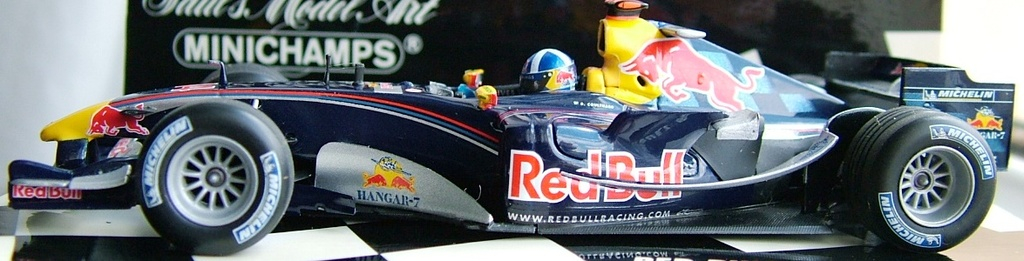
Here is Coulthard's McLaren in pre-season testing livery. Coulthard would win another Grand Prix that year, as McLaren and Mercedes were starting to become more competitive, but they weren't title contenders. That would come in 1998, but it would be Hakkinen who would win the Championships.
Villeneuve was taken out by Eddie Irvine's Ferrari on the first corner of the season and retired, opening up the opportunity for McLaren to take their first victory since Senna won in Adelaide in 1993.

1999 Eddie Irvine

Hot Wheels 24626
1999 was meant to be the season that Michael Schumacher finally won the title in a Ferrari, but a broken leg half way through the season put an end to his challenge. So Ferrari rallied behind Irvine, kind of, to take the challenge to Hakkinen and McLaren. Hakkinen should have ran away with the title that year but mistakes from him and the team made it much more difficult. And Ferrari? Well I think they'd rather wait a year than break their duck with Irvine to be honest. Hakkinen retired from the first race with throttle problems, whilst Schumacher had issues before the start of the race that meant he started at the back of the grid and finished outside the points.


2000s

Similarly in the noughties, only twice did the race winner not go on to win the title.

2003 David Coulthard

Minichamps 530034305
Coulthard makes the list again in 2003. Ferrari were so dominant by now that they started the season with the previous years car and were still competitive. Having said that, McLaren did the same for 2003 and ran the updated car for the whole year. Schumacher damaged his car whilst battling with Raikkonen, whilst Montoya spun out of the lead, leaving Coulthard to pick up the pieces and win the race.

2005 Giancarlo Fisichella

Minichamps 400050006

Remember F1 went through a phase of single shot qualifying, where drivers took one turn each to set a qualifying time? It comes unstuck if the weather changes half way through, which it did in Australia 2005. Alonso qualified in 14th position whilst team mate Fisichella took pole. Fisichella showed the potential of the Renault car by taking victory at the opening round. But it would be his team-mate who would take the title, whilst Fisichella faded into the number 2 driver role.


2010s

However, when you enter the last decade, 6 times, more than half of the winners of the first race has not gone on to win the World Championship. Before we delve into why that is, let's have a look at the each case first.

2010 Fernando Alonso

Mattel Elite T6289
Alonso's debut with Ferrari ended with victory at the Bahrain Grand Prix. The car wasn't that quick, but a late season charge meant that he was in contention for the championship going into the final round, but a strategy error cost him the title to Vettel

Minichamps 530104311
Australia was the 2nd race that year and Jenson Button justified his decision to leave the team whom he won the Championship with, to go to Hamilton's team and prove himself. Button took an opportunistic victory at Melbourne, making the best strategy calls in a race with changeable conditions. But over the course of the season, Button was not able to mount enough of a challenge to defend his title.

2012 Jenson Button

Minichamps 537124303
Button won in Australia again in 2012, but the first half of 2012 was about the teams trying to get their heads around the new Pirelli tyres, which saw seven different winners in the first seven races. It wasn't until mid-season when Vettel gained the upper hand on the Championship despite a plucky challenge from Alonso in a much slower Ferrari.

2013 Kimi Raikkonen

Minichamps 410130107
Kimi Raikkonen started off the 2013 season with a win, having won at the tail end of the 2012 season as well. Whilst the car showed flashes of pace, it was not quick enough to mount a serious title challenge.

2014 Nico Rosberg

Minichamps 413140644
Mercedes were miles ahead when the 2014 season started in the new turbo hybrid era, but it was Rosberg, not Hamilton who would take the first victory of 2014. Hamilton was on pole, but engine issues meant he was third in the first corner and fifth at the end of the first lap before retiring. The battle between the two teammates ran to the final Grand Prix where Hamilton was triumphant.

2017 Sebastian Vettel

Looksmart LSF107
With a major change in regulations, Ferrari built a competitive car, though it wasn't quite on par with the Mercedes, but Vettel made good use of it, leading the championship for more than half the season - not the important half though. After mid-season, mistakes and misjudgments were costly and their challenge fizzled out. At the Australian Grand Prix, again Hamilton took pole position, but Vettel remained close in 2nd. When Hamilton pitted early, he was held up by Verstappen who was yet to stop, allowing Vettel to come back out ahead of Hamilton after his stop.

2018 Sebastian Vettel

Bburago 18-36808V
2018 started so promisingly for Ferrari. Though Hamilton aced qualifying, an opportunistic pitstop by Ferrari under Virtual Safety Car propelled the German to first place. By half way through the season, Vettel was leading the championship, and in a strange case of deja-vu, Vettel's challenge faded in much the same way it did in 2017.


So what can we conclude? Formula 1 is a lot less predictable than it used to be and whilst it's not as competitive as we'd like, it's still in a better place than it was. We still moan that it's only ever going to be one of two, possibly three, teams who can win the title, but there were seasons in the past where one driver dominated for much of the season.

Is Bottas going to win the title, challenge for the title, or was this a one off? Time will tell, but all the predictions for Melbourne turned out to be wrong, as Ferrari were slow and Mercedes were well ahead. Nobody gave Bottas a chance, but the reality is, if the Mercedes can be competitive throughout the season, Bottas has all the tools to challenge. But his team-mate is five-times World Champion, Lewis Hamilton, and when he was on it, he was unstoppable last season. However we haven't seen that kind of form throughout an entire season yet, and he has been beaten before, but that took Rosberg using everything at his disposal to throw Lewis off his game, personally, I can't see Bottas doing that this season. Hamilton has been on pole 8 times in his career, and has won 4 of the last Championships, but has only won this race twice and only one of those times in a Mercedes.

Friday, 15 March 2019

2019 Preview: Historic Team Names

They say its easier to buy an existing company than start up your own. Only a handful of teams are Ferrari, McLaren, Haas and Williams (though you could argue it is Williams version 2.0 (version 1.0 being bought out by Wolf (not Toto Wolff (though he did own a bit of Williams V2 at one stage) but Walter Wolf)) phew!).

Two teams have changed hands once Toro Rosso used to be Minardi, and Alfa Romeo used to be Sauber (with a few years as BMW, but they still retained the Sauber name).

However there are four teams that have a more colourful history.

Team Silverstone

Jordan


>>>

Jordan started the team from 1991 having run various lower formulae teams. When a contract dispute with Vodafone didn't go his way and Honda deciding to pair with BAR, the team quickly ran into money problems and went to the back of the grid. 2005 was the final season under the Jordan name.

Midland F1

In 2006, for the most part, it competed as Midland F1. Except they didn't make it all the way through the season.

Spyker

>>>
Spyker quickly reliveried the car from the Italian GP, but thankfully we had a much toned down version in 2007.

Force India

>>>

From 2008, Vijay Mallya bought the team and it was then known as Force India right through to 2018, well the middle of 2018 when it became...

Racing Point

So apparently the point is a full stop. With the title sponsor, the team is then "SportPesa Racing ."
It's like a joke that you have to explain isn't funny, I get its trying to be clever but I suppose I preferred they didn't revive the Lola name when they had nothing to do with them. The best 'pound-for-pound' team will receive a cash boost with this latest change of ownership and they will be looking to regain 4th in the Constructors' Championship.


Team Enstone

Toleman


Toleman competed between 1981 through to 1985. I only had two Tolemans in my collection, this one with Senna driving.

Benetton

>>>

The clothing company, Benetton, bought the team and introduced its bright colours to the grid. Winning two championships with Schumacher in the mid-90s, the team would eventually sell up in 2001 to Renault.

Renault

>>>

Renault also won two championships with Fernando Alonso. Renault left the sport at the end of 2010, with the team being bought by Genii capital.

Lotus

>>>
They called the team Lotus, even though there was another team called Lotus because they correctly bought the rights, but Proton who owned actual Lotus wanted this team to be called Lotus. Lotus (the other team) became Caterham and Renault transitioned from Lotus Renault to Lotus...

Renault


... and back to Renault again when the manufacturer saved the team from a dire financial situation towards the end of the 2015 season. Renault will be looking to catch the leading three teams in the coming couple of years. This season they will want to be a clear 4th, but that seems like it is not going to be an easy task.


Team Braxley

Tyrrell

>>>
Ken Tyrrell ran Matra cars from 1968, before making his own cars and entering as Tyrrell in 1970. The team were successful in the early 70s, but their competitiveness began to wane, until they were eventually sold to British American Tobacco when they had sunk to the back of the grid in 1998.

BAR

>>>

BAR told us they would win their first Grand Prix. They didn't even score a point all 1999. They wanted to run two seperate liveries, but ended up with the two sides of the car in different liveries. So I'm posting a picture of their much better testing livery. Consistent podium finishes in 2004 saw the team bought by Honda in 2005.

Honda

>>>

The team became Honda in 2006, but the team slipped backwards in competitiveness. It wasn't until 2009 that they would produce a competitive car, but Honda were suffering in the recession and pulled out of the sport at the end of 2008.

Brawn GP


For one glorious season, we had Brawn GP. From the brinks of closing down, this team won it all in 2009 before being bought out by Mercedes.

Mercedes

In 2010, with Rosberg and Schumacher at the wheel, Mercedes began their F1 come-back which has so far seen them win 5 Championships in a row to date. Will they make it a sixth straight year? It looks like they have their biggest fight yet going into 2019.

Team Milton Keynes

Stewart


>>>

Jackie and son Paul Stewart entered a Fords works backed team in 1997. They made good progress, producing a quick but slightly fragile car in 1999. They won their first Grand Prix that season, by which time Ford wanted to buy him out. 

Jaguar

>>>

And Ford called the team Jaguar and brought a welcome green livery back to F1. Unfortunately the team never enjoyed any success and Ford sold out to a drinks company. 

Red Bull Racing


Red Bull made slow initial progress, and the arrival of Adrian Newey did not see much of a boost initially. But with new regulations in 2009, Newey and his team worked with Renault to produce some competitive cars, winning four straight championships. In 2019, a new era with Honda engines promises a return to the front in the near future. How soon can they start competing for championships again is the big question. 

Thursday, 28 February 2019

1/43 Model Review: 1978 World Champion Mario Andretti (Lotus 79 Ford Cosworth)

Background

Colin Chapman had fine tuned the ground effect by extending the rear endplates down behind the rear wheels to enlarge the aerodynamic force. It was introduced at the 6th race of the year, at Belgium, where the car won six wins out of eight, 5 of them by Andretti who claimed the Drivers Championship and helped Lotus win the Constructors' title, the last for the Lotus team. Sadly Andretti's team-mate, Ronnie Peterson lost his life following an accident at Monza.

Though both the Lotus 78 and the 79 were used, it was really the advanced aerodynamics of the 79 that won Lotus their championship, so I'll just be featuring the 79 in this post. From a quick look, besides TSM's set in this post, only Quartzo and RBA produce a version of the 78 from this season. Spark have produced a 78, but not with Andretti in the cockpit.

Minichamps

Minichamps 430780005
As we reach the end of the 1970s, the shapes of the cars have transformed completely from the 72 that took Jochen Rindt to his first title. Spurred by aerodynamic gains, large sidepods shaped as aerofoils, and covered engines were the way forward which makes these models more about the aerodynamic surfaces than engine detail. So this pretty simple offering from Minichamps stands up pretty well, the shape is nicely done and the JPS livery looks as nice as ever. The helmet sits a bit far forward and a little low though.
Score: 7/10 

Spark

Spark S1848


Spark have recently released their version of the 79, this one from the Belgian Grand Prix. Personally, being a Brit, I do like the addition of the flag on the side. I like the detail and the helmet looks really great with Andretti's grey and red stripe. A very nice model from Spark. You'd do well to buy this model yourself for under £100.
Score: 8/10 

Quartzo

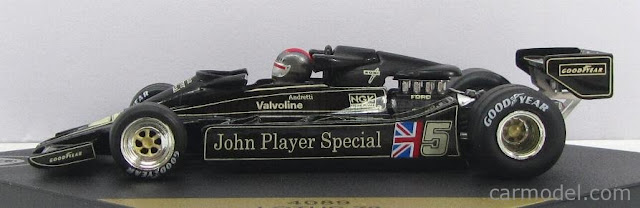
Quartzo 4089

A nice model from Quartzo of the Lotus 78

Formula 1 Car CollectionIxo


This car is also featured as part of the Formula 1 Car Collection series and it's not a bad job. I can't put my finger on it, but it just looks a bit stale, a bit souless, it just lacks the character of the real thing.
Score: 6/10

Tameo

Tameo WCT78

Tameo have produced another stunner with this version of the 79. A mix of good proportions and lovely detail, this one put together very well.
Score: 9/10

True Scale Models (TSM)

TSM TSM12SS3

TSM released their three car set of Andretti in the Lotus. This includes both the 78 car and the 79. It comes with all the usual quality you'd expect from TSM and this doesn't disappoint.
Score: 9/10

Friday, 15 February 2019

1/43 Model Review: 1970 World Champion Jochen Rindt (Lotus 72 Ford Cosworth)

I'm starting a new series of Driver's World Champions of which I have collected over the years. I start with a disclaimer that I grew up as a fan of F1 in the 1990s onwards, so my historical knowledge isn't quite as fanatical about the 80s and 70s and even less so of the 60s and 50s. But I do appreciate the history and the roots of what Formula 1 was back then and how it grew into this global phenomenon it is today. I have a couple of the World Champion models from the 50s or 60s, but not enough to do a series, so I'll begin with 1970 and the Lotus 72 that propelled Jochen Rindt to the title.

There are some very rare models from Spark that I don't have, or I simply can't afford them, and I've not ventured into Brumm, Quatrzo or IXO cars too much to fill in the gaps, as I mainly collect Spark and Minichamps models.

1970 - Lotus 72 - Jochen Rindt

Background

Jochen Rindt was a successful racing driver and previous Le Mans winner, but since his Formula One debut in 1964, he never had a car to match his talent. In 1969, he joined Lotus, and took his first Grand Prix victory finishing the year in fourth place. For the 1970 season, the third race was in Monaco where, due to retirements, Rindt lay second behind Jack Brabham, but his relentless pace caused Brabham to make a mistake on the last corner, letting Rindt through to victory. He then went on to win four races in a row mid-season, giving Rindt the Championship lead.

At Italian Grand Prix, designer, Colin Chapman, experimented by taking off the wings to reduce drag, to try and compete with the more powerful V12 engines, but Rindt's team-mate reported the car as impossible to drive, even in a straight line. In final practice, Rindt suffered a front right brake shaft failure, slinging him into the barriers at the Parabolica corner and taking his life. Nobody was able to gain enough points to overtake Rindt in the Drivers' Championship, and so Rindt remains the only posthumous World Champion to date.

Minichamps 430700005


The original Minichamps offering of the Lotus 72 was a nice simple car from, I think, the British Grand Prix. With the 70's cars, much of the rear end is still exposed, and Minichamps have put in a good effort with the engine and gearbox model.
Score: 6/10

Minichamps 436700005
The World Champions edition comes with wet tyres, a nicely updated driver model and helmet, and decals from, I think, the German GP. I feel they have improved the paint scheme, the original looks a little more like a toy, where as this updated version looks a bit more serious.

Score: 7/10

Other Versions

Spark S4280

Spark released their version from the Dutch GP, and as much as I'm not a fan of their 90s cars, I do love their treatment of the cars from the 60s and 70s, particularly the drivers and the details on the engine/gearbox. Their model is much sharper than the Minichamps model and I think the Spark version is overall a more satisfying model.
Score: 8/10

Quartzo have also done a nice budget model, as have Ixo/Formula 1 Car Collection and RBA.
Quartzo 4019

Quartzo's model is nicely done, lovely details, and despite not being made from resin like Spark, I think it's comparable to it. 
Score: 8/10

Formula 1 Car Collection
Ixo's version, this one from the Formula 1 Car Collection, is a pretty basic, but fairly nicely proportioned car. 
Score: 65/10

RBA

RBA/Atlas released a couple of World Champion cars and here is the Lotus 72, which again for a cheap model comes with nice detail around the engine and suspension.
Score: 6/10


For more from this series of World Champions, click here: https://fongugp4.blogspot.com/p/f1-world-champions.html

Retrospect

It's a sad reminder of a time in F1 where death was a regular occurrence, a state that only begins to change in the 1970s. And it's one criticism of Colin Chapman that his drive to produce a faster car, innovatively brilliant as he was, often pushed the boundaries too far as to risk his driver's safety. That's not to say he didn't care, the death of Jim Clark affected him deeply, but it does make you appreciate the level of engineering, the safety tests, the component testing and the safety standards of the modern day tracks that these days the cars are so reliable and the risk is much reduced.

I came across a comic-strip biography of Colin Chapman when browsing a local book store, and I think the comic was a brilliant way to treat a darker time. Beautifully illustrated and an accurate re-telling of his life is simply fantastic, and I enjoyed going through this book with my young son.