Showing posts with label Benetton B194. Show all posts

Monday, 25 July 2022

GP4: 1994 Benetton B194 Ford Cosworth - Australian GP version released


I proudly present to you the 1994 Benetton B194, created from scratch by me. I had previously written about the car and some insights into creating this car on another post, which you can read here:

more info

This car is the sixth car created for the 1994 season in GP4, based on how the car appeared at the Australian GP, with Michael Schumacher and Johnny Herbert at the wheel. Stay tuned for a 1994 mod update with more variations. I also include in this pack an external steering wheel, based on the internal wheel already included in the mod. I've also included a CSM update package for ease of install, obviously you'll need the 1994 Mod v4 installed first. 

So without further ado, here's the links. 

Enjoy!

Friday, 22 July 2022

GP4: 1994 Benetton B194 Ford Cosworth - coming soon

Coming soon to the 1994 mod is a new Benetton B194 made by me. This is presented as it appeared at the Australian GP, with Schumacher and Herbert at the wheel. 

1994 Benetton B194 by Fongu


Since Codemasters released their version of the B194 in the F1 2020 game, I was grateful to have that resource to be able to check my dimensions and proportions to it, taking nothing from that car at all. Indeed that car is based off one of the current show cars, which Mick Schumacher drove at Spa a few years back, and Damon Hill at Goodwood, but that configuration never actually raced, but is an amalgamation of parts from various races. 

1994 Benetton B194 by Fongu

This championship winning car is a cause of much debate and controversy, with many maintaining that it cheated to gain an advantage, whilst everyone involved with the team at the time, even nearly 30 years later, maintain they did not. I'm not going to solve any arguements with this blogpost, but my leaning is towards them not cheating. 

Martin Brundle drove his old 1992 Benetton B192 recently at the 2022 Austrian GP weekend, saying he and the team were taking an analogue car to race against the technologically-advanced and well-funded teams in Williams and McLaren. I believe when 'driver-aids' were banned from the 1994 season, the Benetton team were in the best position to adapt to the new regulations. Indeed they spent much of 1993 preparing for this. 

The team and Schumacher were working on a very basic and early iteration of a blown diffuser, and whilst Vettel and Red Bull in the 2010 era got Renault to continue to pump out hot exhaust gasses when the driver was off throttle, Schumacher had to learn to do this manually with his foot, and I think it's this odd usage of the throttle that Senna mistakenly confused for traction control, and also why Schumacher had such a large advantage over all three of his team-mates that season. 

On that amazing French GP start, Steve Matchett reveals in his book, 'The Mechanic's Tale', reveals that Michael had spent a test day that very week on perfecting his starts, knowing it was a weakness earlier that year. In terms of Option 13, I can understand having working in Software development, that sometimes its easier to not mess with code by deleting huge amounts of it, because it may break the whole thing, so it was easier to just hide it and not use it. In fact Larini admitted Ferrari had used traction control, albeit during practice only, in 1994 and McLaren were fined for using an automated upshift on their car, however they never fined Benetton for traction control deeming that the mechanism was there, but never used. 

*** Edit Jan 2023 -  A fantastic article, taking input from William Toet ***

The fire at the German GP is well documented, and whilst it was cheating, it is understandable how the Benetton team thought they had legitimate grounds to take the action that they did (removing a part from refueling rig) rather than erring on the side of caution.

I think this car is under-rated because of the cloud that hangs over it,  but it was a brilliantly nimble car that with a Ford V8 Cosworth engine, competed and beat the leading Renault V10s and Ferrari V12s. Generally, Schumacher was driving excellently that season, and there were mistakes, especially at the season finale in Adelaide where he had a massive shunt in practice, and then that famous off in the race, and that chop on Damon Hill that cost the Williams driver the championship. But he was unbeatable in the first half of the season, and it took a lot of events that conspired against the German that lead to Hill getting anywhere near the championship battle in the second half of the year. Whilst the Williams ended the season with the better car, in my opinion, and controversy aside, on a pure racing level, this Benetton B194 driven by Schumacher was fully deserving of the 1994 title. They prepared the best for the new regulations, Schumacher was extracting the very best out of the car, having spent years fine tuning it with the team, and I think the 1995 season which they dominated, should have been a repeat of the 1994 on a pure racing level - it was looking this was in the early races. 

1994 Benetton B194 by Fongu


So with all that in mind, I wanted especially to do justice with this car, a true legend of the sport, whatever side of the fence you fall on. I'm putting my best techniques learned over the last two decades to do this. With me still using Zmodeler 1 to create my shapes, it still takes time to manually put the car together in a polygon efficient manner, without key curves looking blocky. With having spent a bit more time in Photoshop in the past couple of years, my texture work continues to improve and there is a better mapping relationship between shaping and texturing processes. 

To make sure I'm well under GP4's polygon limit, I decided I would not create the engine and keep the gearbox detail to a minimum, sticking with a similar level of detail to the Codemasters version. In the end, this comes to around 55,000 faces, which is by comparison around 10,000 less than my Williams. 

1994 Benetton B194 by Fongu

On the shape front, I have opted for more rounded edges on the front and rear wing endplates, as well as the bargeboards. Where there are more curves, I've put more polygons to smooth them more than I have done in previous 1994 cars. To compensate for this increase in detail, I tried to use much less polygons on flat edges, on parts of the nose and the sidepod in particular. For details like screws and bolts, I've opted to shape them separately, mapping them to a larger and more detailed part of the texture, where previously I had painted them in a smaller resolution. This way, you can zoom in and see the detail. There's more detail in the wheel hub assembly than other cars, though the brake pad itself is still borrowed from when I created my 1996 cars. So pumping more energy into areas that you will see is hopefully a better solution than spending lots of time on an engine that you'll very rarely see in-game. For the cockpit, again I wasn't shy in using polygons where I needed to there. This will carry over into the internal cockpit shape. For wing levels, I tried to match the level of downforce with photos from the Australian Grand Prix as reference. 

On the texture side, I kept a similar mapping to the original 1994 car by Mckey and Oggo, with a second texture at half the size for various details, and I've created a new carbon texture. 

The livery is not that straight forward, and there's curves that passes various seams, so it took a while to get the base livery right. I was able to use a combination of the codemasters car and various photos to make sure the livery is as accurate as possible. 

1994 Benetton B194 by Fongu

For the logos, most of them are personally sourced, but I'm grateful to consult with GP4 logo-master Jurgen (Quickslick), to help me find better quality versions of some logos. On that, I ended up creating my own personal Mild Seven (and Benetton non-tobacco equivalent) vector myself. I searched for a long time, the logo on modern cars, on models, on decal sheets, well let's just say I noticed variations from the original car. Also the one on the engine cover, as it's on a slightly slanted surface, it's stretched vertically, as well as arced to fit - so making my own vector logo ensured the quality remained on the logo itself. Again with the text like 'Power By' on the engine cover, and the font on the lower rear wing, I took care to find the best match using a favourite online tool of mine, whatsthefont.com. I've also taken time to distinguish between black parts, carbon parts, and parts that look like a plain black plastic, and amended the alpha channel (reflection management) to suit. 

1994 Benetton B194 by Fongu

I'm always trying to improve and push myself to create as accurate a model as I can, without breaking the game when I put it in. Hopefully you can see some of the effort I've put into this model when you run it in game. 

My plan is to release this car as a stand alone release first, and then with a couple of variations and other new content in a 1994 mod update at a later date. 

1994 Benetton B194 by Fongu

Wednesday, 1 May 2019

Remembering Ayrton Senna 25 years after his death

1st May, 1994 was the day when the San Marino Grand Prix took place and the life of Ayrton Senna was taken from this world in a tragic accident at the Tamburello corner. In this post, I wanted to remember the early parts of the 1994 season.

The pictures are from the Minichamps cars released in 2016 in resin for each of the Grand Prix that Ayrton took part in, beautifully recreated.

Senna made his anticipated move to Williams, a front running team that would probably add to his championship tally. Judging by McLaren's woeful performance in 1994 with the new Peugeot engines, Senna was right to leave. But with 'driver aids' being banned for 1994, Williams had to prepare, set up and run a car without active suspension for the first time since 1991. The FW16's aero that had been fine tuned for active suspension now had to work in a wider range of conditions. Sadly the car was aerodynamically flawed, with the sidepods too far forward and causing intermittent stalls, thus losing massive amounts of grip suddenly, all of which doesn't give a driver too much confidence. But whilst Hill held back until this issue was fixed (and contending with Mansell returning for a few Grand Prix in the other seat), Senna pushed through it with a great self-belief in his car control. 

Benetton had produced the front running car in the hands of F1's next superstar, Michael Schumacher. Senna was all to weary of the threat, and perhaps over-stated the rivalry in his mind before it properly began. Senna needed a rival to motivate him, just as a superhero needs a super-villain. Senna needed a reason why the German's car was now the benchmark, and illegal traction control on the Benetton was his reasoning. 

Ibrar Malik researched the 1994 season along with its many controversies including Benetton's alleged cheating particularly on the issue of traction control. This is published in his book, 1994: The Untold Story. Though the writer leaves the reader to make their own conclusions, it is quite clear from the evidence that it is more than likely that Benetton did not have traction control and what Senna had heard in Aida was Schumacher's left-foot braking driving style as well as energising the exhaust blown diffuser on the B194. You'd have to buy this excellent book for the detail, but the evidence is quite compelling. 

Round 1: Brazil

Minichamps 547940102

The Brazilian Grand Prix opened the 1994 season. Senna managed to gain pole position with a three-tenth's of a second advantage over Schumacher and a whopping 1.5 seconds ahead of team-mate Hill who started in 4th place. Senna got away well into the lead, whilst Schumacher fell behind Alesi in the Ferrari. The German passed the Ferrari at the end of lap 2 and closed the 4 second gap, showing that the Benetton was quicker. Schumacher got ahead in the pitstops and had a comfortable 10 second lead. But by lap 55, the two had lapped the rest of the field, and Senna closed the gap to 5 seconds when suddenly the Williams spun and Senna was out of the race. 10 points earned for Schumacher and a disappointing 0 points for Senna from his home race. This set up an tantalizingly competitive season, something F1 had been lacking since 1991.

Round 2: Pacific GP

Minichamps 57940202

Japan's first of two races in the country was held at the Aida track for the first time, and the race was dubbed the Pacific Grand Prix. Senna again took pole position, two-tenths ahead of Schumacher and half-a-tenth ahead of team-mate Hill. It was Schumacher who got away well and passed Senna well before the first corner. Hakkinen tagged the Williams going into the first corner, sending Senna spinning off. To make matters worse, Ferrari substitute, Nicola Larini, also went off in turn 1 and ploughed into the stricken Williams, ending both their races. At the end of round 2, Schumacher now had a perfect 20 points whilst Senna remained on 0 points.

Round 3: San Marino

Minichamps 547940302
It was well documented that Senna had safety in the very forefront of his mind. You can read more about the many serious crashes that happened during the early parts of 1994 in this 
blog post. Barrichello's accident and Roland Ratzenberger's death in qualifying would have rattled anyone, but with Senna visiting Rubens in hospital, and being driven to the scene of Roland's accident would not help anyone's mental state if you were about to jump into one of these machines and push it to the limit.

Yet Senna had no choice but to push the car to the limit. He was already 20 points behind a fast Schumacher, and with Monaco around the corner which should have suited Schumacher's Benetton (and history proved correct with a dominant display), Senna had to make the most his opportunity at Imola, a track that suited his powerful Renault engine.

Senna took pole position with a three-tenths of a second advantage over Schumacher in second. Senna took the lead at the start, but a huge start line accident lead to the Safety Car being deployed. F1 had wanted to spice up the show and introduced a number of things from Indycars, which was growing in popularity at the time. Though the Safety Car was reintroduced to F1 in 1993, there was pressure from the powers that be to use it more often. However the Opel Vectra was not really quick enough for F1 cars to maintain tyre temperature and tyre pressures at safe racing levels. Though not proven, it is the most likely cause of Senna's car bottoming out and causing the Brazilian to lose control of his car. Other factors may have been the aerodynamic stall, mentioned above, and a hastily extended steering column which was found to be broken.

Whatever the reason for the cause for the FW16 flying off the track, the impact, though heavy, was not in itself the reason for the fatality, the reason being a stray suspension element that came away from the car from the impact.

As it turns out, Schumacher was on a three stop strategy and Senna on a two-stop strategy, meaning the German had a lighter and faster car at the start of the race and so Senna didn't really need to push as hard as he did to stay ahead of the Benetton because Senna would have to stop less times.


A whole lot of what-ifs could be asked if Senna had survived the accident, would Senna have been able to win the 1994 championship? Hill was only able to close the gap to Schumacher because the German was disqualified from the British and Belgian Grand Prix and was banned for the Italian and Portuguese Grand Prix. But without Senna's accident, perhaps there would not have been the drive for safety, perhaps there would not have been the push to implement mid-season changes (which in the end favoured the FW16), perhaps the FIA might not have singled Benetton out with its penalties when other teams committing similar offences had lesser punishments. The likelihood was that had Senna stayed at Williams (and that was by no-means sure as he had talked with Luca Di Montezemolo about joining Ferrari prior to the San Marino GP), he probably would have challenge for the next three titles at least in fantastic Adrian Newey designed cars. Would Prost have been tempted back into the sport had Senna survived?

But what happened is what happened and we should be grateful for what we have of Senna's career including his three World titles and from his death came the drive for a safer F1 we have today. Sadly there has been a fatality since that day 25 years ago, but thankfully it is not the norm and the threat is much reduced. Senna is remembered as a true F1 legend, a driver of unbelievable talent and dedication, and rallied a nation behind him.

Tuesday, 5 February 2019

1/43 Model Review: 1994 Pacific PR01 Ilmor

Background

The first Pacific Grand Prix car which raced in 1994 was the PR01. It was initially designed for the 1993 season, but due to financial problems had to amend and race the car a year later. It was significantly slower than the other cars, often failing to qualify. When it did, it failed to finish any races. The team would last another season, in which it fared a little better, but these small teams trying to punch above its weight is why we love these cars. Bertrand Gachot and Paul Belmondo were its drivers. By all accounts it was all pretty rubbish, and there's a humourous parody Twitter account that you can find here:
https://twitter.com/PacificRacingF1?lang=en

Pacific had issues with the high nose, and tested with closing the gap under the high nose which they did with duct tape! They eventually went to a low nose solution, not that it helped them get on the grid.


There's a great article written below about how the origins of this design done by Adrian Reynard was the basis for the worst car of the grid, this Pacific PR01, and the for fastest car on the grid, the Benetton B194 (albeit several iterations on).

www.unracedf1.com

Onyx/Heritage Formula

Onyx 199
The shape is clearly the Benetton B192 shape by Onyx, and bearing in mind the cars had the same origins, who could blame Onyx for doing so. 
Score 4/10

There are no alternative models of this car. I found a 1/20 Tamiya decal set for the Benetton B192 shape, but that is as close as I have got.

So if any of the current manufacturers decided to make this car, I suspect they would be snapped up quickly and their value instantly go up.

For more 1994 Model Reviews, click here: https://fongugp4.blogspot.com/p/1994-model-review.html

Wednesday, 30 January 2019

1/43 Model Review: 1994 Larrousse LH94 Ford

Background

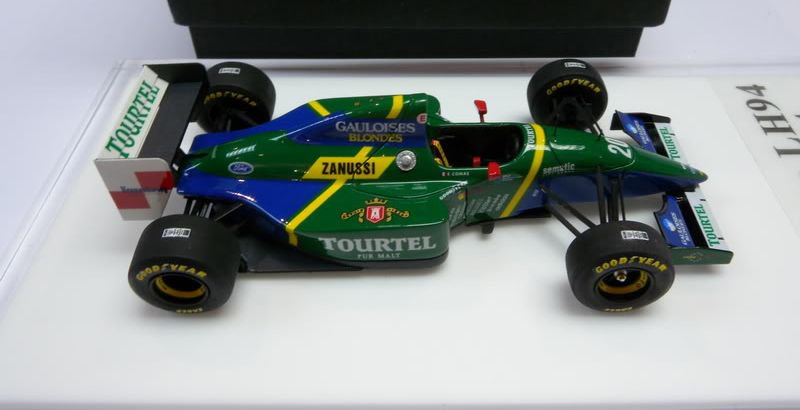
The 1994 Larrousse LH94 car carried two liveries during the year, a red and white Kronenbourg version for a few Grand Prix, and the green Tourtel version. I, personally, can't remember a bigger livery change mid-season, flipping between the two liveries in the early season.

The car was a development of their first in-house built car the LH93, but it would be their final car, due to lack of finances. The season started off well, with a point scored at Aida, but lack of development and reliability meant the team would only repeat this feat once again in Germany. Interestingly the German Grand Prix is remembered for the pit stop fire of Jos Verstappen's Benetton B194, but Benetton and Larrousse had a technical agreement that meant the LH94 ran the Benetton B193 gearbox. The technical association went closer when Benetton claimed that it was Larrousse who liaised with Intertechnique, who produced the fuel rigs, about removing the filter, which gave faster pitstops, but also resulted in that fiery accident. 

Olivier Beretta was a pay driver, and so it was expected that Erik Comas would be the lead driver, and indeed was the one who brought home the points. But when Beretta's money dried up, Phillipe Alliot, Yannick Dalmas amd Hideki Noda all shared the seat in the final part of the year. Even Comas had to give up his seat at the final race for Jean-Louis Deletraz. Deletraz had little experience and was not physically fit, driving some 6 seconds a lap off the pace of the leaders, and between 1 and 2 seconds off the pace of Noda.

The fascinating story of the teams halted attempts for the 1995 season and its eventual demise makes for interesting reading. The LH95 was designed, but never built, they tried to use a Lola T95/30, but they had an unhappy history, before linking up briefly with DAMS and their DM-01 (later merged with the LH95 to become the GD-01), before looking to race the LH94B, a modified 1994 car.  You can read more about it here:
www.unracedf1.com

Eligor

Eligor 2995B

Eligor 2996A


This is my first and last Eligor model, although I had to get both livery versions. These cars are pretty rare to find, but with neither Onyx nor Minichamps making this car, these would have to do. The general proportions isn't great on these cars, it barely resembles the real thing, but you do get some nice details such as the suspension is better than you would get on an Onyx model.
Score 4/10

Other Versions

I haven't owned any other versions, so from my searching, I could only find this beautiful Tameo kit version from the Spanish GP. It's a big step up in accuracy than the Eligor version, but you have to pay handsomely for a nice built version.
Tameo TMK186
I'm not overly convinced of the proportions on this Tameo model. It's got lovely details, the shape is representative, but it just doesn't quite look right to me.
Score 7/10


I'm really hoping this car will be revisited by the modern day model makers.


For more 1994 Model Reviews, click here: https://fongugp4.blogspot.com/search/label/1994 Model Review

Thursday, 24 January 2019

1/43 Models: Michael Schumacher's 50th Birthday Tribute

Statistically, Michael Schumacher is the greatest Formula 1 driver ever. Though the Ferrari domination days were not a very exciting spectacle, and though his return to Mercedes was a little underwhelming, I respected that I was watching a living legend. He had many high points, a his fair share of controversial low points too. I'm a bit late with this, but to celebrate his 50th birthday, I wanted to post some of my favourite Schumacher models (as there's not enough room to post them all) and celebrate some of his F1 achievements that have been faithfully reproduced .


1991 Jordan 191 Ford - debut at Belgian Grand Prix

Minichamps 433910032
Perhaps one of the most beautiful and elegant Formula 1 cars ever, the Jordan 191. It was Jordan's first year in the sport, and when regular Belgian driver was jailed prior to the his home race, Jordan searched for a driver with funds for his cash-strapped team. Along came Mercedes-backed Schumacher. Whilst much of the story in the build up to the weekend was about their imprisoned driver, the after qualifying was about the debutante who qualified 8th (promoted to 7th on the starting grid) and ahead of his team-mate. Sadly, the clutch failed before he got to Eau Rouge (and Radillion). 

It was enough for Bernie to take an interest from a commercial aspect to move him to a top team, and Benetton team boss Flavio Briatore saw a cheap driver who was clearly very fast to invest in and begin to build his team around, and a move away from Jordan was engineered as soon as the next race as Eddie Jordan had not tied Schumacher down to a contract.

Minichamps released an updated model in 2011, appearing in this limited edition model and also in the 20 years since his debut alongside the Mercedes W02 (see below). 
Score 8/10

1992 Benetton B192 Ford - first win at Belgian Grand Prix

Minichamps - 517924318
In the last couple of years, Minichamps released a resin version of the B192, and in the 25th Anniversary Collection, Schumacher has his arm raised as he crossed the line in victory. This is a stunningly accurate and beautiful model and so gets high marks from me.
Score 9/10


1993 Benetton B193 Ford - Portuguese Grand Prix

Spark S4774
In 1993, Schumacher was a regular podium visitor, but his only visit to the top step came in Portugal. Spark released their nice version of this car around 2015. Spark's disappointing proportions take away from the nice detail they've added, so a pretty average score I'm afraid.
Score 7/10

1994 Benetton B194 Ford -  First World Championship

Minichamps 447941605

I have written a separate blog post with many versions of the B194 in and a bit more of the story behind the season. For all the controversy surrounding that season, Schumacher was the stand-out driver over the course of 1994 - his drive at Spain, whilst stuck in 5th gear, in particular was truly special.

The most recent model from Minichamps in my collection is of the Australian Grand Prix model, a resin remake of the B194 and it is a beaut.
Score 9/10


1995 Benetton B195 Renault - Second World Championship

Minichamps 431952701
Benetton secured the standard setting Renault engines by the craftiest of means. Williams had blocked Benetton securing Renault engines to maintain their advantage, but Ligier also ran the Renault engines. Briatore saw an opportunity to buy the Ligier team and then transfer the engine deal across to Benetton, genius! The result was that the 1995 Ligier looked nearly identical to the B195, but the Benetton was a great car. Williams had also produced a great car, but their drivers made too many mistakes, whilst Schumacher dominated with 9 wins from 17 races. 

Though Minichamps have re-released this model a few times in recent years, and Spark have released their version too, my favourite is still this original one, the Alesi taxi version from the Canadian Grand Prix. 
Score 7/10

1996 Ferrari F310

Minichamps 510964311
 Schumacher moved to Ferrari in 1996, but it would take several years before he would be winning championships again. The F310 was not a great car, it was even nicknamed 'the truck'. Yet Schumacher managed 3 victories, in a class by himself in the wet in Spain, a glorious victory in front of the Tifosi in Italy and an opportunistic win at Belgium where Williams messed up their pit strategy behind the safety car.

I liked the bolted on high-nose conversion that appeared from the Canadian Grand Prix onwards, but it's the Spanish Grand Prix model by Minichamps that I want to put here. It was a very rare model for many years and commanded quite high prices, but I managed to snatch a bargain price for this one.
Score 7/10

1997 - 1999 Ferrari F310B, F300 and F399

In 1997, Schumacher famously crashed into Villeneuve and earned a disqualification from the Championship, ruining a great campaign in a car that was clearly 2nd best and showing many fantastic drives such as Monaco and Belgium.
In 1998, McLaren were so far ahead, thanks to the new regulations and the arrival of Adrian Newey, and Schumacher did wonders to make a fight out of it. The win in Hungary stands out, as well as finishing the British Grand Prix in the pit-lane.
In 1999, Schumacher had a brake failure on the first lap of the British Grand Prix and broke his leg, ending his Championship hopes. Had that not happened, he would surely have been champion.

Hot Wheels (Mattel) took over an exclusive model making contract in 1999, but their mass-produced, budget cars lacked the quality of its rivals. But there were two models, both from the 1998 season by Minichamps, that I quite liked, the black test car, and the 'tower wing' version.

Minichamps 510984300

A nice model from Minichamps. 
Score 7/10


Minichamps 510984333
I'm trying to be objective and not be swayed by the ugly tower wing, so I'll stick with the same score.
Score 7/10

2000-2004 Ferrari F2000, F2001, F2002, F2003GA, F2004

The battles with Hakkinen in 2000 were intense and fantastic to watch and when Schumacher won the race in Japan, with three years of missing out on the championship fresh in mind, he clinched his first Championship at Ferrari, who themselves had not won a Driver's Championship since 1979. The Japanese Grand Prix was flat out all the way through, both drivers and teams pushing to the peak of their abilities, and on that day, Schumacher clinched the race and the title. For the next 4 seasons, Schumacher and Ferrari and Bridgestone dominated Formula 1 and records began to tumble. 
I've grouped these together because the models by Hot Wheels were not particularly great. Not even those that were released under the 'Mattel Elite' series made much improvement. But at least they made an effort with some special releases, this of the 2000-2002 series of cars with arms raised and dirty cars remains in my collection today.
Hot Wheels B7022
Score 6/10

The 2003 and 2004 cars are the standard cars.
Hot Wheels B1018
Score 6/10
Hot Wheels B6206
Score 6/10


2005-2006 Ferrari F2005, F248-F1

For 2005, the FIA had so set the regulations that it favoured Ferrari's rivals, and in particular, the Michelin tyres ran by their main competitors. Shockingly, Ferrari were a mid-field team for 2005, and only have one race win that season at the USA Grand Prix due to a problem with the Michelin tyres forcing all their cars to withdraw from running the race. In 2006, Schumacher and Ferrari competed for victories again, though Renault still had the faster car. 
Schumacher retired at the end of the season, and produced a fantastic drive at his final race in Brazil where he fought his way back through the field after starting 10th, then had a puncture battling with Fisichella, and then fighting through the field to finish in 4th place. 

Again, these are the standard Hot Wheel cars for 2005 and 2006. There are slight improvements from the earlier Ferrari models, but if you compare them with the Minichamps cars of the same era, I can't score it any higher.

Hot Wheels G9731
Score 6/10
Hot Wheels J2967
Score 6/10


2010-2012 Mercedes W01, W02, W03

When Felipe Massa was injured at the Hungarian Grand Prix in 2009, Schumacher was keen to substitute for him, but for neck problems to put a halt to it. Brawn, who had been with Schumacher at Benetton and Ferrari, took the opportunity to sign the German to a three year deal at Mercedes. The 2009 World Champions did not have the finances nor the infrastructure to compete in these three years, and they were largely building years that laid the foundations for the current Mercedes domination. 
Schumacher did not beat Rosberg in overall points and mistakes came too often that had looked to tarnish Schumacher's reputation. However in hindsight, Rosberg was close to Hamilton in pace and even beat him to a World Championship, so Rosberg was a quick driver, if not a little under-rated. Schumacher had days he would demonstrate his old pace and was at times a match for Rosberg, like qualifying fastest in the 2012 Monaco GP and a podium finish at the European Grand Prix, but he was nowhere near as consistent as he was in the first part of his career. But I appreciated that he came back, that even though these were no longer his glory days, he was a living legend nonetheless and at times there were 5 World Champion on the grid (Schumacher, Alonso, Hamilton, Button & Vettel).


Minichamps 410100003

Minichamps added to the Michael Schumacher Collection, but they also released a number of special versions. The 2010 car here is with Mercedes packaging.
Score 8/10

Minichamps 412912011

In 2011, they released a Spa special with a 2 car set, one from his debut 20 years previous, and his 2011 car with the golden helmet he wore for that race.
Score 8/10
Minichamps 410120407

In 2012, Minichamps released his final Grand Prix where he took a flag around on his final tour, with 'Thank you, Goodbye Michael' on the car.
Score 8/10

Wednesday, 23 January 2019

1/43 Model Review: 1994 Benetton B194 Ford

Background

The controversial Benetton B194 brought the team and Schumacher their first Drivers’ Championship, though they would have to wait a further year before winning their first Constructors’ Championship. With big regulation changes, mostly in the name of banning ‘driver aids’, Benetton were ahead of the game in preparing for the new rules in early 1993. And it proved a stroke of genius as other teams were caught unawares of the threat from Benetton on the championship. This car will always be remembered for alleged cheating, with traction control on the car (though “never used”), taking an element out of the refuelling rig (which led to Verstappen’s fiery pitstop) and the over-warn plank at the Belgian GP (blamed on a spin). Schumacher, though brilliant as demonstrated at the Spanish Grand Prix whilst being stuck in 5th gear for two-thirds of the race found enough pace to finish second, had many major mistakes, including overtaking pole-sitter Hill on the warm-up lap at the British Grand Prix and ignoring the black flag, to crashing at the title-deciding Australian Grand Prix and then taking Damon Hill out with a damaged car. Schumacher had three team-mates for the year, but none of them came close to Schumacher in qualifying, often over a second a lap off his pace.

You can read a bit more about the traction control controversy and Max Mosley's thoughts on that Adelaide crash here: www.msn.com - source taken from Ibrar Malik's book, 1994 The Untold Story which you can purchase here 1994 F1 Book. 

Onyx

Onyx 204

Onyx produced a number of cars in the early 1990’s and they were cheap and cheerful. The car seemed to bear more resemblance to the
B193B, and Schumacher’s helmet reversed the red and the yellow parts of the flag (presumably since Minichamps owned the rights). The car was diecast with plastic parts and it was simply but effective, but I won’t judge the car too harshly as there were worse cars from the 1994 grid produced by Onyx.
Onyx released a late season version, which had updated barge boards and the wheel rims were painted white with the blue/green stripe. They also corrected Schumacher’s helmet.
Score: 4/10

Minichamps

Michael Schumacher Collection No. 11

Minichamps 510944305
The Minichamps offering from 1994 was a much more accurate representation than the Onyx car of the same era. The shape seems to be based around the early season Brazil version which had the smaller rear wing and the large barge board, but the livery (in this version) is based on the non-tobacco French GP. Schumacher won the first 5 Grand Prix and dominated the first half of the season in this car.
Minichamps released two other liveries on the same shape…
Score: 7/10

Michael Schumacher Collection No. 12 – German GP

Minichamps 510944325

Back then, there were no shape changes to the cars for the different versions. The tail end of the 1994 season saw lots of changes to cars when mid-season regulations were brought in following the tragic events earlier in the season. At least Onyx put some new barge-boards, but Minichamps have done a nice job on the livery.
Score: 7/10

Michael Schumacher Collection No. 12 – Japanese GP (World Champion)

Minichamps 510944335
The Japanese Grand Prix version brought the increased Mild Seven blue around the barge board area and white wheels with the green stripe (though there are some versions with the black rims and a brown helmet visor). There were black decals to represent the holes that were made mandatory in the engine cover. But the front and rear wings had changed considerably since the beginning of the season.
Score: 6/10
Johnny Herbert’s Australian GP outing was also released by Minichamps, with a helmet that bore very little resemblance to the real thing.

Michael Schumacher World Champion (Monaco GP)

Minichamps 413940005

Over 20 years later, Minichamps released a couple of versions of the B194. Sadly it was only an updated version of the same 1990’s diecast mould. However it came with improved decals, new wheels and tyres, new mirrors, new driver and helmet figure and new front and rear wings with an on-board camera. This gave the car much more detail and accuracy to the Monaco GP, a weekend in which Schumacher dominated. Unfortunately, they put the wrong rims on this car.
Score: 8/10

Michael Schumacher 25th Anniversary (World Champion/Australian GP)

Minichamps 447941605

In 2018, Minichamps finally released a resin version of the B194 in the late season configuration. With it came different versions on low production runs from the British, German, Belgian, Japanese and Australian GP, a world Champion version based on the Australian GP, as well as Mick Schumacher’s demonstration run at the 2017 Belgian GP. Oddly, the German GP rear wing seems to stick out further to the rear, and they did not create the skinny low-downforce rear wing levels. They also created a Monaco GP version, however this inaccurately portrays the diffuser. Despite my nitpicking, it is nice to receive this new model from Minichamps and to me, it is the best around at the time of writing. J.J. Lehto (Monaco GP where he finished 7th), Jos Verstappen (German GP when he was on fire & Hungary GP his 1st podium) and Johnny Herbert (Australian GP where he retired) also get new versions.
Schumacher @ Japanese GP
Verstappen @ Hungarian GP

Verstappen @ British GP

Schumacher @ Monaco GP

Mick Schumacher @ 2017 Belgian GP

Score: 9/10


Formula 1 Car Collection / Ixo

The modern-day ‘cheap and cheerful’ version from the Formula 1 Car Collection gave us a welcomed  mid-season version of the B194 featuring correct front and rear wings and bargeboards. I believe this is based on the French GP. I think the curvature of the top of the sidepods and the rollover bar are better than the 1990’s offering from Onyx and Minichamps. The wheel rim shape is wrong, but little to complain about on this model at the price. 
Score: 7/10

Spark

Johnny Herbert Australian GP

Spark S4484

Before Minichamps released their resin model, Spark released their version. The car has lovely details, around the cockpit, the holes in the engine cover, brake ducts and also the correct version of the front and rear wings and bargeboards. For me, Spark have made the wheels a little too big and the helmets a little too small and the rear wing also sits way too high. I love the details, but I don’t think the overall proportions feel quite right.
Score: 6/10

Michael Schumacher Monaco GP

Spark S4481
I was looking forward to the Monaco GP version with the double-stacked rear wing. Unfortunately, they retro-fitted early season wings onto a late season car, so there are indents on the engine cover where there were no holes, and the diffuser is also wrong. It’s a real shame because I love the detail around the cockpit, where Schumacher ran three speedometers, and the different aerials.
Score: 5/10

BBR

BBR Met10


BBR produced this lovely version from the Brazilian Grand Prix. Because there are so few pictures of this, and I've never owned it, I'm going to refrain from giving this full marks.  
Score: 9/10

Tameo

Tameo TMK179

Tameo's early season car comes from the Spanish Grand Prix, which I've already raved about. The model is lovely, running the red number 5. My only slight nit-pick over this is that the front wing is too far forward and the barge-boards are a little too big.
Score: 8/10

Tameo TMK191
Tameo's late season version from the Australian Grand Prix was also brilliantly done. Impressive details matched with nice proportions. Same issue with the nose and the barge-boards from the Spanish GP version, but that rear wing is bang on. 
Score: 8/10


Conclusion

For me, I prefer the latest offerings from Minichamps in the 25th Anniversary Collection in terms of the models themselves. It’s hard to pick a Grand Prix in the latter half of the year that celebrates Schumacher’s brilliance, in Australia he crashed into Damon, in Japan he finished 2nd to an excellent drive from Hill (though it does come with wet tyres), in Belgium he was disqualified, in Germany he was doing wonders keeping up with the V12 Ferrari’s when his engine gave up, in Britain he was black flagged and disqualified. He was brilliant in Monaco, but I can’t help looking at the mistakes once I know that they are there.

For more 1994 Model Reviews, click here: https://fongugp4.blogspot.com/p/1994-model-review.html
This is also featured in the World Champions Model Reviews, for more click here: https://fongugp4.blogspot.com/p/f1-world-champions.html