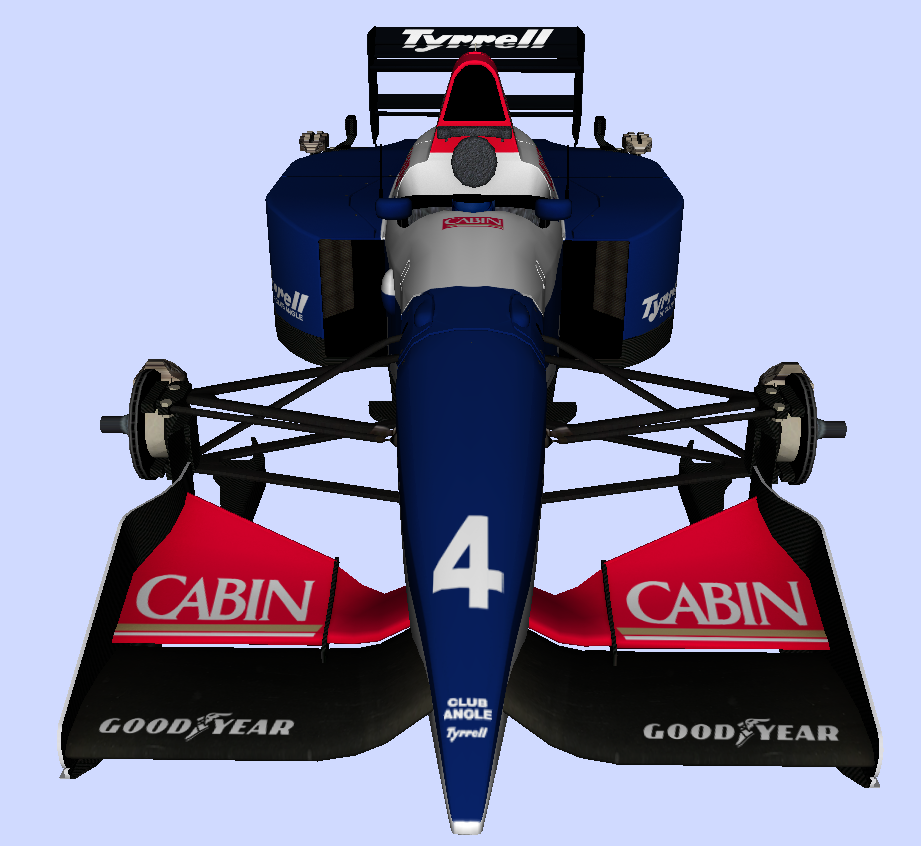
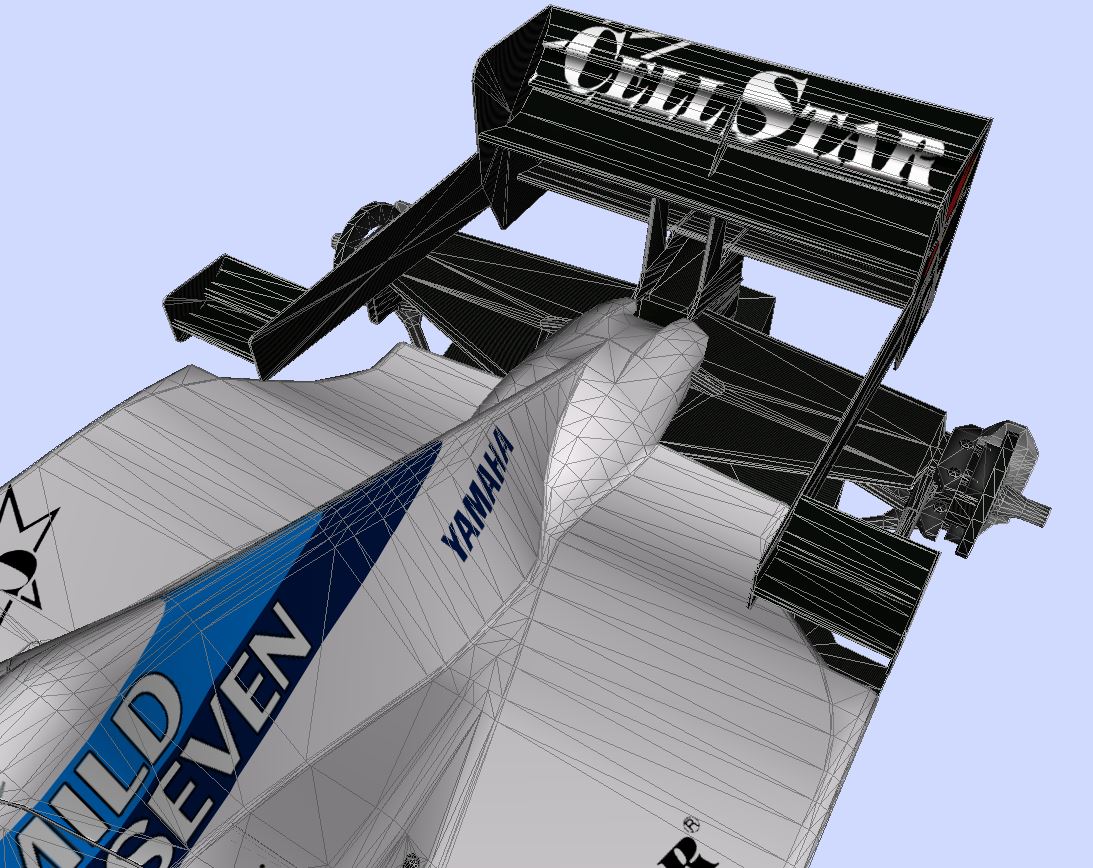
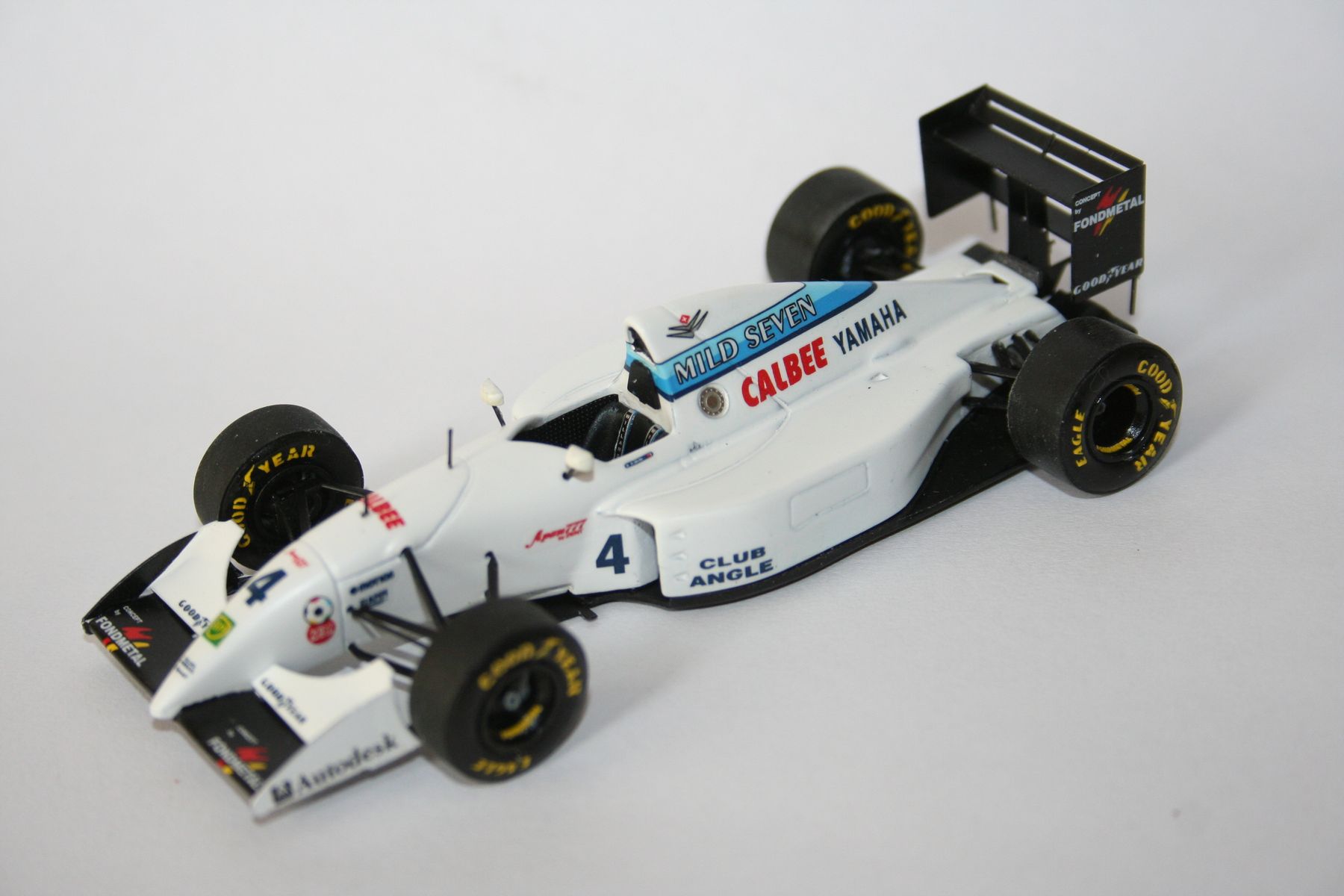
Apologies, no new screenshots, but I have updated the pack to include track specific textures. Though the car appeared at the British GP, it wasn't used in the race, but the textures are there. This includes the non-tabacco version of the Cabin logos, with 'Challenge Spirit' in place of the AB.
In Germany, the Autodesk logo disappears for the rest of the season. I also made the Tyrrell logos on the rear wing a bit smaller to give the impression of a low downforce setup.
The Hungarian GP is the standard livery with Cabin logos, if you wanted to choose one.
The Italian GP is just the Cabin version of the German GP.
At Suzuka, they changed the Tyrrell logos on the sidepod to just a large Club Angle logo. The front wing also sports the Cibie logos.
And finally, the Australian GP version retains the Club Angle logos on the sidepod, but gone are the Cibie logos.
Unfortunately I spotted too late that only Katayama ran Bburago logos on the rear wing, whilst De Cesaris did not, I didn't have the time to remap it and I didn't have space on the main texture to put it. Anyway, all of this blurb is a reminder to me just in case I need to put these textures together again!
Here it is, the 1993 Tyrrell 021 Yamaha, fully painted and optimised for GP4 and available for download.
The car was introduced from the British GP, though only fully used from the German GP and used for the remainder of the season by Ukyo Katayama and Andrea De Cesaris. Unfortunately the car, designed by Mike Coughlan, did not yield any points.
Today I bring an end to a 10 year old project, my 1993 Tyrrell 021 Yamaha. The shape has long been created and has been available as an open source file since, but nobody had taken it up. Well I finally mapped it earlier this year, and I did have a painter lined up, but unfortunately he was busy with other projects, which is fine.
So I decided I would paint it. Having been painting several helmets and also the 2021 Williams, I had much more confidence going back to a mid-90s car. The livery is quite basic, the lines quite simple, and not many logos to search for. I decided to go for brighter colours, as it would have been in real life, but would have come across much duller on TV at the time.
I spent a bit more time on some of the detailing, using a mix of photo samples mixed in with my own painting. The front wing for example has an almost scratched metal texture to the real car, so that's worked into the texture if you looked close enough.
The dashboard was quite fun to recreate, though it was pretty basic compared to some of the cockpits I've been doing for 1994, but the textures help lift the low poly shapes quite nicely. I use an ambient occlusion baked shadows in Blender to create the shapes from the shape direct, and I kept them for the cockpit, so there's a bit more shadow in there than normal, I quite like the effect.
The driver body texture I created from scratch. Renault ran a driver suit competition not so long ago and posted a white template that was perfect for using as a template for my driver. The white stitching is hand drawn, the logos have a slight fabric texture applied over them, and the baked shadows from Blender make it look very realistic, despite my old basic blocky shape, I'm really please with how that's turned out.
I spent a bit of time on the damage model, again I didn't want to spend too much time on it, but there's enough there to make it interesting. Tyrrell ran one spring on the rear suspension tilted up at an angle. They also ran a reflective light metal floor, which I wanted to include, but I couldn't make it too bright as you'd see it from the back of the car.
Much of the modern cars are running matte liveries, so there's not much reflection and shine on them, so it was nice to go back to the 1990s and have a lighter alpha channel to work with. Overall, I'm quite pleased with the overall car. I could have gone back to the shape and made some more amendments but I would most likely have recreated the whole car again, I had to say this is fine as it is.
I think it looks good in GP4, testing it on various tracks with different lighting and reflections. Apologies that I'm running this car in my test setup in GP4, so it's got Katayama driving in De Cesaris' car. Anyway, it's nice to bring the 1993 mod nearer to completion with this car, the download will be available very soon.
I realised that I haven't posted any pictures of the 1993 Tyrrell 021 car since those basic zmodeler shots from 2011. I've dusted it off and mapped it a few months back. Here is the car in GP4, with a plain livery.
I'm quite pleased with how this car holds up, because it was quite a low poly car, so it could have looked a little boxy, but I think it looks good.
Working on this car has given me some motivation to begin work on the 1994 car. Though there are similarities, there's actually very little I can actually recycle from this car.
Here's the car in the middle of the 1994 grid, but a shot from the cockpit. It's not particularly high detailed for modern day standards, but for GP4 external view, I think it looks OK and a good basis for some nice textures to bring it to life a bit more.
Minardi had an all new driver lineup after several drivers were used the previous campaign. Ukyo Katayama joined after 4 years at Tyrrell, bringing Mild Seven sponsorship with him, and reigning F3 champion, Jarno Trulli. When Trulli was promoted to Prost half way through the season, Tarso Marques rejoined the team in the second seat. Though helped on occasion by the better Bridgestone tyre, the underpowered Hart engines meant the the car struggled around the back of the grid.
I personally really liked the 1997 Minardi for some reason, with a slightly refined version of their previous M195/M195B and the addition for yellow in the colour scheme.
Onyx's shape is pretty basic, but I think it's one of their better ones. They produced some nicer 1997 cars in my opinion compared to some of the lows of previous years. Minardi ran a tiny extra flip up on the front wing endplate, which is at least acknowledged with a square bump in this model. The nose is a little bulky and could be better defined, but it includes the wing just in front of the suspension. The sidepod and engine covers have a reasonable enough shape, perhaps a little oversimplified and the rear wing is also nice enough for a budget model. Onyx have generic cockpits and generic dashboards, but they do include a nice bump in front of the cockpit and a nice aerial on the monocoque. Onyx cars are not going to score highly against the likes of Tameo, but for an Onyx car, this really isn't bad at all.
Tameo have recreated the Italian GP version, with it's skinny wings and reduced aerodynamic appendages. Obviously the Tameo model has much more details than the budget diecast version by Onyx, but their attention to detail is second to none and they've really nailed the shape. It would be nice to get a higher downforce version, but I'd be more than happy with this model. Score: 9/10
This part 3 of my walkaround as we begin to look at some of the details of the 1996Tyrrell024 shaped by me, mapped by Soulbringer and painted by Kedy89.
The chassis was quite a reasonable chassis, but the Yamaha engine was under powered and it was not particularly reliable.
Here is a shot of the rear of the cockpit, the side head protection and the rollover bar/engine cover. In terms of modelling, it's one of my favourites in terms of getting the shape and proportions correct, as well as getting flat surfaces merged by smooth curved normals. Essentially, how the light reflects off the body of the car around this region is 'natural'.
Here is a wireframe shot of the front of the sidepods. It's not always the easiest to join the sidepod onto the main body of the car. The top of the sidepod joins to the side of the cockpit and it's not easy to get good looking normals here. Then as the sidepod curves around it joins to the floor at the bottom. You have to watch the curve on the floor is in line with the curve on the top of the sidepod from the top-down view, as the regulations state that from underneath the car, you shouldn't be able to see any bodywork.
Moving to the rear of the sidepods, and there is a small undercut, and a lip on the top. The shape of the top of the sidepod is quite curved, essentially to try and make it as much like a wing as possible. You can see how it is more of a bump than a smooth curve.
Looking from the top down at the rear of the engine cover, you can see the lip and how it works with the winglet. Like the 1995 car, the gearbox housing is quite small, with this bulge at the rear to house it. In terms of managing normals, you have the top of the sidepod, the remains of the side head protection, the rollover bar and the bump all to integrate neatly together. You can see where I've put lots of parallel polies to try and make sure the normals of one part doesn't effect the normals on the others.
From here you can see that the rear suspension also has it's unique coverings, working with the rear of the engine cover to work with the diffuser. It's not new, with the Ligier and Benetton having similar solutions in 1996 and previous years.
The rear of the Tyrrell is quite neat and simple, compared to some of the other 1996 contenders at least. At the time, I always liked the look of the double pylons supporting the upper rear wing.
Looking at the internals of the car, Kedy89 has done a nice job with the textures. I was experimenting with the engine cylinders at the time, of the midfield teams they were all unique, and you can see how bulky the Yamaha ones were. I didn't want to throw too many polygons at it at the time, but if I was to revisit it, I would probably be a bit more generous to make it look a bit smoother.
I didn't want to go overboard with detail at the rear of the car, but enough to make it interesting and the main parts of the rear suspension, the gearbox housing and the engines and radiators being included.
I found a video of a conversion of the car straight into F1C to compare with previous posts.
This part 2 of my walkaround as we begin to look at some of the details of the 1996Tyrrell024 shaped by me, mapped by Soulbringer and painted by Kedy89.
The front wing endplate is quite a standard version on the 1996 grid. The front wing supports are the widest ones on the grid. After pioneering the high nose, the Tyrrell team had returned to a low nose solution for several years, but they developed this nicely sleek nose and monocoque for 1996.
There's a slight bump on the top of the monocoque where the nose cone joins to the main chassis. The team started the season with a normal barge board just in front of the sidepods, but developed a smaller version just behind the front wing to work in conjunction with the upper suspension housing.
Here is a wireframe shot of the front of this car. The underside of the monocoque narrows as it reaches the floor.
Here is a shot of the cockpit from the drivers point of view. Kedy89 has done a nice job with the textures, highlighting some of the 3D details of the cockpit. I wonder why they put the aerial off centre, I don't know if that is more distracting or less distracting than if it was central.
I managed to find this conversion to Automoblista. At least for this one, putting on the early season suspension they amended the textures and removed the shadow. But there are things that you can tell are signs that it's my car with some updates, like my low-poly aerials and mirrors from the cockpit view.
The 1996Tyrrell024 was probably one of my favourite looking cars from 1996. It was a little sad to see so few sponsors on the mostly white car, but I did enjoy the Japanese GP livery in particular with the increased tobacco advertising. It gave me a particular impetus to make this car as nice as I could make it, little did I know at the time that it would be one of my last cars I would create for the 1996 mod.
This car, like the Ligier, was mapped by Soulbringer and painted by Kedy89 and I am truly appreciative that these great artists were able to help out on one of my cars, I'm really pleased with the end result of this car.
Harvey Postlethwaite, the team's head designer, was churning out some interesting designs and ideas for the cash-strapped team, from innovating the high noses in 1990, to swapping the front and rear wheels in Hockenheim practice 1995, to the X-wings in 1997.
The 1995 car had a particularly small rear end, and that concept is further refined in the 1996 car. The sidepod concept had changed from the 1995 car, with the upper element being quite curved, which wasn't easy to get right. Most of the sidepods you see are usually flat rather than slightly tapered, being lower on the outer edges and higher when it meets the engine cover.
One of the stand out things that appeared on the Tyrrell 024 mid-season was the suspension coverings over the top wishbones, both front and rear. The concept remains unique to this car, not being seen on any other car since.
With the car being mostly white in the early part of the season, it was important to make the car as smooth as possible, as any blemishes will show up more obviously. In fact in the shot above, the top of the sidepods just under the winglets show a couple of shadows that are a result of me not quite having the time to fix it. But looking at the smoothness of the engine cover and the side head protection, that's an area that I'm quite pleased with from a normals perspective.
If I remember correctly, the 1993 Tyrrell was already mostly completed by the time I started out on this car, so it was interesting when I got to the internal parts whether there were any transferable parts, mostly using it as a reference for places where I did not have particularly good photos of. In the end, I think the 1997 car was being used in the BOSS series and there were some good shots of the internals from that car, so that was what I used as a reference for this car mainly.
Once again, here is a clip of ta converted version of my car going around Monaco in rFactor 2. What's interesting to me about this conversion is that they put the normal suspension on, but they didn't take away the shadow from the textures.
The Tyrrell024 was designed by Harvey Postlethwaite and retained drivers Ukyo Katayama and Mika Salo. The car was a good improvement on the previous chassis, but the engine was underpowered and unreliable. Mika Salo lead the team with thee points finishes in the early part of the season on the way to earning the team an eighth placed finish in the Constructors' Championship.
Personally, it was one of the nicer shapes and liverys from the 1996 season, though I preferred the end of season livery with increased tobacco livery and Korean Air on the sidepods. It's a shame there isn't that livery version released, but I still like the early season livery.
This model has already featured in the Forti review, but scored low marks because it's nothing like the FG03. But as a Tyrrell as it was originally intended gets a much better score. Generally, a nice shape, although the sidepod is not quite long enough. I'm a little disappointed the by fonts they have chosen for their logos, they're just not quite right.
The Minichamps version is of a better quality, but that's not to knock the improvement from Onyx for their 1996 cars. Their version includes the suspension covers on the front and rear upper wishbones, although by the time they started running them, they had stopped running with the main barge boards. The rims are a nice detail with the four spoke Fondmetal tyres.
This Tameo kit is from the early season Argentine GP.
Tameo TMK217
There is also this version from the German GP. In practice, the team attempted to run four front tyres, presumably to reduce the drag on the long straights on the Old Hockenheim circuit. The car has the aero covers on the front and rear upper suspension arms, unique to Tyrrell's 024 car. This is a brilliant reproduction of the 024. Score: 10/10
This model by BBR is from the opening Brazilian GP. Although it's got nice details, the nose is a bit too long which makes the front wing sit too far forward. The rear wing also sits too low and a little too far back. These two things combined makes the car look worse than it is. Score: 6/10 For more model reviews from the 1996 season, click here: https://fongugp4.blogspot.com/p/1996-model-review.html
The Tyrrell team competed in the 1994 F1 Championship with Ukyo Katayama being joined by Mark Blundell. They were contenders for points finishes, but poor reliability hampered their progress. Katayama was generally the quicker of the two, often qualifying in the top 6, but he retired from 12 of the races, including whilst running third at the German Grand Prix. The highlight came for Mark Blundell when he took an excellent podium finish at the Spanish Grand Prix. This would be Tyrrell's final podium finish.
The Onyx version of the Tyrrell is another instance of Onyx putting the livery on a 1993 car - the McLarenMP4/8. So the less said about this car the better really. Score 2/10
So to the Minichamps car, which at least made an attempt to look like the actual car, but to be honest, this was quite a poor attempt from them. I don't feel it really captures the essence of the car at all. Score 5/10
In recent years, Minichamps updated their model with new tyres and driver body and decals and released it in this limited edition tall box, but it's still the same old disappointing original shape, so I'm not tempted in the slightest with this one. Score 5/10
This is the first of the Spark models released for the 1994 season and I think there are very nice details on this car. However, those jumbo tyres don't do it any favours, and I think the engine cover is too small vertically, and the helmet also looks tiny. It's a shame the proportions are so out, because this is a step up in quality from the Onyx and Minichamps offerings. Score 6/10
There is a limited Japanese edition (for Racing On magazine) where the car was updated to the Japanese Grand Prix, and the updates look lovely, onboard cameras included. They've made some sort of a quick attempt at the diffuser from the late season, but they could have done a much, much better in all honesty.
Score 7/10
There's an even rarer version from the Monaco Grand Prix knocking around as well that has lovely high downforce front and rear wings.
The BBR version in the picture above is from the San Marino GP. Maybe its the angle of the photo, but the cockpit seems too far forward, which makes the nose section seem squished and the sidepods/engine cover section seem elongated. Score 6/10
In conclusion, I'm not particularly happy with any of them, I don't think they really capture the essence of the car, the Tameo kit probably being the best of them. The nose is very narrow at the tip, which is always difficult to do in 1/43 scale. They also ran quite a few variations of rear wing throughout the season.
Towards the end of my time in GP4 around 2011, I offered to produce a car for the 1993 mod. The Tyrrell021 only appeared from the middle of the season and, for me at least, was one of the nicer looking cars from that season. It was driven by Ukyo Katayama and Andrea De Cesaris.
For me this was the most detailed model I created at the time, with the 1993 mod pushing the levels of details on cars up another level for GP4. The basic shape was quite straight forward, but I used all my knowledge on smooth normals and efficient polygon usage to good use.
The problem was that there were simply not many photos of the car at all. These days, you can find a fairly good photo set if you spend the time to look hard enough, with cars in museums and others being refurbished by their owners. So you had to get creative on some parts of the car, and others I had to glean from the early season 020 and the 1994 season's 022.
I also went up a notch on the level of detail, some ideas and parts cross-overed into my 1996 cars at the time. I was new to 3D body lines, new brakepads, suspension/wheel hub detail and cockpit detail seen here below.
I also did some work on the radiators, engine, gearbox and rear suspension areas.
You can download a preview of this car (in zmodeler 1 format) in this pack which has some of my other WIP cars in as well: fongu's-farewell
Now that I am a bit more active, I may map this car properly and get this car finished and released for GP4.