Showing posts with label Jordan 196. Show all posts

Friday, 19 April 2019

GP4: 1996 Jordan 196 walkaround part 3

This is part 3 of my walkaround of my 1996 Jordan 196.


Moving onto the 2nd part of the sidepods, you can see the body line nicely. There is a slight undercut at the bottom of the rear of the sidepod, and with the vent there, it was not the easiest to get right.


The rear of the bodywork has this complex circle for the rear suspension mounts. The bottom part completes the coke bottle and is quite wide, but the upper part of the circle is quite narrow. It's always difficult to get this curve looking smooth from every angle.


You can see some of the detail I added to the rear wing endplates with the indent near the trailing edge. In the pre-season testing, the team didn't initially run with rear wheel winglets, so the endplate was much shorter, and you can see from the wireframe how the winglet is an additional extra.
The rear suspension is probably one of the first cars where I managed to get it as accurate as possible. With the wireframe, you can also see the vane that rises from the floor. At the time, there were a few photos of the inside of the 196, but there were better photos of the 197, which I used as inspiration for parts of the insides of my 196.


On the engine cover you can see where all the body lines meet without disrupting the smooth normals of the rest of the shape. There is also a small triangular vent under the Peugeot logo.


As mentioned in my other walkarounds, there were some interesting developments on the diffusers and I think Jordan's was the most complex and interesting. The main central section is curved, with the lower part of it narrower as we see on other cars. But there are many slits on the top edge of the central diffuser, this helps maintain the boundary layer and reduce the likelihood of stalling. The rest of the diffuser is lower in the central parts for the exhaust, which is a squat oval shape. The rest of the diffuser is then angled with a gurney flap on top.

You can see I modelled some of the rear suspension mounting points as well in more detail than I remember.


Whoever mapped the GP4 car and put it back together again has merged a lot of parts together I had initially intended to keep separate. So if you go and crash this car, not much falls off and you can't see much of the detail I put on the inside of the car. Here, you can see the curved rear bodywork and how it exposes the gearbox.


You can see how the sidepods channeled air towards the engine. By this stage, I had made individual cylinders on the engine myself. In terms of internals of a car, this car is probably one of my favourites, so I was a little disappointed that you can't appreciate that on the final car. However, I'm still grateful for all the contributors for making this car and its variants, it could still be sat on my hard drive unfinished.

All in all, this remains one of the best cars I've created and I think the end result is pretty good. If I was really picky, I'd say the rear wing could move rearwards a touch, but that is only minor. Here's some shots of the car in GP4.


You can download this car for GP4 as part of the 1996 mod.

Thursday, 18 April 2019

GP4: 1996 Jordan 196 walkaround part 2

Welcome back for part 2 of my 1996 Jordan 196 walkaround. There's quite a few screenshots to feature that I'd like to talk apart so there are 3 parts in total, but let's get into the detail now starting at the front of the car.


The nose and monocoque section has a nice flat side and then a smooth rounded top and bottom. So you can see how I tried to be efficient on polygon use on the flat regions compared to the curved ones which has lots more polygons. The front wing endplate has the small lip that comes out at the front bottom, and then it creates a little bit of an outwash, with the rounded bottom at the rear producing a vortices.

The lower front wing, like most of the grid, curves up on the leading edge in the middle of the car, whilst the trailing edge is flat. Like modern day cars, the upper front wing is separated from the central section to the main part. The front wing support is an interesting shape, because it doesn't really follow the contours of the nose (have a look at the front view in my previous blog) where the lower back part extends wider than any other part of the support. It took a few goes for me to get that right from various angles.


Not that you can tell as it's all black, but the suspension has a bit of detail added to the shape when it connects to the monocoque. The small barge-board also has 3D holes for the suspension to go through.


Again, hard to see when it is all black, but for me it's a first in modelling my first wheel hub and brake ducts.


The first sidepod inlet is an interesting shape. Like the 1995 car, the top part is smoothly merged to the car in a lovely rounded shape around the front of the cockpit. The lower part is attached to the tea-tray element of the floor. Because of the stepped floor to house the plank, the sidepod sits a little higher up than the floor. Again it wasn't easy getting the shape right for the top of the first part of the sidepod, it almost has two separate curves. I'm really pleased with the outcome though, and also the inlet for the second rear sidepod was not easy to get right, especially as it is slightly raised.

The hardest part to model of all was the body line that runs along the side of the cockpit. Not only are the lines curved, but the bodyline itself is on a curved part of the car. Though I'm happy with the positioning, I'm not all too happy with how it turned out compared to the other bodylines. Though I'm glad they are there rather than not there too.


Again, thankfully there were some good shots of the cockpit that I could find and try and get as accurate as possible. My only regrets is that none of the textures have put any effort into lighting up the dash, but at least the 3D rev lights are lit up.


Having shown the video of the converted rfactor 2 car, this is a video the car in Assetto Corsa.

Wednesday, 17 April 2019

GP4: 1996 Jordan 196 walkaround part 1

Next up in my walkaround series is the 1996 Jordan 196 Peugeot, which is one of my all time favourite cars. It's a very clean shape and has a bold gold livery (though my screenshots has the more mustard colour from the early season). Does anyone remember the pre-season testing livery with the green and white? I thought it looked good in that too. Anyway, as we get into some of the detail, there are lots of places of interest too.

As usual, you can read my model blog for comparison: Model Review. I wasn't particularly happy with any of the Jordan models, and that's because I spent a long time working on my own version, albeit in 3D.


I'm not sure who mapped the car, but Celinho did the original livery, and Quickslick and Kedy provided season specific updates I believe. There are a few little mapping issues, but overall I think we did the car justice, so thank you to all who contributed on this one.


Again, I post my plan views before going into the 3D views. Before I started creating cars for 1996, I actually did not use pictures as blueprints, preferring to do things by eye. However I had converted to starting shapes with pictures, but you have to be careful with perspective and if the shot is not quite straight, you may have to tweak the photos before you use them as a blueprint. I have, in the past, merged various photos together, so maybe a side shot without the wheel on. Anyway the reason I used them was to give an additional reference that my proportions were good in as many angles as possible.

This Jordan was the first car where I went all out on detail, both on outside the car and inside the car. As I came back to do this blog, I surprised myself with how much detail I went into in parts, so I can't wait to show you some of that. 

The car has a William-esque nose and monocoque section, very slim and nicely moulded. The continued with a Ferrari 640/61 style sidepod which they adopted for the 1995 car. They added a second inlet in a more conventional position. How this all smoothly integrates with the rest of the car is very beautifully done. Like Williams, they had a very low side-head protection, a new regulation for the year, and teams that had high ones were stuck with it for the season.


Moving towards the rear of the car and there is the rear sidepod cooling vane, which I think I created a cover for as an alternative at different GPs. Like most teams, the endplates extend past the rear wheels to a winglet just in front of the rear wheels, and again I quite like the curves that make it a bit more beautiful. Underneath that winglet, there is a large black vane emanating from the floor. McLaren had a small one on the MP4/9, but it's a solution that comes and goes, with them being a bit more popular in the mid-2000s. The central diffuser part is fascinating, but we'll get into that later on. They sometimes ran an extra third element on their lower rear wing, it wasn't there for all races.

As usual, the walkarounds are split into parts, parts 2 and 3 coming soon. Here is my car in rfactor 2 in the meantime.


Monday, 18 March 2019

1/43 Model Review: 1996 Jordan 196 Peugeot

Background

Barrichello in his fourth year with the team was joined by Martin Brundle in what turned out to be his final season in F1. The Jordan 196 car sported a now common high nose cone for the first time, sporting unique double radiator inlets and low side cockpit head protection, whilst it enjoyed its second year of Peugeot works engines. After testing in a green, white and red livery, the team secured B&H backing turning the cars, initially a yellowy gold, before refining to a distinctive gold. Brundle spectacularly barrel-rolled at the first Grand Prix in Australia and was able to walk away and take the restart. But the season was not Jordan's most competitive with no podium finishes, but it did finish 5th in the Constructors' Championship with 22 points.

Minichamps 

Minichamps 430960011
Minichamps 430960012
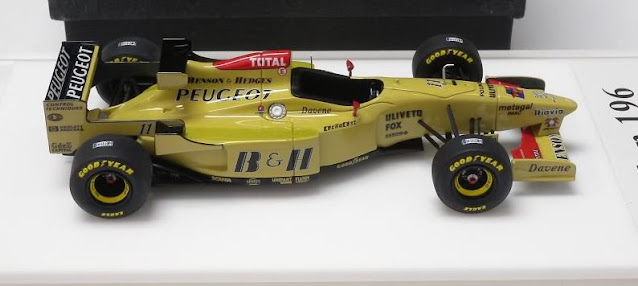
I quite like Barrichello and Brundle as drivers, and couldn't resist getting both versions of the car. The livery is distinctly from the British GP, with a combination of the drivers' names and 'Special F1' replacing the tobacco logos. Whilst most of the bodylines are there, they didn't include the bodyline that runs over the top of the front half of the sidepod around the side of the cockpit.
Score: 7/10

Minichamps 402109596
The Jordan model was updated slightly for the 10 year anniversary of Jordan twin set collection. The gold was made a bit lighter, I personally preferred the original colour. I like the updated rear wing - winglet, but much of the rest of the model is the same as the original. To me, there's not enough of an improvement to gain any extra points in my score.
Score: 7/10

Ixo (Eaglemoss)


In Brazil, you could get this Ixo version with early season colours of Barrichello's car. The front sidepod opening isn't great, but the rest of the car is quite nicely done. They could have painted the bargeboard around the front suspension. Nevertheless, it wouldn't be a bad car to add to the collection as an early season version next to the Minichamps cars. I was tempted to give it the same score as the Minichamps car, but I had to mark it down for the reasons above.
Score: 6/10

Tameo

Tameo TMK212

Tameo have produced some excellent models for the 1996 grid, but for me, this one is a disappointment. The B&H logos are particularly bad. The front sidepod inlet is too straight and there's no actual opening. The top of the nose doesn't look right to me either. I like the inclusion of the turning vane just in front of the rear wheels. This version is from the Australian GP.


Tameo TMK213

We do get an early season version from Tameo, this one from the Argentine GP which includes the mid-wing and the more mustard coloured gold.

Tameo TMK224
We also get a German GP version of the Jordan with amended gold livery. The Peugeot decal on the engine cover is too bold for me.
Combining the models together, I gave it the same score as the Minichamps car, because despite my misgivings over the overall shape, the details bump up the score back up, with the pitot tubes, in-cockpit detail, fuel caps, suspension detail, and nicely modeled rear wings.
Score: 7/10

BBR

BBR BG96
BBR's version also comes from the Australian GP. I was disappointed by the Tameo offering, and to me the BBR version is worse. That rear wing is huge, and the nose/monocoque is too low. Again, you get nice additional details over the Minichamps and Ixo offerings, so that bumps the score up from a 5 to a 6.
Score: 6/10

To read more reviews from the 1996 season, click here: https://fongugp4.blogspot.com/p/1996-model-review.html