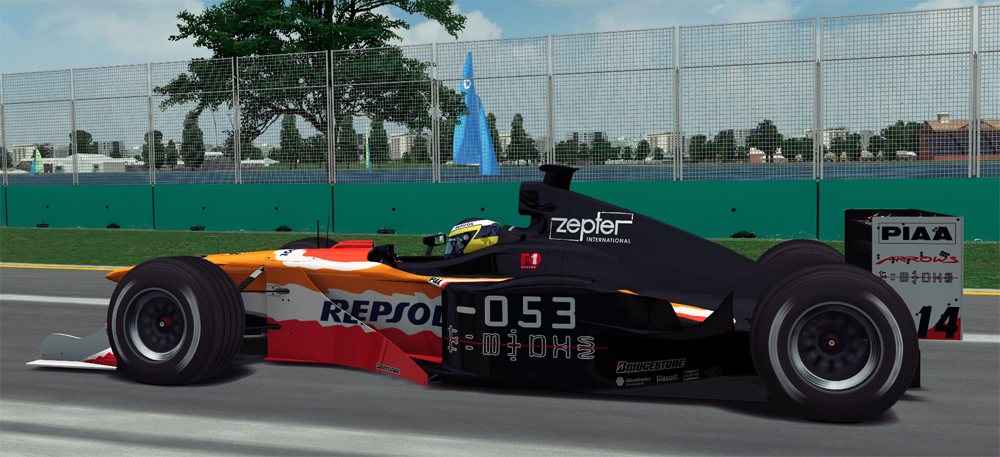
Here is the 1999 Arrows A20 as driven by Tora Takagi and Pedro de la Rosa.
This car is by Hega, with help on the car model by me, logos and reference photos provided by Quickslick, and some objects from Soulbringer's A19 model.
This car comes with 6 difference shape variants as well as a full season's worth of textures.
This is the car that appears in the GPedia videos with Mark Hemsworth
So what about the positives. It scored a point, back in the day when points were only awarded to the six. Admittedly, it was at the first race.
It was based on the beautiful A19, designed originally by John Barnard and Mike Coughlan, but the former star designed had since left and Coughlan and Eghbal Hamidy were tasked to develop the car with minimal funding.
It had in-house built engines, kind of. Tom Walkinshaw had injected funds into Brian Hart's engine company, but an ownership dispute ensued and Hart departed from the project.
Though both drivers were 'pay-drivers', de la Rosa would go on to prove to be a talented racer, and he is also the one responsible for bringing Repsol as a sponsor to the team. This resulted in the first orange Arrows of that short era, the front half of the car decked in Repsol colours.
As mentioned earlier, with investments from a Nigerian prince, the building blocks for a good little team was brought together. But sadly, with the funds not arriving, the departures of Hart and Barnard, meant the team were underfunded and underpowered.
Still, despite being such a slow car, it did beat BAR in the Constructors' Championship.
Around this time, 2 seater cars were kind of a thing, with Arrows building a 2-seateer and also the Arrows AX3 (3-seater car) was based on this A20.
On my side, I really enjoyed working on this car, I think it's quite a nice shape, and the sidepods are quite unique and a different challenge to making other cars.
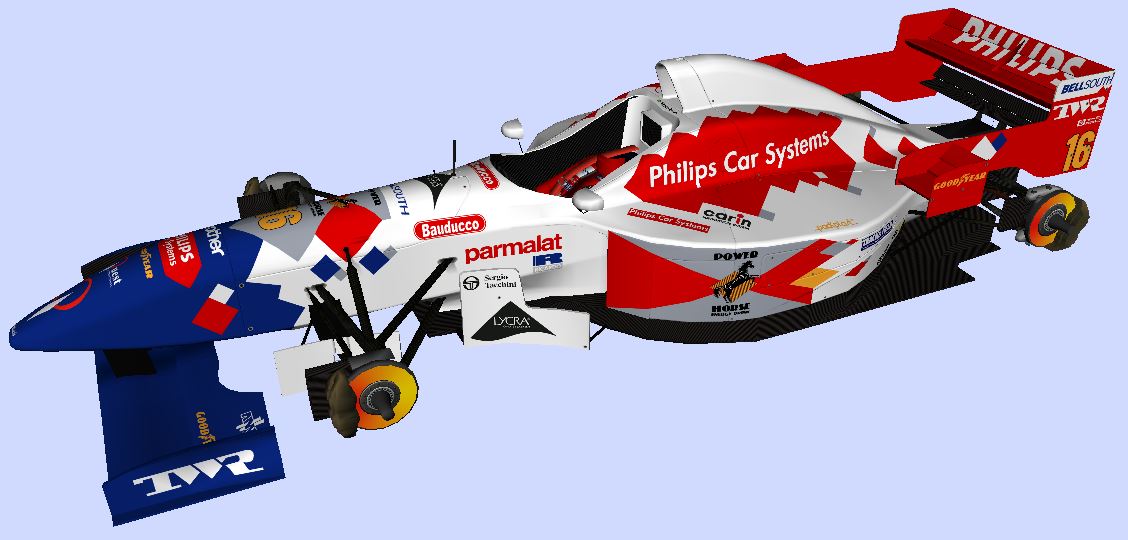
This is part 3 of my walkaround, as we begin to look at some of the details of this 1996 Footwork Arrows FA17 shaped by me, with Soulbringer, Kedy89 and AUS_Doug all helping to compelte this car. This car forms part of the 1996 mod for GP4, and has subsequently been converted to other games such as rFactor 2 and Assetto Corsa.
Footwork ran quite a rounded sidepod. Look at the bottom of the sidepod inlet, how it is rounded to let the air under the sidepod. The gradient then becomes more square as you get the join with the floor at the rear, and again I wanted to merge the sidepod smoothly with the floor which a nicely rounded. The sidepods show an undercut or sorts. The top of the sidepod shape was not flat, infact the contours at the bottom of the cockpit side protection and the top of the sidepod are not the same. So the top the sidepod has a different cross section as you progress from the front to the rear. This wasn't easy to get right and also to get the normals to look natural here was tricky too.
As mentioned previously, I'm happy with how the rollover hoop merges smoothly onto the engine cover section, again this was an area I wanted to perfect in my modelling. The rear wing is quite standard, with Footwork being one of very few teams to colour the inside of the rear wing endplates.
Here's a wireframe shot of the rear of the car, just to show some of the contours and details of the rear that would otherwise be missed. Again there weren't too many shots of this area of the car, but I like how it turned out. There was a big fat exhaust at the back, but there's no fancy blown diffuser on this car. You can see how the sidepod cooling outlet at the top separates that flow from the exhaust. The diffuser is nothing special again other than the kink along the top of the central section.
Finally, here's a quick view of the internals of the car. I wanted to get some of the larger parts of the pipes and other larger details in there to give some interest, some of this more close to the 1997 car which I could find some internal photos of.
Well that's it for the Footwork FA17 walkaround, and indeed the 1996 walkaround of my cars. I hope you guys enjoyed it, look out for more insights into my more recent work.
This is part 2 of my walkaround, as we begin to look at some of the details of this 1996 Footwork Arrows FA17 shaped by me, with Soulbringer, Kedy89 and AUS_Doug all helping to compelte this car. This car forms part of the 1996 mod for GP4, and has subsequently been converted to other games such as rFactor 2 and Assetto Corsa.
Footwork ran quite a bulky nose cone and monocoque section. The front wing supports are slightly angled back, and the front wing endplates are looking to generate an outwash effect, whilst most the other teams were looking to direct the air towards the inside of the front tyre.
Footwork also ran a small barge board in the front suspension, looking to stop any turbulent air from the front wheels from disrupting the flow under the nose. I've shown the wireframe in the shot above, again you can see how I put lots of rows of polygons to get the right normals. You can see the body lines too have lots of rows of polygons too. The top of the cockpit, above the driver's legs, is almost indented.
The main barge board is quite small in comparison, very similar to the one it ran the previous year. Behind that and Footwork are trying to maximise the undercut at the bottom of the cockpit section, an Adrian Newey concept from his March days.
I was in the routine to creating unique cockpit dashboards at that time, though this was quite primitive back then. I'm glad that Kedy has brought some colour to the buttons. You can see the odd indent on the top of the cockpit clearer from this angle, presumably encouraging the air downwards towards the sidepods and under the car.
Footwork also ran remarkably high cockpit side protection. These were not always easy to get right, but I enjoyed getting this to look smooth and seamless and the reflections look good off it too. The head rest behind the driver, usually I wouldn't join it to the main shape, but here I went the extra mile and blended it in. I've also included the hole on the top of the rollover bar, this was for the cranes to wrap around the rollover bar so that it could be easily craned away.
This Footwork Arrows car would be my final contribution to the 1996 mod and in theory the shape that bests represents my modelling techniques that I have picked up along the way at that time. Credits go to Soulbringer for mapping, Kedy89 for the textures and I believe AUS_Doug was involved with the shadows.
I was really pleased with how this car turned out, on the shape side on my part, and also on the rest of the work to bring it to completion, the early season Footwork livery being my preferred livery before TWR brought Power Horse sponsorship with him and a new livery for the car.
I'd learnt by now how to proportion the car, making sure the dimensions match the other 1996 cars in terms of width and height in particular. A bug bear of mine from the early days when multiple car shapers were active, there was not much consistency in that regard, so I wanted to make sure that for the 1996 cars they were consistent throughout.
There weren't, at that time, many good photographs of the rear and the internals, so there was a bit of artistic license employed if I remember correctly. I really wanted to make this car as smooth as possible, and I was perfecting my normals management, that's probably most evident where the rollover bar attaches to the side head protection/engine cover.
It's been a long time since I wrote one of these, but this is the final one of my cars from 1996, so I look forward to enjoying the detail with you over the next couple of blog posts.
In the meantime, here's a video of a converted version of the car in rFactor2.
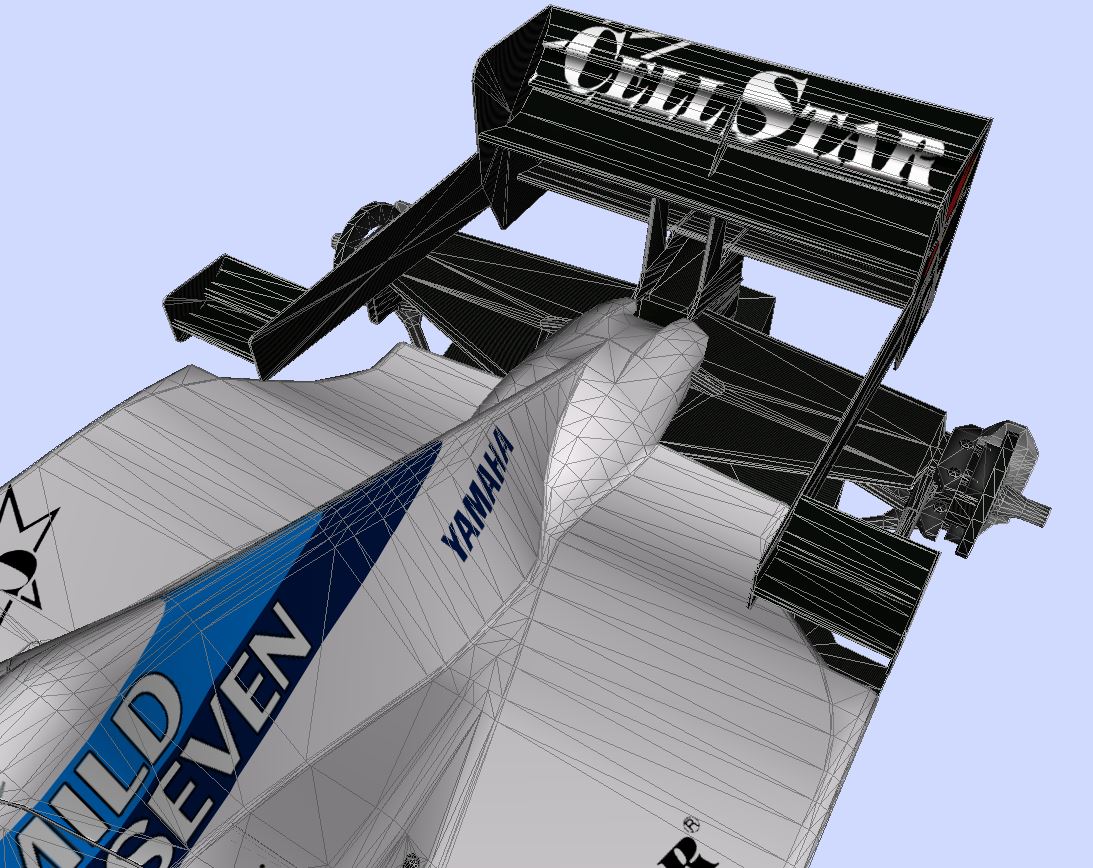
This part 3 of my walkaround as we begin to look at some of the details of the 1996Tyrrell024 shaped by me, mapped by Soulbringer and painted by Kedy89.
The chassis was quite a reasonable chassis, but the Yamaha engine was under powered and it was not particularly reliable.
Here is a shot of the rear of the cockpit, the side head protection and the rollover bar/engine cover. In terms of modelling, it's one of my favourites in terms of getting the shape and proportions correct, as well as getting flat surfaces merged by smooth curved normals. Essentially, how the light reflects off the body of the car around this region is 'natural'.
Here is a wireframe shot of the front of the sidepods. It's not always the easiest to join the sidepod onto the main body of the car. The top of the sidepod joins to the side of the cockpit and it's not easy to get good looking normals here. Then as the sidepod curves around it joins to the floor at the bottom. You have to watch the curve on the floor is in line with the curve on the top of the sidepod from the top-down view, as the regulations state that from underneath the car, you shouldn't be able to see any bodywork.
Moving to the rear of the sidepods, and there is a small undercut, and a lip on the top. The shape of the top of the sidepod is quite curved, essentially to try and make it as much like a wing as possible. You can see how it is more of a bump than a smooth curve.
Looking from the top down at the rear of the engine cover, you can see the lip and how it works with the winglet. Like the 1995 car, the gearbox housing is quite small, with this bulge at the rear to house it. In terms of managing normals, you have the top of the sidepod, the remains of the side head protection, the rollover bar and the bump all to integrate neatly together. You can see where I've put lots of parallel polies to try and make sure the normals of one part doesn't effect the normals on the others.
From here you can see that the rear suspension also has it's unique coverings, working with the rear of the engine cover to work with the diffuser. It's not new, with the Ligier and Benetton having similar solutions in 1996 and previous years.
The rear of the Tyrrell is quite neat and simple, compared to some of the other 1996 contenders at least. At the time, I always liked the look of the double pylons supporting the upper rear wing.
Looking at the internals of the car, Kedy89 has done a nice job with the textures. I was experimenting with the engine cylinders at the time, of the midfield teams they were all unique, and you can see how bulky the Yamaha ones were. I didn't want to throw too many polygons at it at the time, but if I was to revisit it, I would probably be a bit more generous to make it look a bit smoother.
I didn't want to go overboard with detail at the rear of the car, but enough to make it interesting and the main parts of the rear suspension, the gearbox housing and the engines and radiators being included.
I found a video of a conversion of the car straight into F1C to compare with previous posts.
This part 2 of my walkaround as we begin to look at some of the details of the 1996Tyrrell024 shaped by me, mapped by Soulbringer and painted by Kedy89.
The front wing endplate is quite a standard version on the 1996 grid. The front wing supports are the widest ones on the grid. After pioneering the high nose, the Tyrrell team had returned to a low nose solution for several years, but they developed this nicely sleek nose and monocoque for 1996.
There's a slight bump on the top of the monocoque where the nose cone joins to the main chassis. The team started the season with a normal barge board just in front of the sidepods, but developed a smaller version just behind the front wing to work in conjunction with the upper suspension housing.
Here is a wireframe shot of the front of this car. The underside of the monocoque narrows as it reaches the floor.
Here is a shot of the cockpit from the drivers point of view. Kedy89 has done a nice job with the textures, highlighting some of the 3D details of the cockpit. I wonder why they put the aerial off centre, I don't know if that is more distracting or less distracting than if it was central.
I managed to find this conversion to Automoblista. At least for this one, putting on the early season suspension they amended the textures and removed the shadow. But there are things that you can tell are signs that it's my car with some updates, like my low-poly aerials and mirrors from the cockpit view.
The 1996Tyrrell024 was probably one of my favourite looking cars from 1996. It was a little sad to see so few sponsors on the mostly white car, but I did enjoy the Japanese GP livery in particular with the increased tobacco advertising. It gave me a particular impetus to make this car as nice as I could make it, little did I know at the time that it would be one of my last cars I would create for the 1996 mod.
This car, like the Ligier, was mapped by Soulbringer and painted by Kedy89 and I am truly appreciative that these great artists were able to help out on one of my cars, I'm really pleased with the end result of this car.
Harvey Postlethwaite, the team's head designer, was churning out some interesting designs and ideas for the cash-strapped team, from innovating the high noses in 1990, to swapping the front and rear wheels in Hockenheim practice 1995, to the X-wings in 1997.
The 1995 car had a particularly small rear end, and that concept is further refined in the 1996 car. The sidepod concept had changed from the 1995 car, with the upper element being quite curved, which wasn't easy to get right. Most of the sidepods you see are usually flat rather than slightly tapered, being lower on the outer edges and higher when it meets the engine cover.
One of the stand out things that appeared on the Tyrrell 024 mid-season was the suspension coverings over the top wishbones, both front and rear. The concept remains unique to this car, not being seen on any other car since.
With the car being mostly white in the early part of the season, it was important to make the car as smooth as possible, as any blemishes will show up more obviously. In fact in the shot above, the top of the sidepods just under the winglets show a couple of shadows that are a result of me not quite having the time to fix it. But looking at the smoothness of the engine cover and the side head protection, that's an area that I'm quite pleased with from a normals perspective.
If I remember correctly, the 1993 Tyrrell was already mostly completed by the time I started out on this car, so it was interesting when I got to the internal parts whether there were any transferable parts, mostly using it as a reference for places where I did not have particularly good photos of. In the end, I think the 1997 car was being used in the BOSS series and there were some good shots of the internals from that car, so that was what I used as a reference for this car mainly.
Once again, here is a clip of ta converted version of my car going around Monaco in rFactor 2. What's interesting to me about this conversion is that they put the normal suspension on, but they didn't take away the shadow from the textures.
Welcome back to the third installment of the LigierJS43 walkaround, a car I made for the 1996 mod for GP4 with the help of Oggo, Soulbringer and Kedy89. The car won one race incredibly at Monaco, though there were only 4 classified finishers in a bonkers wet race which you can see highlights of below.
Coulthard ran in Schumacher's helmet, it rained, a first corner crash with Verstappen on slicks being the cause, Schumacher crashed into a barrier on lap 1. After 5 laps, only 13 cars remained from the 21 that started. Hill lead and his engine blew up, Alesi lead and he retired. Villeneuve was struggling and crashed into a Forti. Irvine was having all kinds of dramas and took out another two cars when doing a recovery spin when Salo'sTyrrell came around the corner and into the back of him. With four runners left, Frentzen gave up on the penultimate lap and pulled into the pits, leaving only the three cars to actually finish the race - all of them on the podium. Oh if all that would happen in 2019!
Here is a look at the side head protection, and the unique way in which it joins the engine cover. Rather than tapering down, it tapers into the rollover bar, with the fuel cap neatly positioned in there. There is a mini shark-fin at the top, not unique to Ligier.
The front of Ligier's sidepods are very similar to the 1995 car. Notice the floor underneath, where it is higher off the ground at the front half, before it joins with the rest of the floor half way down. The winglets at the rear are a unique take with an additional element half way down the sidepod. The rear wing end plate fence does not extend all the way to the winglet, but enough to cover the rear wheels from the airflow in the middle of the car.
The shape of the sidepods at the rear is different to the 1995 car, with the JS43 extending the top surface to lead the airflow smoothly to the winglets, leading to something of an undercut at the bottom.
The 1995 Ligier and Benetton had an aerofoil cover for the upper suspension elements, with the engine cover going neatly underneath it. The concept is largely kept by Ligier, and is also developed on the Benetton B196. The bulges at the centre of the car are always tricky to get right and integrate with the rest of the engine cover whilst keeping normals smooth.
Here is a wireframe shot of the rear of the car. It's got an interesting diffuser, with multiple vanes on the outer diffuser, but the central part has a deep undercut and the top element is split into a number of elements. For me, these things and the rear wing support which integrates the rear jack hold is always fun to model.
Coming to the insides of the car, all the parts, bar the engine itself is unique to this car. Even the cylinders are unique to the Mugen-Honda V10. You can see the rear suspension covers clearly. Kedy89 has done a great job with the textures - not overdoing it, not making it too bright.
The radiators are asymmetric, and you can see a small radiator on the left side hidden under the raised sidepods. I like modelling the insides, but its easy to over do it on the detail, so the idea was to put the main parts in, keep it low-poly, so that you get an idea of what's there rather than focussing a lot of effort into creating something nobody sees or has time to inspect in-game. If you look carefully, you'll see the exhaust is in the central section of the diffuser, looking to exploit gains from an exhaust-blown-diffuser, which has its roots from the B194.
I hope you enjoyed this walkaround. The Ligier didn't really excite me when I came to making it, but having spent time looking at it and remodelling it, I've come to appreciate some of the nice details that has gone into it, and I hope that's come across in these blog posts.
This is the second post on the 1996LigierJS43 made for GP4, shaped primarily by me, with help from great modders Oggo, Soulbringer & Kedy89. The car is available in the 1996 mod which you can download for GP4 in my downloads section. You can also find it converted in many other games.
As mentioned in my last post, the lovely nose is made by Oggo for the BenettonB196, which is perfect for the LigierJS43, both based on the same original design. The front wing itself is pretty basic, where the outer parts of the main plane are lower than the central section. So there's nothing out of the ordinary from this shot.
As we look from behind the front wing, you can see that there are two vanes underneath the front wing and there is a vortex generator at the rear of the front wing endplate.
There are a number of bumps present on the monocoque of the Ligier, which are different from the Benetton car, and the front suspension is unique to Ligier.
As we move towards the cockpit, I wanted to show the wireframe so that you can see where the curves on the car are and where the detail has been put in. The section around the fuel cap was probably the most difficult to get right for me, as addition of the side head protection led to a few different solutions with what to do behind it for aero benefit, Ligier's perhaps not being particularly smooth.
Again I kept the wireframe on for this view of the sidepods. Like its predecessor, and the Benetton B194 it features a slightly raised sidepod, or perhaps it is lowered in the central section, which is a concept that McLaren took to an extreme in 2011. From a modelling perspective, you can see the direction of the polygons that help ensure the curved shape and smooth normals.
Having a look at the cockpit and it's great the Kedy89 was able to put some great detail onto the shape.