I'm please to share with you another season package of the 1995 Ligier JS41. Once more, this was created in partnership with David Marques, and will be released on both GP4 and Formula 1 Challenge 99-02. As with my other recent releases, this car also comes with a full seasons worth of liveries and body shape changes.
The 1995 Ligier was driven by Oliver Panis in one seat, and then Aguri Suzuki and Martin Brundle shared the other seat. At the start of the season, Flavio Briatore and Tom Walkinshaw (both at Benetton at the time) owned the Ligier team, with the former taking the Renault engine deal with him to the Benetton team. During the season, Flavio sold his shares to TWR. The team would eventually finish the season in fifth place, with Brundle scoring an excellent podium finish at a rain soaked Belgian GP, and Panis went one better at the season finale in Australia, albeit two laps down where only eight cars were still running at the end.
In many ways, this is a 1995 Benetton chassis. Whilst Ligier did receive some of the Benetton updates, the French outfit also took its own independent development path. There are differences on the top of the monocoque in terms of the various bulges that are unique to each car, and the top of the rollover hoop is more acute on the Ligier. Ligier start out the season with a sidepod very similar to the 1994 Benetton, in fact, that's exactly where I took it from. Ligier did take on the rear wing endplate double winglet arrangement that Benetton did, but then developed its own winglet system mid-season. They also went their own way for the front wing. Both the winglets and front-wing developments were taken from my 1996 Ligier. There are also low downforce variants for this car too. Thanks to David Marques for making the unique Ligier dashboard object that differs from the Benetton one. So this car isn't simply just taking a Benetton and painting it blue, but at the same time, I appreciate it did not take too long to make the changes.
I'm very grateful for the excellent paint work completed by David Marques. I'm also grateful for Quickslick for some logo help and testing too.
I proudly present to you my 1994 McLaren MP4/9. If you've been around this blog for a while, you'll know this is one of the first cars I blogged about. I talk about the car shape and features in my MP4/9 Walkaround back in January 2019. I also did a summary of the season as part of the Model review & season overview. It was my second carshape since my return to GP4, but this is the fourth 1994 car to be completed. I was inspired by my visit to the Donington museum just before it was closed where I was able to get a good number of detail photographs that helped me massively make this car as accurate as I could, whilst taking care of the polygon count.
As the car was mapped and sitting around on my hard drive for a while I decided to release the car ready to paint. As no one else had the time to do it, I picked it up back in the beginning of 2021, but I got caught up producing lots of content that this project once again gathered dust. But now that the 2021 creation draws to an end, I was able to come back to this car and bring it to completion.
If you look at my 1994 Williams, you'll see I have included a lot of textures for my swatches, but for my 2021 cars, I decided to bring them all into a second texture, and I've done the same for the McLaren. Thankfully the car didn't see many visible updates throughout the season, just different rear wing configurations. Also the livery and logo placements remained largely unchanged, so making track specific versions shouldn't be too difficult. I hope to do that in the near future.
My plan is to make hay during the F1 off-season to do some more work on 1994 related content. I hope to have something to show you and share with you soon.
Today, I release just
the shape with the wireframe and zmodeler file ready for someone to paint. Once
painted, I can create the second car ready for its proper release. The mapping
of the first texture is loosely based around the textures of McKey and Oggo’s
early season MP4/9.
As with the 1995 Ferrari released yesterday, please report any bugs, and car 2 will be mapped after painting.
Enjoy painting this car.
EDIT: Eventually, I found some time to finish this car and it's available here
I bought a Heritage RacingMcLarenMP4/9 this week and I was pleased when I received it that the car was of a better quality than I expected (I suppose I wasn't expecting much). Having assumed that it was one of the better Onyx cars of the time, I realised after looking at it in a bit more detail that this is infact a Minichamps car in an Onyx style box. I suppose that is why there is no serial number visible. And so I've snapped up a bargain, as the Minichamps version of this car usually fetches a bit more than I paid for this one. The only problem is that the car does not sit very tightly on the base and does move very easily.
But I thought I would post a few more pictures of the car from a few more angles than usual.
You can really see how sleek and slender this car is with its minimal sidepods, angled like a dart perhaps a bit like the 1983 Brabham BT51.
The Onyx cars would usually have a single axle between the two front wheels, but Minichamps have found a way to do realistic suspension, with all elements attached to the main monocoque. The front wing includes the early season extensions that go behind the front wheel. These were banned mid-season as one of the measures to reduce speeds. Minichamps also use brown for their visors, where as Onyx tend to use a grey. Minichamps have also made the sidepod and airbox openings as actual holes in the car, whereas on Onyx cars of that time had stickers for the airbox.
You can see the front suspension more clearly in the overhead shot, and also the shape of the sidepods is nicely done. They have even modelled the small inlet just in front of the rear wing.
Minichamps also did some good bodylines, with the chassis having indents for the engine and suspension covers. There's also nice detail around the front of the cockpit, which is slightly more raised than the side of the driver's helmet.
This is part 3 of my walkaround of my 1996Jordan196.
Moving onto the 2nd part of the sidepods, you can see the body line nicely. There is a slight undercut at the bottom of the rear of the sidepod, and with the vent there, it was not the easiest to get right.
The rear of the bodywork has this complex circle for the rear suspension mounts. The bottom part completes the coke bottle and is quite wide, but the upper part of the circle is quite narrow. It's always difficult to get this curve looking smooth from every angle.
You can see some of the detail I added to the rear wing endplates with the indent near the trailing edge. In the pre-season testing, the team didn't initially run with rear wheel winglets, so the endplate was much shorter, and you can see from the wireframe how the winglet is an additional extra.
The rear suspension is probably one of the first cars where I managed to get it as accurate as possible. With the wireframe, you can also see the vane that rises from the floor. At the time, there were a few photos of the inside of the 196, but there were better photos of the 197, which I used as inspiration for parts of the insides of my 196.
On the engine cover you can see where all the body lines meet without disrupting the smooth normals of the rest of the shape. There is also a small triangular vent under the Peugeot logo.
As mentioned in my other walkarounds, there were some interesting developments on the diffusers and I think Jordan's was the most complex and interesting. The main central section is curved, with the lower part of it narrower as we see on other cars. But there are many slits on the top edge of the central diffuser, this helps maintain the boundary layer and reduce the likelihood of stalling. The rest of the diffuser is lower in the central parts for the exhaust, which is a squat oval shape. The rest of the diffuser is then angled with a gurney flap on top.
You can see I modelled some of the rear suspension mounting points as well in more detail than I remember.
Whoever mapped the GP4 car and put it back together again has merged a lot of parts together I had initially intended to keep separate. So if you go and crash this car, not much falls off and you can't see much of the detail I put on the inside of the car. Here, you can see the curved rear bodywork and how it exposes the gearbox.
You can see how the sidepods channeled air towards the engine. By this stage, I had made individual cylinders on the engine myself. In terms of internals of a car, this car is probably one of my favourites, so I was a little disappointed that you can't appreciate that on the final car. However, I'm still grateful for all the contributors for making this car and its variants, it could still be sat on my hard drive unfinished.
All in all, this remains one of the best cars I've created and I think the end result is pretty good. If I was really picky, I'd say the rear wing could move rearwards a touch, but that is only minor. Here's some shots of the car in GP4.
You can download this car for GP4 as part of the 1996 mod.
Welcome back for part 2 of my 1996Jordan196 walkaround. There's quite a few screenshots to feature that I'd like to talk apart so there are 3 parts in total, but let's get into the detail now starting at the front of the car.
The nose and monocoque section has a nice flat side and then a smooth rounded top and bottom. So you can see how I tried to be efficient on polygon use on the flat regions compared to the curved ones which has lots more polygons. The front wing endplate has the small lip that comes out at the front bottom, and then it creates a little bit of an outwash, with the rounded bottom at the rear producing a vortices.
The lower front wing, like most of the grid, curves up on the leading edge in the middle of the car, whilst the trailing edge is flat. Like modern day cars, the upper front wing is separated from the central section to the main part. The front wing support is an interesting shape, because it doesn't really follow the contours of the nose (have a look at the front view in my previous blog) where the lower back part extends wider than any other part of the support. It took a few goes for me to get that right from various angles.
Not that you can tell as it's all black, but the suspension has a bit of detail added to the shape when it connects to the monocoque. The small barge-board also has 3D holes for the suspension to go through.
Again, hard to see when it is all black, but for me it's a first in modelling my first wheel hub and brake ducts.
The first sidepod inlet is an interesting shape. Like the 1995 car, the top part is smoothly merged to the car in a lovely rounded shape around the front of the cockpit. The lower part is attached to the tea-tray element of the floor. Because of the stepped floor to house the plank, the sidepod sits a little higher up than the floor. Again it wasn't easy getting the shape right for the top of the first part of the sidepod, it almost has two separate curves. I'm really pleased with the outcome though, and also the inlet for the second rear sidepod was not easy to get right, especially as it is slightly raised.
The hardest part to model of all was the body line that runs along the side of the cockpit. Not only are the lines curved, but the bodyline itself is on a curved part of the car. Though I'm happy with the positioning, I'm not all too happy with how it turned out compared to the other bodylines. Though I'm glad they are there rather than not there too.
Again, thankfully there were some good shots of the cockpit that I could find and try and get as accurate as possible. My only regrets is that none of the textures have put any effort into lighting up the dash, but at least the 3D rev lights are lit up.
Having shown the video of the converted rfactor 2 car, this is a video the car in Assetto Corsa.
Next up in my walkaround series is the 1996Jordan196 Peugeot, which is one of my all time favourite cars. It's a very clean shape and has a bold gold livery (though my screenshots has the more mustard colour from the early season). Does anyone remember the pre-season testing livery with the green and white? I thought it looked good in that too. Anyway, as we get into some of the detail, there are lots of places of interest too.
As usual, you can read my model blog for comparison: Model Review. I wasn't particularly happy with any of the Jordan models, and that's because I spent a long time working on my own version, albeit in 3D.
I'm not sure who mapped the car, but Celinho did the original livery, and Quickslick and Kedy provided season specific updates I believe. There are a few little mapping issues, but overall I think we did the car justice, so thank you to all who contributed on this one.
Again, I post my plan views before going into the 3D views. Before I started creating cars for 1996, I actually did not use pictures as blueprints, preferring to do things by eye. However I had converted to starting shapes with pictures, but you have to be careful with perspective and if the shot is not quite straight, you may have to tweak the photos before you use them as a blueprint. I have, in the past, merged various photos together, so maybe a side shot without the wheel on. Anyway the reason I used them was to give an additional reference that my proportions were good in as many angles as possible.
This Jordan was the first car where I went all out on detail, both on outside the car and inside the car. As I came back to do this blog, I surprised myself with how much detail I went into in parts, so I can't wait to show you some of that.
The car has a William-esque nose and monocoque section, very slim and nicely moulded. The continued with a Ferrari 640/61 style sidepod which they adopted for the 1995 car. They added a second inlet in a more conventional position. How this all smoothly integrates with the rest of the car is very beautifully done. Like Williams, they had a very low side-head protection, a new regulation for the year, and teams that had high ones were stuck with it for the season.
Moving towards the rear of the car and there is the rear sidepod cooling vane, which I think I created a cover for as an alternative at different GPs. Like most teams, the endplates extend past the rear wheels to a winglet just in front of the rear wheels, and again I quite like the curves that make it a bit more beautiful. Underneath that winglet, there is a large black vane emanating from the floor. McLaren had a small one on the MP4/9, but it's a solution that comes and goes, with them being a bit more popular in the mid-2000s. The central diffuser part is fascinating, but we'll get into that later on. They sometimes ran an extra third element on their lower rear wing, it wasn't there for all races.
As usual, the walkarounds are split into parts, parts 2 and 3 coming soon. Here is my car in rfactor 2 in the meantime.
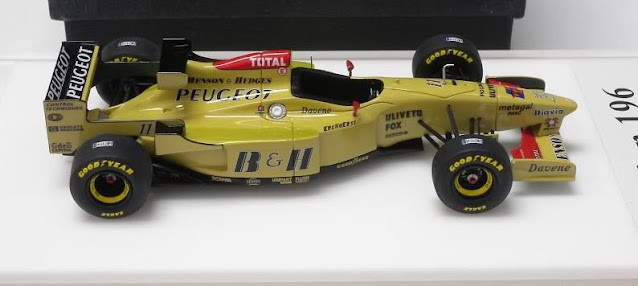
Barrichello in his fourth year with the team was joined by Martin Brundle in what turned out to be his final season in F1. The Jordan196 car sported a now common high nose cone for the first time, sporting unique double radiator inlets and low side cockpit head protection, whilst it enjoyed its second year of Peugeot works engines. After testing in a green, white and red livery, the team secured B&H backing turning the cars, initially a yellowy gold, before refining to a distinctive gold. Brundle spectacularly barrel-rolled at the first Grand Prix in Australia and was able to walk away and take the restart. But the season was not Jordan's most competitive with no podium finishes, but it did finish 5th in the Constructors' Championship with 22 points.
I quite like Barrichello and Brundle as drivers, and couldn't resist getting both versions of the car. The livery is distinctly from the British GP, with a combination of the drivers' names and 'Special F1' replacing the tobacco logos. Whilst most of the bodylines are there, they didn't include the bodyline that runs over the top of the front half of the sidepod around the side of the cockpit. Score: 7/10
Minichamps 402109596
The Jordan model was updated slightly for the 10 year anniversary of Jordan twin set collection. The gold was made a bit lighter, I personally preferred the original colour. I like the updated rear wing - winglet, but much of the rest of the model is the same as the original. To me, there's not enough of an improvement to gain any extra points in my score. Score: 7/10
In Brazil, you could get this Ixo version with early season colours of Barrichello's car. The front sidepod opening isn't great, but the rest of the car is quite nicely done. They could have painted the bargeboard around the front suspension. Nevertheless, it wouldn't be a bad car to add to the collection as an early season version next to the Minichamps cars. I was tempted to give it the same score as the Minichamps car, but I had to mark it down for the reasons above. Score: 6/10
Tameo have produced some excellent models for the 1996 grid, but for me, this one is a disappointment. The B&H logos are particularly bad. The front sidepod inlet is too straight and there's no actual opening. The top of the nose doesn't look right to me either. I like the inclusion of the turning vane just in front of the rear wheels. This version is from the Australian GP.
Tameo TMK213
We do get an early season version from Tameo, this one from the Argentine GP which includes the mid-wing and the more mustard coloured gold.
Tameo TMK224
We also get a German GP version of the Jordan with amended gold livery. The Peugeot decal on the engine cover is too bold for me.
Combining the models together, I gave it the same score as the Minichamps car, because despite my misgivings over the overall shape, the details bump up the score back up, with the pitot tubes, in-cockpit detail, fuel caps, suspension detail, and nicely modeled rear wings. Score: 7/10
BBR's version also comes from the Australian GP. I was disappointed by the Tameo offering, and to me the BBR version is worse. That rear wing is huge, and the nose/monocoque is too low. Again, you get nice additional details over the Minichamps and Ixo offerings, so that bumps the score up from a 5 to a 6. Score: 6/10
In a departure from my usual GP4 cars and model reviews, I wanted to write a quick article about one of the crazy aspects of the 1994F1 season, the large number of serious crashes.
The new 1994 regulations that banned 'driver aids' was rather rushed in, and the rules were particularly ambiguous (vague), which meant that the FIA had the casting vote to rule in any specific case as to whether parts of the car were legal or not. These days, the rules tend to be better thought out, and teams can consult the FIA, Charlie Whiting in particular, as to the legality of its parts before they participate in a Grand Prix. But in 1994, it wasn't short of teams who were 'trying it on', chancing parts would be legal on the basis of the ambiguity in the rules.
The drivers, who had been used to high levels of grip from driver aids, and fat rear tyres in previous seasons, were regularly caught out by the combination of high speeds and a lack of grip of its newer models. The result is that there were a number of large crashes at the beginning of the season, that should have given the FIA warnings to make changes before there were any serious injuries. Interestingly, Senna was quoted as saying that without any changes to the speeds of the cars, it would be "a season with a lot of accidents". Unfortunately, that would be true and it would be the deaths of Roland Ratzenberger and Ayrton Senna at Imola, and Karl Wendlinger's crash at Monaco that led to a host of changes to cars and tracks that began a renewed drive of improvement on safety in F1.
Frank Dernie explains that flat bottom cars are inherently unstable, and that active suspension was one of the things that helped bring stability, so by banning the system it made the cars unstable, and thus unpredictable. Aerodynamics that work fine in wind-tunnel are subjected to slides, and quick changes of directions, to roll and pitch and changes in wind and other factors that can cause loss of downforce, so when a car is so heavily dependent on its downforce, to suddenly lose it means it will cause high-speed accidents beyond the control of the driver.
I wanted to highlight the number of big accidents that happened, some lucky near-misses whilst others with memorable losses of life:
Shortly after signing for Benetton for the 1994 season, Lehto was testing on a damp Silverstone track in a 1993 car when he went off backwards at Stowe and injured his neck. The injury meant he sat out the first two Grand Prix, having yet to drive the B194. You can read more from his interview with Motorsport Magazine here:
At the Brazilian Grand Prix, Eddie Irvine, in his Jordan, and Jos Verstappen (deputising for Lehto in the Benetton) were battling as they came to lap Eric Bernard's Ligier, along with a slowing Martin Brundle, who had an engine failure in the McLaren. Irvine chopped across the track to overtake Bernard, without taking into account Verstappen was pulling alongside. Verstappen was left with no choice but to go on the grass, and spun as they braked for the corner. Verstappen's car went airbourne and his rear tyre hit Brundle's helmet, causing it to crack. Brundle was lucky to walk away from this accident (who also had another near fatal accident in the wet at the Japanese Grand Prix later that year, not too dissimilar to Jules Bianchi's accident some 20 years later).
Irvine was slapped with a fine and a one race ban, and after an appeal, the ban was extended to three races.
After the Brazilian Grand Prix, Jean was testing his Ferrari412T1 at Mugello, when he also went backwards into a barried and he also injured his neck, that caused him to miss two Grand Prix.
Rubens Barrichello had been on a roll, after finishing on the podium at the previous race in Aida. Barrichello entered the Variante Bassa some 15kph faster than the previous lap, went wide and hit the kerb on the chicane which sent the Jordan airbourne before hitting the barrier above the tyre barrier. Thankfully, this was not a fatal accident,
Roland Ratzenberger - Qualifying at San Marino Grand Prix
A front wing flap came off from the car, causing major suspension damage, which failed at 180mph sending Roland into the barrier in a fatal crash. A photograph, linked below, sees Roland tangling with the Footwork of Fittipaldi, which may have been the cause for the failure that led to him loosing control of his car.
JJ Lehto - Start at San Marino Grand Prix
Lehto returned from his accident into the cockpit of the Benetton for the third race in Imola, but he has since admitted that he returned too soon (more in the Motorsport Magazine link above). "When I came back I was sick and in pain; Flavio didn’t give me any testing."
Perhaps unfamiliar with the B194, the Finn stalled his car on the start as the rest of the field raced past him. All except Pedro Lamy in his Lotus who collided with the stationary Benetton, and debris, including a tyre, was sent into the crowd, injuring four spectators and a policeman.
Ayrton Senna - San Marino Grand Prix
Senna's accident, after the safety car period to clear up the start line crash, is still a topic of debate, and the cause remains not fully known. His WilliamsFW16 car is seen to hit a bump at the Tamburello corner and bottom out, with sparks seen from Schumacher's onboard camera, which was unlike previous laps. Perhaps behind a slow safety car, the tyres were not up to full pressure? The car then slides, with Senna seeming to over correct and he heads for the barriers to the right. We know his steering column was hastily modified before the race and it was found to have failed, but it is not known whether it was the cause or a consequence of the accident. The end result, though, is that Senna lost his life in this accident.
A touching point was that an Austrian flag was found folded up in his cockpit, with Senna hoping to dedicate the win to Roland Ratzenberger.
Michele Alboreto had just pitted, and back then, there was no pit-lane speed limit. His rear wing failed on his Minardi, and the accident caused his to lose a wheel which caused injuries to some of the Ferrari pitcrew. Alboreto's car came to a halt just outside of the pitlane. This incident caused the pit-lane speed limit to be introduced.
Karl Wendlinger - Practice at Monaco Grand Prix
Karl Wendlinger lost control of his SauberC13 on the downhill approach to the chicane. The accident put Wendlinger into a coma. Sauber responded by raising the cockpit sides of the car, something that was eventually implemented on all cars for the 1996 season.
Pedro Lamy - Testing at Silverstone
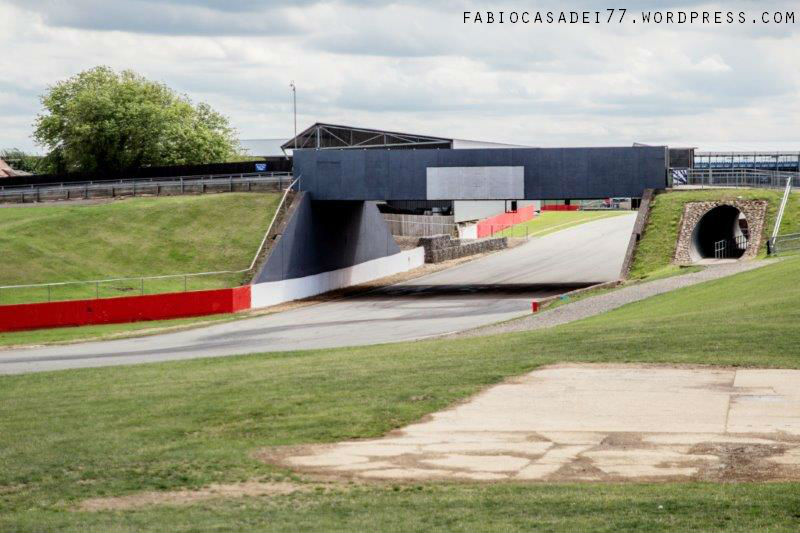
The FIA had begun to react by this stage, and a change to the diffusers were hurried into the regulations. This caused a spate of rear wing failures, with both Williams and Ligier reporting cracks on their assemblies. A rear wing failure on Lamy's Lotus caused an accident that strangely saw the car end up in the spectator tunnel at Bridge corner at Silverstone, pictured below. I've walked through this tunnel and it is small, so who knows what happened for the car to end up in there, but he managed to hit a barrier, clear a safety barrier and end up in the tunnel! Lamy's injuries to his leg would take nearly a year to recover from.
Reading Johnny Herbert's autobiography, he said he was a few hundred metres behind his teammate and as he rounded the fast left hander, all he could see was the engine and gearbox from the rear of Lamy's car strewn across the track. He looked further to see a hole in the fence, but still no sign of his car. A small flame caught his attention from the tunnel and there, Lamy was in his monocoque, partially exposed, sitting at an odd angle.
Simtek only ran one car out of respect at the Monaco Grand Prix. Andrea Montermini, who was suffering from a virus at the time, took up the second seat for the Spanish Grand Prix, although he never made it to the Grand Prix thanks to a massive accident on the last corner of the Barcelona track in practice. Thankfully, he only had injuries to his foot and a facial wound, but yet another massive accident in a season that has already had its fair share of them.
The aftermath
By the Monaco GP, F1 was under a lot of pressure from sponsors and manufacturers to get on top of these accidents, threatening to pull out of F1 and endangering the series altogether. It's debatable if Senna had never lost his life at Imola, whether the FIA would have felt the need to make so many changes despite the 10 other serious incidents.
A wide range of changes to the car were announced, though not all of them made it into the regulations before the end of the season, many of them phased in over the following Grand Prix. It meant that the teams at the lower end of the grid, already struggling with their finances, had to spend extra resources to simply show up and race legally. So the late season driver merry-go-round saw an influx of pay drivers racing in various seats towards the end of the season. Changes to tracks included temporary tyre barrier chicanes installed in Spain, Canada and Belgium.
1994, perhaps unsurprisingly, saw the most driver changes of any Formula 1 season, with 46 drivers taking part at some stage over the season, that's 40 driver changes! You can read about all the changes here:
Every now and again, I test myself on quiz website Sporcle to see if I can remember all the drivers from the 1994 season, only to usually miss out on one or two: www.sporcle.com
Having lost ground and lead driver Ayrton Senna to Williams, McLaren were looking to rebuild the team. Mika Hakkinen impressed in the few races he was given in 1993 which led to a full time race seat in 1994, next to Martin Brundle from Ligier. Peugeot were also making their debut in Formula One and suffered many reliability problems, most notably on the starting grid at the British GP, when Brundle's car was smoking when standing still, but when the lights turned green, a huge fireball erupted from the engine. Brundle scored a second place in Monaco, but the team were unable to compete for victories, their first winless season since 1980.
Martin Brundle, a reknowned journalist today, was an ex Sportscar champion, who beat Ayrton Senna to the F3 title, but sadly smashed up his legs in a horrific crash in 1984 and arguably, he may not have been as quick as he once was. Brundle was not the first choice to partner Hakkinen for the 94 drive, but it was all pending on whether Alain Prost would return to the team where he won 3 of his World Championships (in 1985, 1986 and 1989). Prost tested the car, but decided against a return. In fact, had Peugeot had their way, it would have been Philippe Alliot, who deputized for Hakkinen (who had a ban for causing the accident in the 1st corner at the German Grand Prix) at the 1994 Hungarian Grand Prix, who would have been next in line, but Ron Dennis over-ruled in favour of Brundle. More info can be found on Ibrar Malik's blog on his new book about the 1994 season.
Hakkinen, in one of his only finishes early in the season, was on the podium at the San Marino Grand Prix. Hakkinen was on the podium again, despite clashing with the Jordan of Barrichello on the last corner of the last lap, for which Mika was awarded a suspended ban which was enforced after causing the crash at the German GP as mentioned above. On his return, Hakkinen finished third in the Belgian GP, promoted to 2nd after Schumacher's disqualification. Hakkinen then scored another 3 podiums, ending the season in 4th place in the Drivers' Championship.
The car itself is visually very similar to the 1993 MP4/8. The biggest change is the sidepods which were further back and notably very small. A low nose was used, but the underside rose quite high around the suspension region, a compromise between not having a high-nose to running a low-nose, and encouraging more air underneath the car and energising it to be later used by the diffuser.
To my knowledge, only 3 models of this car exist, all made in the mid-90s.
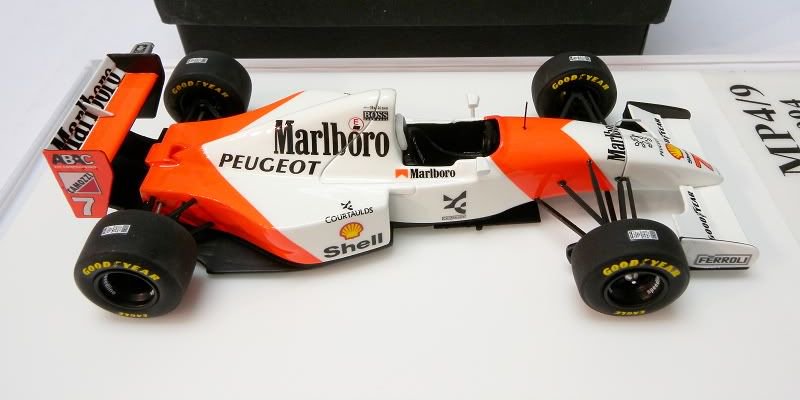
The base model comes with either Hakkinen or Brundle and the shape and general sponsor locations of the early season car, probably the Brazilian GP - albeit with non-tobacco logos instead of Marlboro. Score: 7/10
British and German GP Models
Minichamps - 533944387
Only 1000 of the German GP models were made, and the same volume for the British GP version. That has made this model particularly rare and expensive, still fetching close to £100 today. The main difference from the base model is that it contains the large barge boards, with the associated change in logos. It also has the updated helmet shape which is much nicer. Of course, the shape is based on the early season regulations, so there are no changes to the front wing nor diffuser. They haven't even used decals for the hole in the engine cover. However they did fix the mirror holder which is now black instead of white on the base model. I think this is a very nice model and one of the better 1994's models made that year.
***updated July 2019***
After a few months of watching out for a cheap version of this car on ebay, I managed to get a Heritage Racing McLaren. Because there were never any particularly good shots online, I always simply assumed it was an Onyx built car, albeit a successful one from them. It was only as I started to look at this car that I noted it had very familiar features and realised it is the original Minichamps car repackaged and presented in an Onyx style box. My model is in remarkably good condition considering its age. Score: 7/10
I bought a hand-built BBR model based on the Brazilian Grand Prix, this being Brundle's car where he was involved in an accident caused by Eddie Irvine when he collected 3 cars and was subsequently banned for a couple of races. The model is nice and accurate, and it comes with lovely details like the 3D fuel cap for example. But I'm left a little disappointed by the quality of the decals the sponsors themselves are not particularly great.
Tameo's version of the Brazilian Grand Prix does seem to capture the contours of the model nicely. The area around the side of the cockpit is not wide enough for me, which makes it feel like there's something missing from that area of the car.
This is my second car since returning to making cars for GP4, the 1994McLarenMP4/9 Peugeot from the Australian Grand Prix.
The 1994 McLaren MP4/9 is very much an updated MP4/8 fitted
with the Peugeot engine, though it did flirt with Lamborghini at one stage. And
so much of the front of my creation began its life loosely based around Öggo’s
excellent MP4/8. When I began, I thought it was close enough to the 1993 car to
not take up too much time in modelling, but then I looked more closely at the
photos.
I think only McLaren kept elements of the front end plates
that began the season wrapping around the front wheels until they were banned,
but kept the parts that belonged under the front wing.
I put a bit more effort into adding low-poly detail to
suspension ends and made the nose-cone damage a bit more detailed than I would
have done in the past.
McLaren kept with the low nose, but it rose higher around
the suspension area (to try and gain some of the benefit from a high nose
without having one), and there is quite a pronounced undercut around the
drivers legs (pioneered by Adrian Newey’s WilliamsFW14).
The second half of the year forced holes to be cut in the
engine cover, and you can see through from the front of the airbox through to
the rear.
The right side of the engine cover had a few extra holes,
one for the extinguisher and the other an access point to plug a laptop in. The
MP4/9 has very small sidepods and from the top down looks like a triangle – the
biggest change from the MP4/9. Perhaps the cooling requirements were much less
from the Peugeot engine, but then again it did blow up a lot! The floor just in
front of the rear wheels is stepped and contains a vertical element (hidden in
dark carbon).
I put a bit more detail into the rear suspension and gearbox
and its mountings. I felt it gives the rear of the car a bit of depth even though
it spends much of its time under shadow and never seen.
I also put a bit more detail into the cockpit and dashboard shape. This is the first time I modelled the seat separate from the main
monocoque (not that you can see it!). It’s a real shame we can’t have 3D steering wheels
in GP4, it would really help to complete the look. There’s a lot less buttons
and dials on the MP4/9 than the MP4/8.