Showing posts with label Alliot. Show all posts

Friday, 21 January 2022

GP4: 1994 McLaren MP4/9 Peugeot - Australian GP Version released


I proudly present to you my 1994 McLaren MP4/9. If you've been around this blog for a while, you'll know this is one of the first cars I blogged about. I talk about the car shape and features in my MP4/9 Walkaround back in January 2019. I also did a summary of the season as part of the Model review & season overview. It was my second carshape since my return to GP4, but this is the fourth 1994 car to be completed. I was inspired by my visit to the Donington museum just before it was closed where I was able to get a good number of detail photographs that helped me massively make this car as accurate as I could, whilst taking care of the polygon count. 

As the car was mapped and sitting around on my hard drive for a while I decided to release the car ready to paint. As no one else had the time to do it, I picked it up back in the beginning of 2021, but I got caught up producing lots of content that this project once again gathered dust. But now that the 2021 creation draws to an end, I was able to come back to this car and bring it to completion. 

If you look at my 1994 Williams, you'll see I have included a lot of textures for my swatches, but for my 2021 cars, I decided to bring them all into a second texture, and I've done the same for the McLaren. Thankfully the car didn't see many visible updates throughout the season, just different rear wing configurations. Also the livery and logo placements remained largely unchanged, so making track specific versions shouldn't be too difficult. I hope to do that in the near future. 

My plan is to make hay during the F1 off-season to do some more work on 1994 related content. I hope to have something to show you and share with you soon. 

Friday, 20 September 2019

GP4: 1994 McLaren MP4/9 Peugeot v0.9 release


Today, I release just the shape with the wireframe and zmodeler file ready for someone to paint. Once painted, I can create the second car ready for its proper release. The mapping of the first texture is loosely based around the textures of McKey and Oggo’s early season MP4/9.


As with the 1995 Ferrari released yesterday, please report any bugs, and car 2 will be mapped after painting. 

Enjoy painting this car.


EDIT: Eventually, I found some time to finish this car and it's available here

Wednesday, 10 July 2019

Updated 1/43 Model Review: 1994 McLaren MP4/9 Peugeot

I bought a Heritage Racing McLaren MP4/9 this week and I was pleased when I received it that the car was of a better quality than I expected (I suppose I wasn't expecting much). Having assumed that it was one of the better Onyx cars of the time, I realised after looking at it in a bit more detail that this is infact a Minichamps car in an Onyx style box. I suppose that is why there is no serial number visible. And so I've snapped up a bargain, as the Minichamps version of this car usually fetches a bit more than I paid for this one. The only problem is that the car does not sit very tightly on the base and does move very easily.

So I've updated my original blog post about this car.
https://fongugp4.blogspot.com/2019/01/143-model-review-1994-mclaren-mp49_19.html

But I thought I would post a few more pictures of the car from a few more angles than usual.


You can really see how sleek and slender this car is with its minimal sidepods, angled like a dart perhaps a bit like the 1983 Brabham BT51.


The Onyx cars would usually have a single axle between the two front wheels, but Minichamps have found a way to do realistic suspension, with all elements attached to the main monocoque. The front wing includes the early season extensions that go behind the front wheel. These were banned mid-season as one of the measures to reduce speeds. Minichamps also use brown for their visors, where as Onyx tend to use a grey. Minichamps have also made the sidepod and airbox openings as actual holes in the car, whereas on Onyx cars of that time had stickers for the airbox.


You can see the front suspension more clearly in the overhead shot, and also the shape of the sidepods is nicely done. They have even modelled the small inlet just in front of the rear wing.


Minichamps also did some good bodylines, with the chassis having indents for the engine and suspension covers. There's also nice detail around the front of the cockpit, which is slightly more raised than the side of the driver's helmet.

Wednesday, 30 January 2019

1/43 Model Review: 1994 Larrousse LH94 Ford

Background

The 1994 Larrousse LH94 car carried two liveries during the year, a red and white Kronenbourg version for a few Grand Prix, and the green Tourtel version. I, personally, can't remember a bigger livery change mid-season, flipping between the two liveries in the early season.

The car was a development of their first in-house built car the LH93, but it would be their final car, due to lack of finances. The season started off well, with a point scored at Aida, but lack of development and reliability meant the team would only repeat this feat once again in Germany. Interestingly the German Grand Prix is remembered for the pit stop fire of Jos Verstappen's Benetton B194, but Benetton and Larrousse had a technical agreement that meant the LH94 ran the Benetton B193 gearbox. The technical association went closer when Benetton claimed that it was Larrousse who liaised with Intertechnique, who produced the fuel rigs, about removing the filter, which gave faster pitstops, but also resulted in that fiery accident. 

Olivier Beretta was a pay driver, and so it was expected that Erik Comas would be the lead driver, and indeed was the one who brought home the points. But when Beretta's money dried up, Phillipe Alliot, Yannick Dalmas amd Hideki Noda all shared the seat in the final part of the year. Even Comas had to give up his seat at the final race for Jean-Louis Deletraz. Deletraz had little experience and was not physically fit, driving some 6 seconds a lap off the pace of the leaders, and between 1 and 2 seconds off the pace of Noda.

The fascinating story of the teams halted attempts for the 1995 season and its eventual demise makes for interesting reading. The LH95 was designed, but never built, they tried to use a Lola T95/30, but they had an unhappy history, before linking up briefly with DAMS and their DM-01 (later merged with the LH95 to become the GD-01), before looking to race the LH94B, a modified 1994 car.  You can read more about it here:
www.unracedf1.com

Eligor

Eligor 2995B

Eligor 2996A


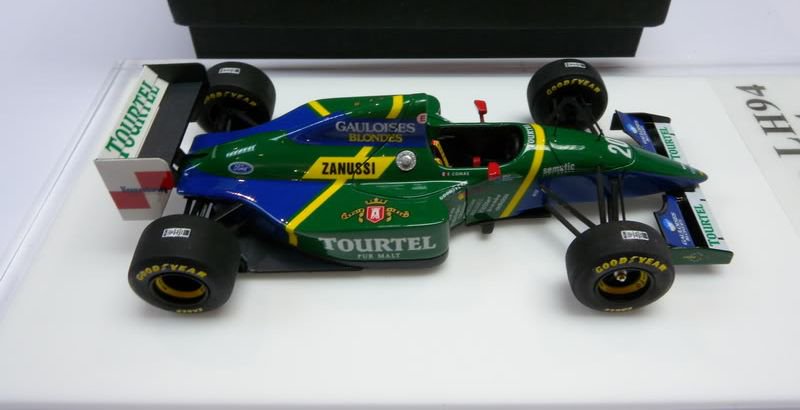
This is my first and last Eligor model, although I had to get both livery versions. These cars are pretty rare to find, but with neither Onyx nor Minichamps making this car, these would have to do. The general proportions isn't great on these cars, it barely resembles the real thing, but you do get some nice details such as the suspension is better than you would get on an Onyx model.
Score 4/10

Other Versions

I haven't owned any other versions, so from my searching, I could only find this beautiful Tameo kit version from the Spanish GP. It's a big step up in accuracy than the Eligor version, but you have to pay handsomely for a nice built version.
Tameo TMK186
I'm not overly convinced of the proportions on this Tameo model. It's got lovely details, the shape is representative, but it just doesn't quite look right to me.
Score 7/10


I'm really hoping this car will be revisited by the modern day model makers.


For more 1994 Model Reviews, click here: https://fongugp4.blogspot.com/search/label/1994 Model Review

Monday, 21 January 2019

1/43 Model Review: 1994 McLaren MP4/9 Peugeot

Background


Having lost ground and lead driver Ayrton Senna to Williams, McLaren were looking to rebuild the team. Mika Hakkinen impressed in the few races he was given in 1993 which led to a full time race seat in 1994, next to Martin Brundle from Ligier. Peugeot were also making their debut in Formula One and suffered many reliability problems, most notably on the starting grid at the British GP, when Brundle's car was smoking when standing still, but when the lights turned green, a huge fireball erupted from the engine. Brundle scored a second place in Monaco, but the team were unable to compete for victories, their first winless season since 1980.

Martin Brundle, a reknowned journalist today, was an ex Sportscar champion, who beat Ayrton Senna to the F3 title, but sadly smashed up his legs in a horrific crash in 1984 and arguably, he may not have been as quick as he once was. Brundle was not the first choice to partner Hakkinen for the 94 drive, but it was all pending on whether Alain Prost would return to the team where he won 3 of his World Championships (in 1985, 1986 and 1989). Prost tested the car, but decided against a return. In fact, had Peugeot had their way, it would have been Philippe Alliot, who deputized for Hakkinen (who had a ban for causing the accident in the 1st corner at the German Grand Prix) at the 1994 Hungarian Grand Prix, who would have been next in line, but Ron Dennis over-ruled in favour of Brundle. More info can be found on Ibrar Malik's blog on his new book about the 1994 season.
http://www.1994f1.com

Hakkinen, in one of his only finishes early in the season, was on the podium at the San Marino Grand Prix. Hakkinen was on the podium again, despite clashing with the Jordan of Barrichello on the last corner of the last lap, for which Mika was awarded a suspended ban which was enforced after causing the crash at the German GP as mentioned above. On his return, Hakkinen finished third in the Belgian GP, promoted to 2nd after Schumacher's disqualification. Hakkinen then scored another 3 podiums, ending the season in 4th place in the Drivers' Championship.

The car itself is visually very similar to the 1993 MP4/8. The biggest change is the sidepods which were further back and notably very small. A low nose was used, but the underside rose quite high around the suspension region, a compromise between not having a high-nose to running a low-nose, and encouraging more air underneath the car and energising it to be later used by the diffuser.

To my knowledge, only 3 models of this car exist, all made in the mid-90s.

Minichamps

Standard Model

Minichamps - 530944308
The base model comes with either Hakkinen or Brundle and the shape and general sponsor locations of the early season car, probably the Brazilian GP - albeit with non-tobacco logos instead of Marlboro.
Score: 7/10

British and German GP Models

Minichamps - 533944387
Only 1000 of the German GP models were made, and the same volume for the British GP version. That has made this model particularly rare and expensive, still fetching close to £100 today. The main difference from the base model is that it contains the large barge boards, with the associated change in logos. It also has the updated helmet shape which is much nicer. Of course, the shape is based on the early season regulations, so there are no changes to the front wing nor diffuser. They haven't even used decals for the hole in the engine cover. However they did fix the mirror holder which is now black instead of white on the base model. I think this is a very nice model and one of the better 1994's models made that year. 
Score: 8/10

Heritage Racing

***updated July 2019***
After a few months of watching out for a cheap version of this car on ebay, I managed to get a Heritage Racing McLaren. Because there were never any particularly good shots online, I always simply assumed it was an Onyx built car, albeit a successful one from them. It was only as I started to look at this car that I noted it had very familiar features and realised it is the original Minichamps car repackaged and presented in an Onyx style box. My model is in remarkably good condition considering its age.
Score: 7/10

BBR

BBR - MET08
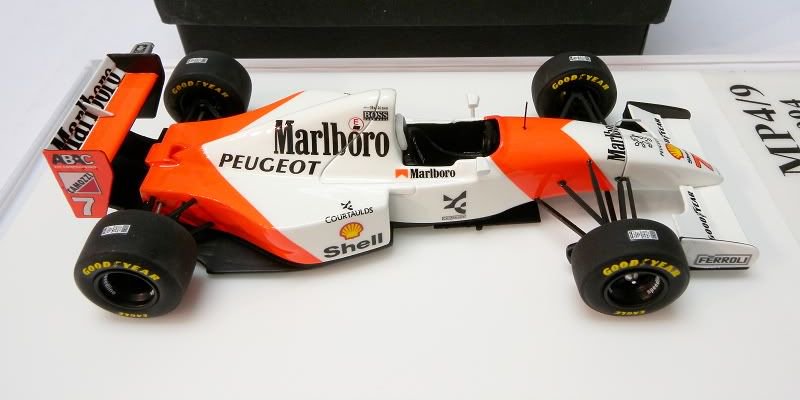
I bought a hand-built BBR model based on the Brazilian Grand Prix, this being Brundle's car where he was involved in an accident caused by Eddie Irvine when he collected 3 cars and was subsequently banned for a couple of races. The model is nice and accurate, and it comes with lovely details like the 3D fuel cap for example. But I'm left a little disappointed by the quality of the decals the sponsors themselves are not particularly great.
Score: 7/10

Tameo

Tameo TMK178
Tameo's version of the Brazilian Grand Prix does seem to capture the contours of the model nicely. The area around the side of the cockpit is not wide enough for me, which makes it feel like there's something missing from that area of the car. 
Score: 8/10


You can see my GP4 creation of the Australian Grand Prix version here: https://fongugp4.blogspot.com/2019/01/gp4-1994-mclaren-mp49-peugeot.html

For more 1994 Model Reviews, click here: https://fongugp4.blogspot.com/p/1994-model-review.html

Friday, 18 January 2019

GP4: 1994 McLaren MP4/9 Peugeot WIP


This is my second car since returning to making cars for GP4, the 1994 McLaren MP4/9 Peugeot from the Australian Grand Prix.


The 1994 McLaren MP4/9 is very much an updated MP4/8 fitted with the Peugeot engine, though it did flirt with Lamborghini at one stage. And so much of the front of my creation began its life loosely based around Öggo’s excellent MP4/8. When I began, I thought it was close enough to the 1993 car to not take up too much time in modelling, but then I looked more closely at the photos.


I think only McLaren kept elements of the front end plates that began the season wrapping around the front wheels until they were banned, but kept the parts that belonged under the front wing.


I put a bit more effort into adding low-poly detail to suspension ends and made the nose-cone damage a bit more detailed than I would have done in the past.


McLaren kept with the low nose, but it rose higher around the suspension area (to try and gain some of the benefit from a high nose without having one), and there is quite a pronounced undercut around the drivers legs (pioneered by Adrian Newey’s Williams FW14).


The second half of the year forced holes to be cut in the engine cover, and you can see through from the front of the airbox through to the rear.

The right side of the engine cover had a few extra holes, one for the extinguisher and the other an access point to plug a laptop in. The MP4/9 has very small sidepods and from the top down looks like a triangle – the biggest change from the MP4/9. Perhaps the cooling requirements were much less from the Peugeot engine, but then again it did blow up a lot! The floor just in front of the rear wheels is stepped and contains a vertical element (hidden in dark carbon).

I put a bit more detail into the rear suspension and gearbox and its mountings. I felt it gives the rear of the car a bit of depth even though it spends much of its time under shadow and never seen.


I also put a bit more detail into the cockpit and dashboard shape. This is the first time I modelled the seat separate from the main monocoque (not that you can see it!). It’s a real shame we can’t have 3D steering wheels in GP4, it would really help to complete the look. There’s a lot less buttons and dials on the MP4/9 than the MP4/8. 

You can read my model review and also how McLaren got on in the 1994 season here: https://fongugp4.blogspot.com/2019/01/143-model-review-1994-mclaren-mp49_19.html