It was announced last week that the Sauber name will depart from the sport for the first time since 1993. It's sad to see the heritage of the name be completely replaced by Alfa Romeo, as welcome as they were was when it was introduced for the 2018 season. Even through the BMW days when the team was entirely owned by the manufacturer, they were still called BMW Sauber. So I for one will be sad to see the name go. But here is a reminder of one of the more eventful seasons of their history.
Background
Following an impressive debut season, the 1994 season would again see Sauber challenge for the lower points scoring positions. After a huge accident at Monaco to Karl Wendlinger, the race after that weekend at Imola, the team developed higher cockpit sides to protect their driver. This development would be mandatory from the 1996 season. Andrea De Cesaris would fill his seat from the Canadian GP onwards, his 200th GP, but Wendlinger was due to come back for the final two GP's but that did not go ahead. The team tried to contact De Cesaris, but were unable to get a hold of him on holiday, so JJ Lehto who drove for them in 1993, freshly dropped by Benetton, filled the seat and De Cesaris retired. The team finished 8th in the Constructors' title.
Heinz-Harold Frentzen drove the entire season for the team, his debut year. He had a fan in Frank Williams early on, with reports he was going to be called up to Williams after Senna's tragic death, but the German decided to stay with Sauber, earning a Williams seat in 1997.
1994 saw the team run Mercedes-Benz engines, though they were rebadged Ilmor engines, but they received full manufacturer backing, harking back to their successful sports car partnership earlier that decade. However it only lasted for one season, with McLaren snatching the deal from 1995 through to 2009 when Mercedes became a full constructor once more, and I'd say they're doing pretty well.
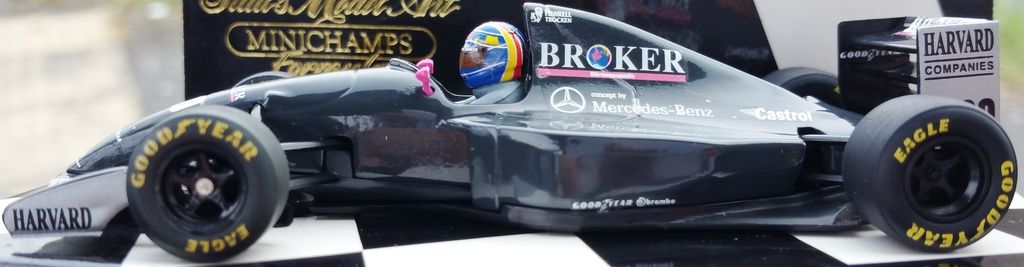
The car started the season with Broker sponsorship, and ran a black livery very similar to their 1993, except for silver endplates front and rear. The shape itself is a bit basic, it's recognizable enough, but at the same time it's not particularly accurate either. Score 4/10
Onyx 193B
When De Cesaris arrived from Jordan to run for the team at the Canadian Grand Prix, his 200th race, Sauber celebrated with this one off livery. The nice livery bumps up the score from the early season version. Score 5/10
Onyx 194B
By the French Grand Prix, the Broker logos were replaced by Tissot ones and at the German Grand Prix, this lovely livery with white spots and a large watch in front of the driver ran till the end of the season. The only thing to note is the lack of change in the shape from Onyx, as was common at that time. Score 4/10
Minichamps released their own version of the three liveries seen that year. The shape of the car is an improvement on the Onyx shape, much closer to the real thing. Score 6/10
Minichamps 430940129
At the Canadian Grand Prix, Sauber introduced their raised cockpit sides solution - still in bare carbon fibre at that time. Minichamps at least made an effort to add this to their model. Score 7/10
Minichamps 430940229
Minichamps also released their updated cockpit sides with the late season livery, specifically from the German GP. However there are no further changes to the shape inline with the regulations from that part of the season. The late season Sauber also had barge boards and rounded sidepods along the top edge, rather than the indent they ran on the early season car - but again this is not reflected in this model. We also don't have a release with Lehto in the car. Score 6/10
BBR released both versions of the Sauber, with correct shapes for both parts of the season. There's a nicely built version of the late season car in this link: https://www.racingdioramics.us/1994_Sauber.html
The BBR version, is in my opinion, the nicest of the lot. Score 9/10
Tameo have also released their version of the late season shape, pictured here in the De Cesaris Canadian GP livery. The Tameo kits are always of the highest standard, but I think the BBR car just edges it for me in its resemblance to the real car. Score 8/10
In a departure from my usual GP4 cars and model reviews, I wanted to write a quick article about one of the crazy aspects of the 1994F1 season, the large number of serious crashes.
The new 1994 regulations that banned 'driver aids' was rather rushed in, and the rules were particularly ambiguous (vague), which meant that the FIA had the casting vote to rule in any specific case as to whether parts of the car were legal or not. These days, the rules tend to be better thought out, and teams can consult the FIA, Charlie Whiting in particular, as to the legality of its parts before they participate in a Grand Prix. But in 1994, it wasn't short of teams who were 'trying it on', chancing parts would be legal on the basis of the ambiguity in the rules.
The drivers, who had been used to high levels of grip from driver aids, and fat rear tyres in previous seasons, were regularly caught out by the combination of high speeds and a lack of grip of its newer models. The result is that there were a number of large crashes at the beginning of the season, that should have given the FIA warnings to make changes before there were any serious injuries. Interestingly, Senna was quoted as saying that without any changes to the speeds of the cars, it would be "a season with a lot of accidents". Unfortunately, that would be true and it would be the deaths of Roland Ratzenberger and Ayrton Senna at Imola, and Karl Wendlinger's crash at Monaco that led to a host of changes to cars and tracks that began a renewed drive of improvement on safety in F1.
Frank Dernie explains that flat bottom cars are inherently unstable, and that active suspension was one of the things that helped bring stability, so by banning the system it made the cars unstable, and thus unpredictable. Aerodynamics that work fine in wind-tunnel are subjected to slides, and quick changes of directions, to roll and pitch and changes in wind and other factors that can cause loss of downforce, so when a car is so heavily dependent on its downforce, to suddenly lose it means it will cause high-speed accidents beyond the control of the driver.
I wanted to highlight the number of big accidents that happened, some lucky near-misses whilst others with memorable losses of life:
Shortly after signing for Benetton for the 1994 season, Lehto was testing on a damp Silverstone track in a 1993 car when he went off backwards at Stowe and injured his neck. The injury meant he sat out the first two Grand Prix, having yet to drive the B194. You can read more from his interview with Motorsport Magazine here:
At the Brazilian Grand Prix, Eddie Irvine, in his Jordan, and Jos Verstappen (deputising for Lehto in the Benetton) were battling as they came to lap Eric Bernard's Ligier, along with a slowing Martin Brundle, who had an engine failure in the McLaren. Irvine chopped across the track to overtake Bernard, without taking into account Verstappen was pulling alongside. Verstappen was left with no choice but to go on the grass, and spun as they braked for the corner. Verstappen's car went airbourne and his rear tyre hit Brundle's helmet, causing it to crack. Brundle was lucky to walk away from this accident (who also had another near fatal accident in the wet at the Japanese Grand Prix later that year, not too dissimilar to Jules Bianchi's accident some 20 years later).
Irvine was slapped with a fine and a one race ban, and after an appeal, the ban was extended to three races.
After the Brazilian Grand Prix, Jean was testing his Ferrari412T1 at Mugello, when he also went backwards into a barried and he also injured his neck, that caused him to miss two Grand Prix.
Rubens Barrichello had been on a roll, after finishing on the podium at the previous race in Aida. Barrichello entered the Variante Bassa some 15kph faster than the previous lap, went wide and hit the kerb on the chicane which sent the Jordan airbourne before hitting the barrier above the tyre barrier. Thankfully, this was not a fatal accident,
Roland Ratzenberger - Qualifying at San Marino Grand Prix
A front wing flap came off from the car, causing major suspension damage, which failed at 180mph sending Roland into the barrier in a fatal crash. A photograph, linked below, sees Roland tangling with the Footwork of Fittipaldi, which may have been the cause for the failure that led to him loosing control of his car.
JJ Lehto - Start at San Marino Grand Prix
Lehto returned from his accident into the cockpit of the Benetton for the third race in Imola, but he has since admitted that he returned too soon (more in the Motorsport Magazine link above). "When I came back I was sick and in pain; Flavio didn’t give me any testing."
Perhaps unfamiliar with the B194, the Finn stalled his car on the start as the rest of the field raced past him. All except Pedro Lamy in his Lotus who collided with the stationary Benetton, and debris, including a tyre, was sent into the crowd, injuring four spectators and a policeman.
Ayrton Senna - San Marino Grand Prix
Senna's accident, after the safety car period to clear up the start line crash, is still a topic of debate, and the cause remains not fully known. His WilliamsFW16 car is seen to hit a bump at the Tamburello corner and bottom out, with sparks seen from Schumacher's onboard camera, which was unlike previous laps. Perhaps behind a slow safety car, the tyres were not up to full pressure? The car then slides, with Senna seeming to over correct and he heads for the barriers to the right. We know his steering column was hastily modified before the race and it was found to have failed, but it is not known whether it was the cause or a consequence of the accident. The end result, though, is that Senna lost his life in this accident.
A touching point was that an Austrian flag was found folded up in his cockpit, with Senna hoping to dedicate the win to Roland Ratzenberger.
Michele Alboreto had just pitted, and back then, there was no pit-lane speed limit. His rear wing failed on his Minardi, and the accident caused his to lose a wheel which caused injuries to some of the Ferrari pitcrew. Alboreto's car came to a halt just outside of the pitlane. This incident caused the pit-lane speed limit to be introduced.
Karl Wendlinger - Practice at Monaco Grand Prix
Karl Wendlinger lost control of his SauberC13 on the downhill approach to the chicane. The accident put Wendlinger into a coma. Sauber responded by raising the cockpit sides of the car, something that was eventually implemented on all cars for the 1996 season.
Pedro Lamy - Testing at Silverstone
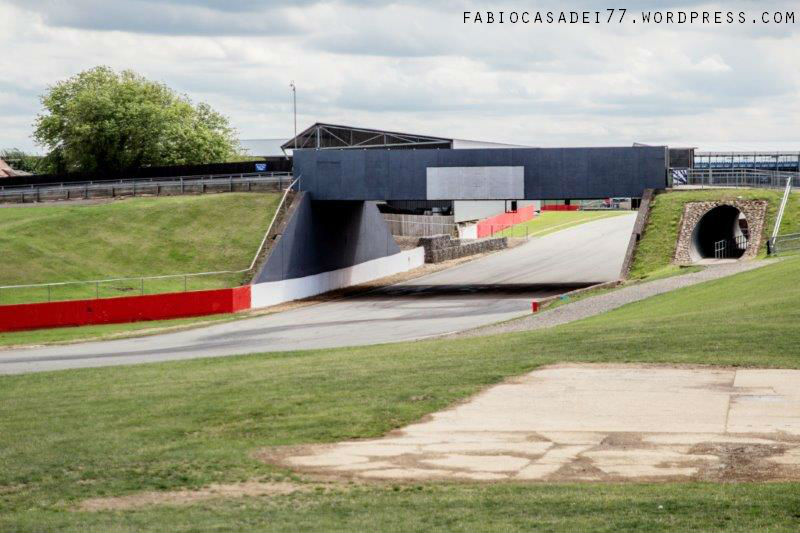
The FIA had begun to react by this stage, and a change to the diffusers were hurried into the regulations. This caused a spate of rear wing failures, with both Williams and Ligier reporting cracks on their assemblies. A rear wing failure on Lamy's Lotus caused an accident that strangely saw the car end up in the spectator tunnel at Bridge corner at Silverstone, pictured below. I've walked through this tunnel and it is small, so who knows what happened for the car to end up in there, but he managed to hit a barrier, clear a safety barrier and end up in the tunnel! Lamy's injuries to his leg would take nearly a year to recover from.
Reading Johnny Herbert's autobiography, he said he was a few hundred metres behind his teammate and as he rounded the fast left hander, all he could see was the engine and gearbox from the rear of Lamy's car strewn across the track. He looked further to see a hole in the fence, but still no sign of his car. A small flame caught his attention from the tunnel and there, Lamy was in his monocoque, partially exposed, sitting at an odd angle.
Simtek only ran one car out of respect at the Monaco Grand Prix. Andrea Montermini, who was suffering from a virus at the time, took up the second seat for the Spanish Grand Prix, although he never made it to the Grand Prix thanks to a massive accident on the last corner of the Barcelona track in practice. Thankfully, he only had injuries to his foot and a facial wound, but yet another massive accident in a season that has already had its fair share of them.
The aftermath
By the Monaco GP, F1 was under a lot of pressure from sponsors and manufacturers to get on top of these accidents, threatening to pull out of F1 and endangering the series altogether. It's debatable if Senna had never lost his life at Imola, whether the FIA would have felt the need to make so many changes despite the 10 other serious incidents.
A wide range of changes to the car were announced, though not all of them made it into the regulations before the end of the season, many of them phased in over the following Grand Prix. It meant that the teams at the lower end of the grid, already struggling with their finances, had to spend extra resources to simply show up and race legally. So the late season driver merry-go-round saw an influx of pay drivers racing in various seats towards the end of the season. Changes to tracks included temporary tyre barrier chicanes installed in Spain, Canada and Belgium.
1994, perhaps unsurprisingly, saw the most driver changes of any Formula 1 season, with 46 drivers taking part at some stage over the season, that's 40 driver changes! You can read about all the changes here:
Every now and again, I test myself on quiz website Sporcle to see if I can remember all the drivers from the 1994 season, only to usually miss out on one or two: www.sporcle.com