Showing posts with label Quickslick. Show all posts

Saturday, 14 February 2026

GP4: Benetton B197 v1.1 updated

If you’ve downloaded the B197 recently, you’ll know it already features David Marques’ excellent mapping and 4K textures as part of the original release.


While he was preparing the F1 Challenge release (available here), David noticed a detail that deserved a slight correction.

Specifically, the yellow section at the rear of the B197 — an important mark of the colours of Benetton livery — wasn’t matching its real-world reference as closely as it could. Even subtle variations in tone  can be noticeable when compared to period photography or in-game lighting, so David made a quick adjustment which looks a lot better.

All texture files have now been updated to incorporate this change for all races.


You can download the updated version here.


1997 Benetton B197 v1.1

by fongu & David Marques

Download v1.1

Thursday, 4 December 2025

GP4: 1997 Benetton B197 Renault by fongu & David Marques

I’m excited to unveil my newest release: the Benetton B197 (1997) in collaboration with the talented David Marques.


If you’ve tried my 1997 Jordan, you’ll notice immediately: this 3D model is on another level. I faced a familiar dilemma every modder knows too well — do I sink countless hours into a hyper-detailed model that could stand proudly in a modern engine? Or aim for something simpler and more in line with an older game’s limits?
This time, thanks to the wealth of reference photos from track-run B197s in recent years, I went for detail!

The result is we have a high quality car, complete with a fully built cockpit, accurate rear-end geometry, diffuser, crash structure, gearbox, and subtle internal components. The best thing is that this car is still within GP4 limits for polygon counts. 

While I tackled the painting on most of the internal elements, David Marques once again elevated the project with his impeccable mapping and paintwork on the main body, plus new 3D bolts, multiple wing specs, and gorgeous full 4K textures. Every race of the 1997 season gets its own unique livery — all thanks to David’s dedication and obsessive eye for historical detail, with help from Quickslick.

Since the B197 evolved directly from the ’96 car — itself evolved from the ’95 championship winner, which I made not too long ago, it helped me recreate some parts quickly and accurately that would usually take me a long time in making parts that are difficult to see from pictures. 

On track, the B197 had flashes of brilliance. Wurz debuted in it and immediately impressed with a podium at Silverstone. Alesi delivered a pole and several strong finishes. And of course, after recovering from illness and reeling from personal tragedy, Berger returned to the cockpit with that unforgettable, inspired victory at the German Grand Prix. This would also be Berger's swansong season finishing a strong fourth place, just shy of the podium at the final round at Jerez. 

This release is for Grand Prix 4 of course, but it is also jointly being released in F1 Challenge

I hope you enjoy driving it as much as we enjoyed bringing it back to life.

1997 Benetton B197

by fongu & David Marques

version 1.1 updated February 2026

Download v1.1


Thursday, 24 July 2025

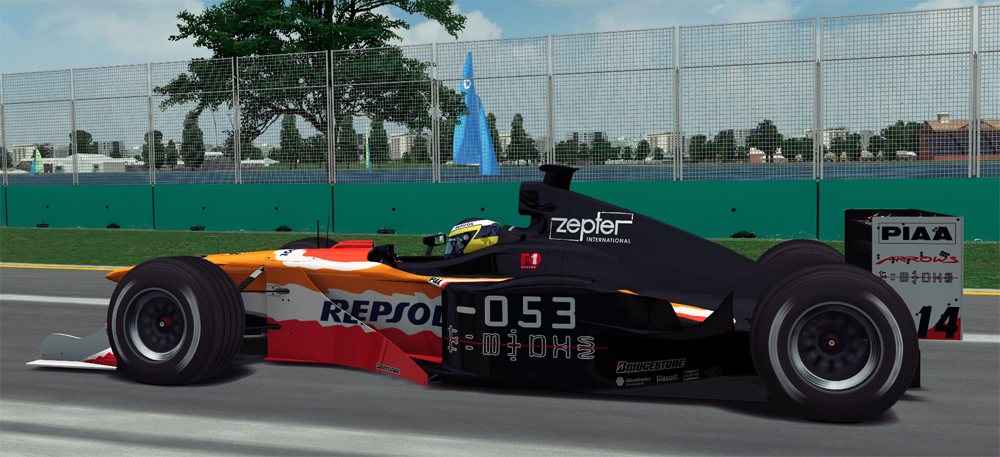
GP4: 1999 Arrows A20 by Hega and fongu


Here is the 1999 Arrows A20 as driven by Tora Takagi and Pedro de la Rosa. 

This car is by Hega, with help on the car model by me, logos and reference photos provided by Quickslick, and some objects from Soulbringer's A19 model. 

This car comes with 6 difference shape variants as well as a full season's worth of textures. 


This is the car that appears in the GPedia videos with Mark Hemsworth

In my review of the Minichamps model (https://fongugp4.blogspot.com/2019/06/143-model-review-1999-arrows-a20.html), I dwelt mainly on the negatives. Sure it was slow, yes it was embroiled in a controversy (which by the way, if you don't know anything about t-minus and the so-called Nigerian prince, then I'd suggest you check out the saga https://youtu.be/DQPNfDC0_Vw?feature=shared)

So what about the positives. It scored a point, back in the day when points were only awarded to the six. Admittedly, it was at the first race. 

It was based on the beautiful A19, designed originally by John Barnard and Mike Coughlan, but the former star designed had since left and Coughlan and Eghbal Hamidy were tasked to develop the car with minimal funding. 

It had in-house built engines, kind of. Tom Walkinshaw had injected funds into Brian Hart's engine company, but an ownership dispute ensued and Hart departed from the project. 

Though both drivers were 'pay-drivers', de la Rosa would go on to prove to be a talented racer, and he is also the one responsible for bringing Repsol as a sponsor to the team. This resulted in the first orange Arrows of that short era, the front half of the car decked in Repsol colours. 

As mentioned earlier, with investments from a Nigerian prince, the building blocks for a good little team was brought together. But sadly, with the funds not arriving, the departures of Hart and Barnard, meant the team were underfunded and underpowered. 

Still, despite being such a slow car, it did beat BAR in the Constructors' Championship. 

Around this time, 2 seater cars were kind of a thing, with Arrows building a 2-seateer and also the Arrows AX3 (3-seater car) was based on this A20.


On my side, I really enjoyed working on this car, I think it's quite a nice shape, and the sidepods are quite unique and a different challenge to making other cars. 

I hope you enjoy it. 

Download: 1999 Arrows A20 by Hega & fongu

More Info Download

Friday, 10 January 2025

GP4: 1993 JJ Lehto helmet

When you think of early-mid 1990s helmets, you're probably thinking of simple designs, designed to be seen on a small screen, immediately identifiable with bold colours and basic shapes. They were perfect material for little boy drawings, memorable, distinct, simple, iconic. 

For JJ Lehto, his main helmet design followed this trend for 1991 and 1992, with a white and blue base with red lines. 

For 1993, Uffedesigns (who is still doing the odd helmet for modern day F1 drivers), added a bold five leaf design to the top of his helmet, graduating from green to yellow to orange. This varied in colour at different rounds of the early season, and is troublesome for anyone trying to recreate it in sim racing, because it invariably goes over seams and it's incredibly hard not only to get the design lined up, but getting the gradient colours to match over the seams is very, very difficult. 

By the British GP, the design on the top went to a simple chequered pattern, that ran through to the back of the helmet and this design would carry through to his 1994 season at Benetton and Sauber. 

However, Lehto ran a special helmet design for the 1993 Monaco GP, featuring a sunrise strip at the front and an even more elaborate five leaf design across the top, that also penetrating the side and rear design. The base is a repeated blue square pattern, with some white strips added along the bottom. It was so unusual for that era to have such a bold design. A tweaked version of this helmet was used at the Le Mans 24 hour race, I think in 1996 in a Gulf liveried McLaren F1. 

I've long been a fan of Öggo's 1993 helmet set, the exquisite helmet shapes, the detail and personalisation of each drivers helmet on a track specific level, was an inspiration to the update I did for 1994. It was an honour to be asked to be involved by recreating Lehto's 1993 Monaco GP helmet. Öggo had done a great job in creating the standard leaf top used at the early races. It took a lot of persuading, and as is usual when we make requests of one another, that it can take months, if not years, or even a decade in the case of the 1993 Tyrrell, that we fulfil each other's requests. He had made a little bit of a start, and in two batches, one in the autumn of 2024 and another couple of sessions early in 2025, I'm proud to say it was finally complete. 

I started by doing the blue base, which is a repeated pattern. It wasn't easy getting the level of blue to show through without it being over exposed. The red lines actually have a slight orange outline to make it stand out more. The leaves were hand drawn as best I can with a pen tool and simple trial and error to make it line up across two textures. Then it was getting the gradients in, adding a slight white glow to the inner edges to give it that layered spray-paint effect. In the end, I really enjoyed the challenge and how it turned out, and it really pops in the all black Sauber Mercedes car. 

1993 JJ Lehto Monaco GP helmet by fongu & Ã–ggo 

I want to thank Quickslick for some help with photos, and to Öggo for his logos, this beautiful render and hastling me,  I mean inspiring me to do this project, not to mention the great Arai helmet shape and template upon which its painted on. 


You can download the recently released 1993 helmet pack that now includes Arai, Shoei and three types of Bell helmet, which includes my sole contribution of this beautiful helmet. It's really worth your time to have a look at this beautiful set, recreated with love and care and attention of detail synonymous with Öggo's work. 


I know there is a 1993 mod update being worked on, of which I have a little involvement with, which will include these new helmets as well as some other nice updates. I hope it won't be too long before the work on that is done and shared with this fantastic community. 

Tuesday, 30 April 2024

GP4: 1994 Mod v4.2

It's now been 30 years since 1994. 

The dates 30th April and 1st May are the most poignant days of that year in Formula 1. 

We remember the two lives lost that black weekend, both born a few months apart, departed this earth at 33 years of age. Austrian rookie, who has completed just one race, Roland Ratzenberger, and three time Formula 1 World Champion, Ayrton Senna

Friday, 20 January 2023

GP4 Mods List

Hey GP4 fans. 

I've not got any new content in store to present to you right now, however I'll trade that off with lots of old things to share with you instead. 

For a long time, GP4 has always lacked one central location for downloads and those that did start something, well most of them have all but disappeared now. GP4's not been immune from in fighting and ownership arguements that have lead to a fractured community, and there continues to be people who take advantage of free content to earn themselves a quick dollar or two. It's left individuals maintaining their own content and many of those links have been removed or expired, so its difficult to know a) what exists and b) what is available. Without such great resources as gp4db, GP4 Italia, GP4 Central and many others, it's become very difficult to find anything.


But the game is now over 20 years old, and there's two decades of wonderful history in that. Those of you who have been on my blog will know I've tried to keep some older mods alive by keeping them on my cloud drives. For my annual blog tidy up, I've decided to dedicate some time to collecting mods from the past and the present and try and host them for you. I'm indebted to my friends Jürgen 'Quickslick', Carl_gpgames, KerleyF1 and Ariel 'Meteoro405' for their help in compiling this list. 

I've tried to stay mainly with mods, CSM mods at that, because they are a quick and easy way for a beginner to access and play a variety of seasons and series. I've also tried to stick with F1 mods. With a fair few Indycar and DTM mods as well as junior category series being created, and played with over the years, a number of them are included too.

**************
Sorry, 2025 Fongu here. 

This database has since expanded to include as many mods that I can find (including some non-CSM mods), fictional cars, templates, utilities and editors and real and fictional tracks and trackpacks. I have tried to not include items that are available in mods, so you won't find all cars, helmets and pitcrews etc individually. 

This blog also has a regular ICYMI post which, is a summary of releases in GP4 at regular intervals, helpful for those who dip in and out of the community. 

www.grandprixgames.org is still the go-to source, but hopefully this is a complementary resource where you can find content a bit easier. 

**************

You can navigate from any of the menus or start here at this page: GP4 Downloads

It begins with a free full GP4 game download along with popular tools GPxPatch and Zaz Tools (which includes CSM). Download and install some mods and you're off and away. 

If you have any mods that you can track down, credit and happy to share, I'll happily add it to the list. 

Let me add: I do not support selling of mods or leeching. 

I intended to do this as a celebration of GP4, praising the original authors, and keeping it all free and available for you to enjoy. It's unbelievable a 20 year old game is still being played so broadly and passionately, so I hope my little contribution will help it survive that bit longer. 

Enjoy!

Tuesday, 30 April 2019

GP4: 1996 McLaren MP4/11 walkaround part 3

This is the third installment of my McLaren MP4/11 walkaround of the GP4 car originally created by Eugenio Faria and completed by me, painted by Celinho with help from Soulbringer and Quickslick.
After Hakkinen's huge accident at Adelaide in the final Grand Prix weekend of 1995, thankfully the Finn was able to take part in the 1996 season, losing none of his speed. The accident brought Mika and Ron Dennis closer together, with Coulthard claiming that Mika garnered favourable support due to their closer relationship, in part due to the accident in Adelaide.


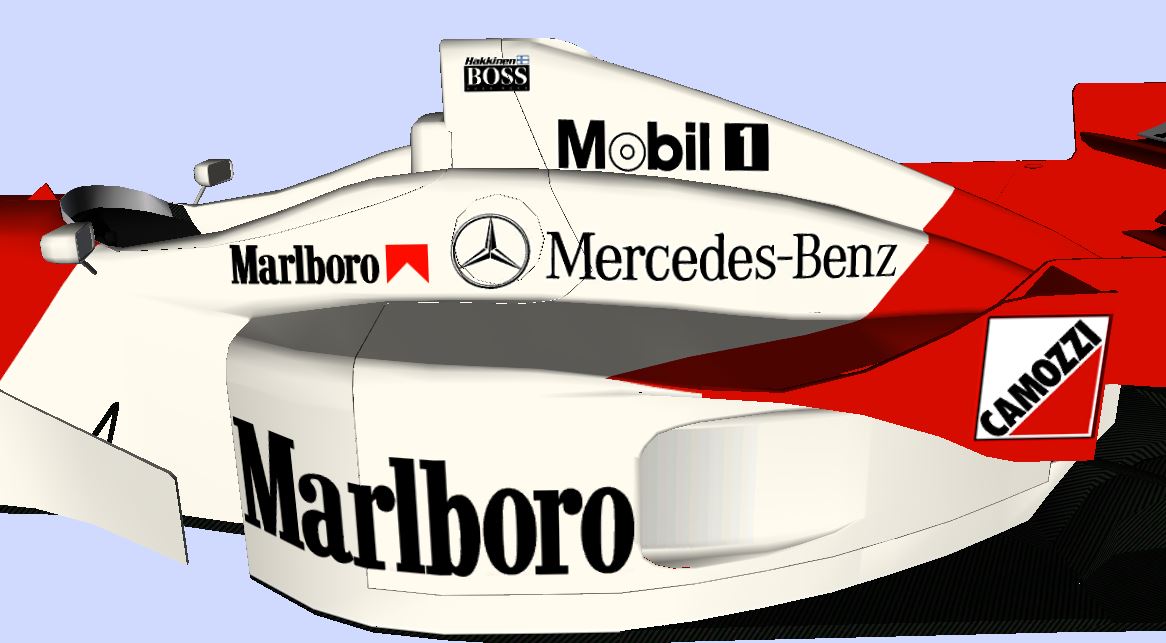
You can see the bodylines go past some interesting curves around the car, all of which takes time to do and get right. I added the very small fin at the top of the rollover bar, something similar to the shark fins of recent years. Eugenio did some good work on the smooth radiator outlet at the rear of the sidepod, I simply resized it to match the proportions of the real car. The winglets from the rear wing are also nicely done.


You can see how the winglet is attached to the engine cover, whilst the rest of the endplate is attached to the rear wing assembly. The rear suspension and diffuser area was all added by me.


Here is a clearer shot of the rear of the car with the diffuser. The side fences of the diffuser are quite high, ensuring the air from the rear of the coke bottle shape is not disturbed by the opening for the insides of the car.


The car has a relatively simple internals, with the radiators, airbox, engine and cylinders/exhaust and rear suspension elements. The standard texture mapping means the engine is still a Renault albeit mirrored. You can see a non-textured version below:

So that's it, the 1996 McLaren MP4/11 for GP4 done. You can find this car as part of the GP4 1996 mod and converted in other games.

You can compare the car against the 1/43 model here: https://fongugp4.blogspot.com/2019/03/143-model-review-1996-mclaren-mp411.html

Monday, 29 April 2019

GP4: 1996 McLaren MP4/11 walkaround part 2

The McLaren MP4/11 was powered by the Mercedes engine, their second season with their new partners that would last through to 2014 and enjoy many competitive seasons. But 1996 was a rebuilding period. New driver, David Coulthard revealed in the recent F1 podcast that he signed for McLaren just before Christmas of 1994, having signed for Williams earlier the same day for 1995.

We must get back to talking about the car as we delve into the details on this GP4 creation.

The front wing is Eugenio's work and on the endplate I added the indent near the bottom. It's quite a simple and basic wing that McLaren ran for the season, there's not even a bend on the front plane. The nose on the 1996 is much more sleek and slimmer than the 1995 car, with a nice single keel solution to mount the front lower suspension wishbones.


You can see from the wireframe how the top of the nose has lots of polygons to make the smooth shape, which towards the front of the car is quite flat. I added the 3D body lines on the nose and the suspension cover. I also added suspension wishbone connection points to the bespoke suspension.


McLaren's side headrest solution was unique to them in that it creates a channel either side of the rollover bar. Getting the body lines around this smooth shape was difficult. The mirrors are asymmetrical, presumably to reduce the turbulent air generated, by having the smooth shape facing the direction of the oncoming airflow.


Moving into the cockpit, and I was able to find some reasonably good photos to re-create the dashboard and some of the buttons along each side.

In case you missed it, here was part 1 https://fongugp4.blogspot.com/2019/04/gp4-1996-mclaren-mp411-walkaround-part-1.html.

Stay tuned for part 3 tomorrow.

Friday, 26 April 2019

GP4: 1996 McLaren MP4/11 walkaround part 1

The first 1996 car ever released in GP4 was Eugenio's McLaren, which included a Monaco GP version with the winglet on the engine cover. Unfortunately I don't have a copy of that car, and I can't find any screenshots of it neither. If I remember correctly, he was working on an updated version years later but was not able to complete it, and so I stepped in and took over. I found this picture lying around, where the white parts of the car were all of Eugenio's work.


If you look carefully and compare the above shot to the end results below, you can see I did quite a lot of modification to it. It's always quicker when there was quite a lot of the car there already. I started by doing quite a bit of work on changing proportions to be more consistent with my other 1996 cars and also with photos as a base. After I was happy with the main shape and proportions, I got to work adding details to it.


This is another car painted by Celinho and this would be the final Marlboro liveried McLaren, having raced in the red and white scheme since the early 1970s.


There was a B spec version of the car that appeared late on in the season, the most notable change from the outside is that the front wing supports are angled rather than straight. This small change is included in the 1996 mod, although the mid-wing was never added. The camera also seems to have gone missing.


Anyway, I'm really pleased with how the shape worked out in the end. My thanks go to the contributors, with Quickslick and Soulbringer having an input too. Eugenio did a great job on the main shape and it was a pleasure to bring this car to completion.


I can't remember exactly, but this was certainly among one of the first 1996 cars that I was involved with completed after the Forti and Minardi. I added suspension (common parts from other 1996 cars) the cockpit, the engine and gearbox, the mirrors and added details such as the hump on the rollover bar and the body lines.


I also did quite a bit of work in smoothing out the normals. If you look at the first shot, there's lots of odd shadows on the flat surfaces and where the light bounces off in an odd way. This is an area I felt I helped improve.

In the next post, we will begin to look at some of the detailed work that's gone into this car.

Here's the car in rfactor 2.

Friday, 19 April 2019

GP4: 1996 Jordan 196 walkaround part 3

This is part 3 of my walkaround of my 1996 Jordan 196.


Moving onto the 2nd part of the sidepods, you can see the body line nicely. There is a slight undercut at the bottom of the rear of the sidepod, and with the vent there, it was not the easiest to get right.


The rear of the bodywork has this complex circle for the rear suspension mounts. The bottom part completes the coke bottle and is quite wide, but the upper part of the circle is quite narrow. It's always difficult to get this curve looking smooth from every angle.


You can see some of the detail I added to the rear wing endplates with the indent near the trailing edge. In the pre-season testing, the team didn't initially run with rear wheel winglets, so the endplate was much shorter, and you can see from the wireframe how the winglet is an additional extra.
The rear suspension is probably one of the first cars where I managed to get it as accurate as possible. With the wireframe, you can also see the vane that rises from the floor. At the time, there were a few photos of the inside of the 196, but there were better photos of the 197, which I used as inspiration for parts of the insides of my 196.


On the engine cover you can see where all the body lines meet without disrupting the smooth normals of the rest of the shape. There is also a small triangular vent under the Peugeot logo.


As mentioned in my other walkarounds, there were some interesting developments on the diffusers and I think Jordan's was the most complex and interesting. The main central section is curved, with the lower part of it narrower as we see on other cars. But there are many slits on the top edge of the central diffuser, this helps maintain the boundary layer and reduce the likelihood of stalling. The rest of the diffuser is lower in the central parts for the exhaust, which is a squat oval shape. The rest of the diffuser is then angled with a gurney flap on top.

You can see I modelled some of the rear suspension mounting points as well in more detail than I remember.


Whoever mapped the GP4 car and put it back together again has merged a lot of parts together I had initially intended to keep separate. So if you go and crash this car, not much falls off and you can't see much of the detail I put on the inside of the car. Here, you can see the curved rear bodywork and how it exposes the gearbox.


You can see how the sidepods channeled air towards the engine. By this stage, I had made individual cylinders on the engine myself. In terms of internals of a car, this car is probably one of my favourites, so I was a little disappointed that you can't appreciate that on the final car. However, I'm still grateful for all the contributors for making this car and its variants, it could still be sat on my hard drive unfinished.

All in all, this remains one of the best cars I've created and I think the end result is pretty good. If I was really picky, I'd say the rear wing could move rearwards a touch, but that is only minor. Here's some shots of the car in GP4.


You can download this car for GP4 as part of the 1996 mod.

Thursday, 18 April 2019

GP4: 1996 Jordan 196 walkaround part 2

Welcome back for part 2 of my 1996 Jordan 196 walkaround. There's quite a few screenshots to feature that I'd like to talk apart so there are 3 parts in total, but let's get into the detail now starting at the front of the car.


The nose and monocoque section has a nice flat side and then a smooth rounded top and bottom. So you can see how I tried to be efficient on polygon use on the flat regions compared to the curved ones which has lots more polygons. The front wing endplate has the small lip that comes out at the front bottom, and then it creates a little bit of an outwash, with the rounded bottom at the rear producing a vortices.

The lower front wing, like most of the grid, curves up on the leading edge in the middle of the car, whilst the trailing edge is flat. Like modern day cars, the upper front wing is separated from the central section to the main part. The front wing support is an interesting shape, because it doesn't really follow the contours of the nose (have a look at the front view in my previous blog) where the lower back part extends wider than any other part of the support. It took a few goes for me to get that right from various angles.


Not that you can tell as it's all black, but the suspension has a bit of detail added to the shape when it connects to the monocoque. The small barge-board also has 3D holes for the suspension to go through.


Again, hard to see when it is all black, but for me it's a first in modelling my first wheel hub and brake ducts.


The first sidepod inlet is an interesting shape. Like the 1995 car, the top part is smoothly merged to the car in a lovely rounded shape around the front of the cockpit. The lower part is attached to the tea-tray element of the floor. Because of the stepped floor to house the plank, the sidepod sits a little higher up than the floor. Again it wasn't easy getting the shape right for the top of the first part of the sidepod, it almost has two separate curves. I'm really pleased with the outcome though, and also the inlet for the second rear sidepod was not easy to get right, especially as it is slightly raised.

The hardest part to model of all was the body line that runs along the side of the cockpit. Not only are the lines curved, but the bodyline itself is on a curved part of the car. Though I'm happy with the positioning, I'm not all too happy with how it turned out compared to the other bodylines. Though I'm glad they are there rather than not there too.


Again, thankfully there were some good shots of the cockpit that I could find and try and get as accurate as possible. My only regrets is that none of the textures have put any effort into lighting up the dash, but at least the 3D rev lights are lit up.


Having shown the video of the converted rfactor 2 car, this is a video the car in Assetto Corsa.