Looksmart have continued to produce excellent Ferrari's again, being priced around £100, more than the resin Minichamps cars. These SF90s are based on the Chinese GP, the so-called 1000th F1 race.
Looksmart LSF1019
Looksmart LSF1020
BBR BBRC225B
I will compare it to the BBR model that has already been released. The first thing to notice for me is that the BBR car is longer, with the rear wing endplate having at more of an inclined angle (more akin to the 2018 rules). The detailing looks of similar high quality from both model makers, and besides the length, proportionally both cars are very similar.
The front ends of both cars look of very similar high quality, there's good definition of the front wing elements and the turning vanes on the underside of the nose. The complex bargeboard and sidepod leading edge section is well modelled by both brands. The Looksmart car does come with a driver figure, though the helmet remains the same basic one that they've been using for years - it could do with updating.
The rear of the BBR car seems more defined, from the mini T wing, to the slots in the rear fin.
The only thing that I'm not too keen on is the red on the Looksmart model. It is matte compared to the previous year's model, but I think it needs to be a little less pink. Still, a very nice model. Score: 8/10
Race Specific Versions
Looksmart LSF1022
Looksmart LSF1021
Looksmart have released a pair of Canadian GP versions of the SF90, where both cars were classified on the podium, with Vettel being penalised after finishing first on the road. The model includes all the changes from the Spanish GP update package, the most noticable being the gap on the shark fin.
Looksmart LSF1023
This is the Belgian GP version, Leclerc's long awaited first victory in F1 and for Ferrari. It was a bitter sweet weekend, with the death of F2 driver and fellow Frenchman, Antoine Hubert. It was only fitting that one of his friends and rival whilst growing up took victory in his honour.
Looksmart LSF1024
This is the Italian GP version, where Leclerc is the latest Ferrari driver to win at the team's home race to emotional scenes. There was a great battle for the lead with Leclerc fending off the World Champion to claim a popular victory.
Looksmart LSF1026
This is the Singapore GP version of the car, where Leclerc did everything right to earn victory, but Vettel got the favoured pit strategy and leapfrogged into the lead to seal his only win of the season.
The Japanese Grand Prix was not the most exciting of races, with Typhoon Hagibis disrupting the order of running. FP3 was cancelled and qualifying moved to Sunday morning, gave teams less preparation than normal. Kubica and Magnussen crashed out, and Hulkenberg had hydraulic issues so there wasn't as much time as normal to get these cars back out for the race.
Ferrari stole the show again, showing some surprising pace in Q3 when it mattered and Mercedes could not respond. Red Bull were a little disappointing that they weren't a bit closer, but Albon and Verstappen setting the exact same time was good to see. Vettel took pole position ahead of his team-mate who could only acknowledge that Vettel did a better job.
The race was by and large decided at the first two corners. Vettel moved before the lights went out, but was lucky to catch it without moving out of his box and being stationary when the lights went out, all of which was different when Raikkonen did the same thing in Russia. Vettel got away with a penalty, but didn't get away particularly well understandably. Leclerc also made a poor start, whilst Bottas produced one of his rocket starts, blasting into a clear lead. Verstappen was alongside Leclerc into turn 2, but the Ferrari driver was caught out by a loss of grip when Vettel came across the front of him and Leclerc went wide taking Verstappen out. He was given a five-second penalty after the race was finished, and Verstappen retired the car a few laps later.
Leclerc's damaged car did not come into the pits at the end of the first lap and should have been given the flag to pit and get his car repaired. Instead, the front wing end plate came off taking off Hamilton's wing mirror and lodging some of it in Norris' McLaren brake ducts ruining his race. Given how close it came to Hamilton's cockpit, you have to say this was a near miss that could have easily been avoided and could have been much, much worse. Some of Leclerc's passing on the way back up the grid was awesome, avoiding a late defensive block from Verstappen, passing Kvyat and Gasly into Spoon, and just about clearing Kimi's Alfa Romeo into 130R, brilliant.
There was a bit of back and forth between Hamilton and his team over strategy and one wonders whether he could have pulled off the one stop in the end and Mercedes could have ended up with a probably 1-2. Instead Hamilton was given fresher tyres to chase Vettel on a track that was difficult to overtake on. Vettel did well to defend, and time his overtakes on the lapped cars, giving himself DRS when Hamilton looked closest. With the chequered flag error that came out a lap too early, imagine if Hamilton had gotten past on the last lap only for it to have not counted.
Mercedes took their sixth consecutive Constructors' Championship and made certain that one of their drivers will win the Drivers' Championship. This Mercedes era ought to be celebrated for the incredibly professional job that they have been doing, the cars remain quick, generally well set up and run, good strategy, on form drivers, fantastic reliability and few mistakes have all propelled the team to a dominant position. The competition are getting closer, their cars faster on occasions, but their challenges have not been sustainable, their mistakes frequent and costly and their strategy calls questionable.
Bottas had a good weekend, on a driver's track, he out-qualified Hamilton and ran away with the race after he took the lead. Mercedes had a race pace advantage, but he made sure Ferrari were never in the question, that's the kind of Bottas we want to see more consistently.
Magnussen's and Hulkenberg's start though! Magnussen started at the back with Grosjean in Q3, and Kevin passed his teammate at the start. Shame there's not that much more to write about the Haas boys after that.
Albon did not have a great start and had to battle his way past the McLarens. Once again, we don't have a direct comparison with his team-mate.
Carlos Sainz made the most of his weekend, and looked closer to the top three and further ahead of the rest of the midfield. Norris, as discussed above, was unlucky to have to pit early to clear debris and later was caught out by a late dive from Albon into the final chicane. Thankfully no real damage done, and no silly penalties issued.
Perez had a good weekend, albeit crashing out of the last lap that wasn't counted. He could have given Gasly a bit more room in their battle for 8th place.
Ricciardo made a great recovery drive, helped by his team-mate waving him through, but he made some great overtakes, had good pace and finished a well deserved 6th place (after Leclerc's penalties).
Gasly had another strong performance, qualifying in 8th place and finishing 9th, miles ahead of his teammate who had a lacklustre weekend. Did well to keep it together at the end when he had suspension problems, and in the end his tangle with Perez counted for nothing.
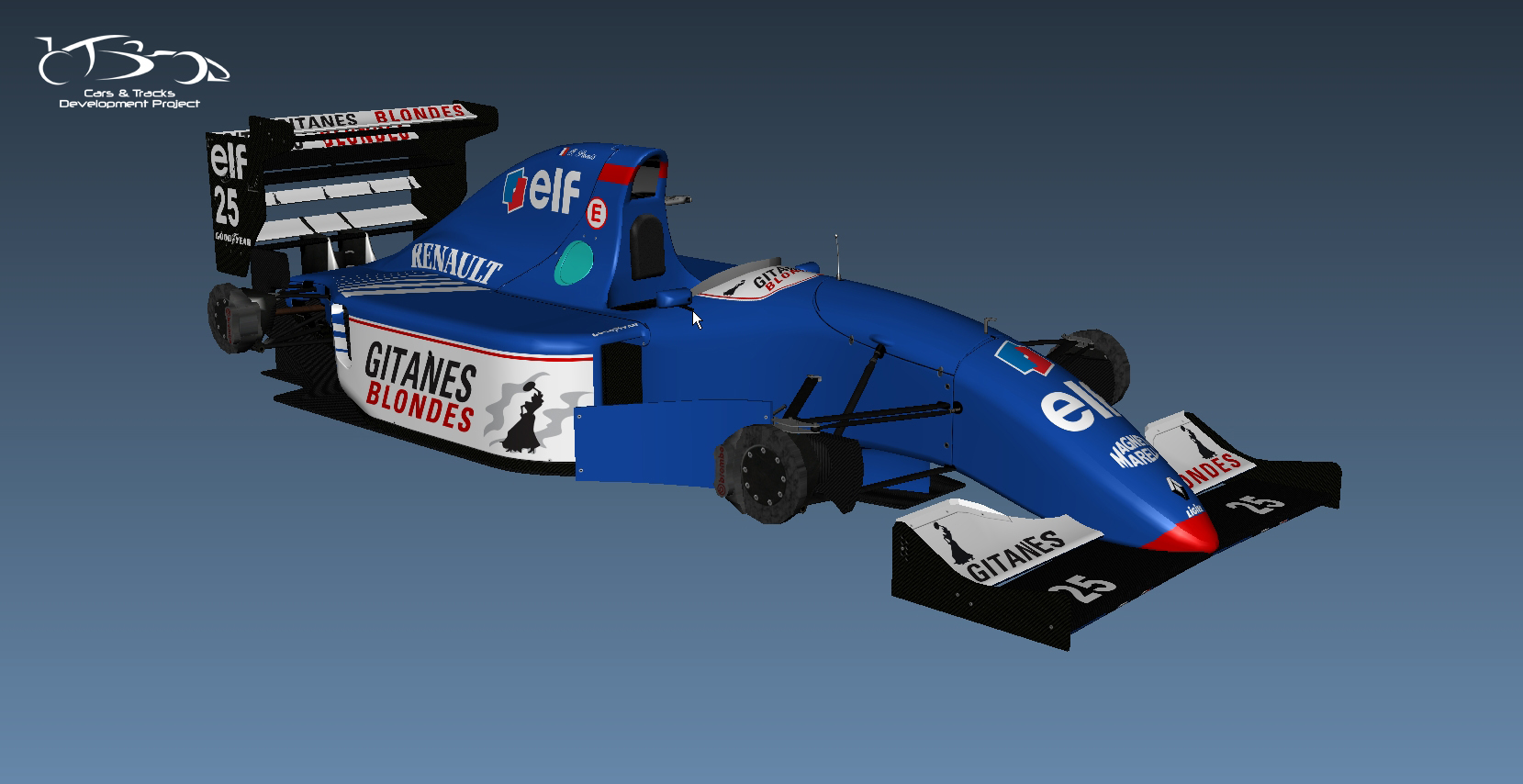
In the last of my walkaround work in progress shots of the Ligier, I concentrate on this post on the central and rear parts of the 3D car I have shaped.
For my 1994 cars, I've been fairly minimal in making the inside parts under the engine cover, but for where some of the cars that have holes cut in them, you can see through the airbox. One of the problems with modelling this is in GP4 you can get some flickering if the internal parts are too close to the surface.
The engine cover changed a bit for the late season, the hump at the back begins much sooner, and there is an additional bump above it (this is a bit clearer in the previous screenshot). The top of the sidepod is flat and not curved or at an angle, so that was quite simple to model.
Moving to the rear of the car, and we have a new diffuser. The outer parts of the diffuser are from my 1994 McLaren, with the exhaust integrated into the top part of it. The central diffuser section is quite unique, with three seperate elements, and the top central part is transparent so that you can see the rain light. The jack points are always a fun bit of detail to put in. As so much of the underside of this car is exposed, though still difficult to see with it being under shadow, I've put a bit of detail on the gearbox, the suspension mounting points and the actual suspension springs themselves.
Here you can see the opening at the rear of the sidepod, and you can see the rear suspension and rear wheel hub.
On the late season Renault engined cars, and into 1995, there is this small inlet, almost like a periscope sticking out of the engine cover. I found someone selling a late season rear wing endplate, so there were a couple of nice reference photos from that. Again, you can't see it on the screenshot, but I've put a bit of detail on the rear wing. It's interesting from the front view, the main black element covers the middle element, looking like they are running quite low wing. If you remember my model review of the Spark model, I complained that they basically only modelled the top element and coloured it all white, but I can kind of see how that mistake happened having inspected various photos.
I hope to get this car mapped fairly soon, and I will release the car as is for anyone who has the talent and time to paint this car.
In this blogpost, I'll do a walkaround some of the details of the 1994 car. Buried away in the Ligier museum, there are a few good detail shots of the car on my usual resource site http://www.gurneyflap.com/ligiermuseum.html
Ligier ran quite a small front wing endplate at the beginning of the season, but upgraded to quite a big endplate for the end of the season. I've put the wireframe on so that you can see there is quite bump half way down the endplate, I'm not quite sure why. The under side on the leading edge curves outwards, before directing the air to the inside of the front wheels on the trailing edge. So it's not quite as straight forward as I had initially thought, but I'm always pleased to add the detail onto my 3D model. The front wing is pretty basic, the main plane is raised in the centre section, a smoother version of their 1993 concept. The two white dots on the nose I'm not sure what they were for exactly, but again it's always nice to add a few details on when I spot them.
The nose itself is an interesting shape and one where my version differs from my resources. The flat side does not go all the way to the tip of the nose, instead it is rounded for half the width of the front wing. It also sits higher than the early season resource models I've been referring to, and is actually not too dissimilar in height from the 1993 car which was slightly raised. I also added a hole at the trailing edge of the nose cone for the steering arm as per the real car.
The front suspension is actually lifted from the 1994 Williams, just amended in position to fit this car. The brake duct is new, although I could not find any good shots of the brake ducts from the late season car, but I put on quite a generic one. The mounting points are different from the Williams, but quite straight forward on this car. For the front lower wishbone, I had to cut out a section of the monocoque, again in a similar way to the Williams. It's not very clear on this screenshot, but I've put quite a bit of detail into the section underneath the nose.
Ligier run a double pitot tube, one directly behind the other. The team added bargeboards mid-season, it's quite a simple rectangular shape, though it has a bit cut off for the suspension arm to pass through. There are also a couple of bumps on the monocoque to factor in, the one above the diagonal suspension arm, which I had to put a hole in as well, and there are two small bumps on top of the monocoque, in between the pitot tube and the aerial. For me, it's quite a fun challenge to get the normals working well with the flat side of the monocoque and the curved section along the top, which dissipates as you get towards the opening of the sidepod and the cockpit. You can see the curved bodyline at the sidepod opening which wasn't easy to get right. Actually, I departed from my normal method of doing body lines, simple having detached indents to save time and actually is slightly more effective.
The mirrors sit quite low on the Ligier, but when I modelled the rear wing elements, I realised it had a very small gap to see through. The Ligier had quite a large and rounded cockpit opening, particularly along the sides. It means much more of the driver body (taken from my 1995 Ferrari) and the seat is exposed. The dash and steering wheel mounts are all covered by the top of the monocoque, and though the rules threated to change this arrangement (in accidents heads were hitting the front of the cockpit), it didn't get fully implemented until 1995 (as far as I can tell). From the photos that I have, there was simply just a screen, or for the museum car most of the cockpit had been stripped. Other cars have done a generic dashboard model, but I've decided to follow the pictures and just have a small rectangular screen and one button for the fire extinguisher. The visor (coloured in black here) is also an upside down L shape, which has been a feature of Ligier cars in the early 90s.
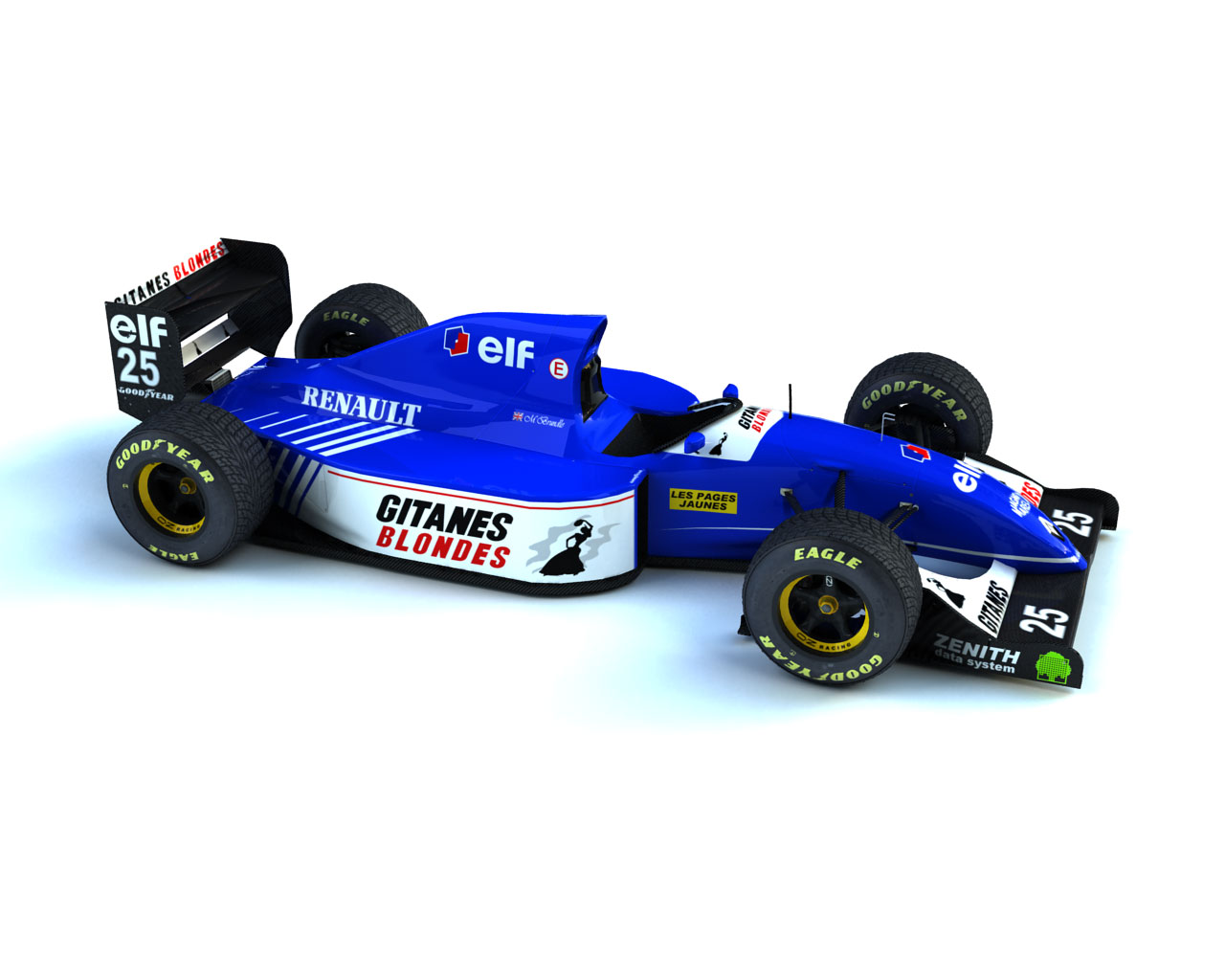
For my next GP4 car from 1994, I've manage to complete the build in just a couple of weeks, partly down to some sick days I had, but I went for the Ligier due to its simplicity and a couple of other good references available to me. I thought the early season GP4 car by Mckey and Oggo was a good base, but needed updating to late season spec and could have done with some more details.
I also found lying about on my old files a copy of the CTDP car to use as reference, again from the early season. It was optimised for F1C/rFactor so the scaling is a bit different, but it was a useful resource.
CTDP 1994 Ligier JS39B
The 1994 car was a B spec version of the 1993 car, so the monocoque is pretty much identical with very few changes, and the one in GP4 is excellent too.
RF900R, Adry77 & Oggo's 1993 Ligier JS39
GP4 1994 Mod (Mckey & Oggo)
So I thought, great, this should be easy and like the 1995 Ferrari, I had lots of references to follow. But then I started looking at some photos and realised it wasn't quite as simple as I had imagined. Apologies for the GP4 Builder shots, I don't have anything better to show preview shots in at the moment.
As mentioned before in my blog, the rules were amended mid-season, and that led to a number of changes, as well as the usual in-season developments. The car was raised from the ground a bit to accommodate the plank, and if you played the GP4 1994 mod, you'll notice Mckey's car ran pretty low to the ground. The team introduced bargeboards, a new front wing endplate at the front of the car.
The engine cover had to incorporate holes as part of the rule changes, and the late season car also had an extra hump at the rear that was not present on the early season car. Like most the teams on the grid, they introduced new rear wing winglets by the rear wheels.
Moving to the rear of the car, the diffuser rules also changed, meaning that I couldn't use the other cars as a reference on that area. Ligier also removed the bodywork by the rear suspension, so a lot of the gearbox and rear suspension mountings are visible. On the rear wing, they curved the lower section and also introduced a straight wing in the middle too. So quite a lot of the rear of the car is new compared to the early season and 1993 car that I had references for.
I'm quite pleased with how this car ended up and all that is left is the mapping and the painting.
Coming up is a walkaround talking through some of the details I've put in and where almost every part of the car is different from the reference models I've used.
The Tyrrell 025 is an evolution of the previous car, but now carries the Ford engines, having ditched the Yamaha engines. Sadly the V8’s lacked the power to keep up with its rivals, despite having good drivers and a well balanced chassis. The San-Marino GP saw the innovation of the “Tower Wings” or X-Wings, which came up out of the sidepod by the side of the driver to generate downforce. These were adopted in the early part of the 1998 season by many other teams before the FIA banned the technology. This is also the last Tyrrell GP car to score a point before it was sold at the end of the 1998 season.
I personally like the majority of the 1997 grid for its shapes and liveries. I like the Tyrrell for it's simplicity, it's white with black trim looks good, the shape is smooth and simple. The nose is just an extended version of the nose that Ferrari ran at the beginning of 1996, just pushing the nose higher. However, even with this concept, you lose the downforce generation of the central part of the front wing. Simple bargeboards hidden within the suspension and tiny small sidepods, and shrink wrapped gearbox have been features of Tyrrells going back to 1995.
The Minichamps car comes in two editions, one from the San Marino GP which features the X-Wing and nose winglets as well.
Minichamps 430970019
The standard car looks quite bare without all the additional wings, but again I like the simplicity of the livery and the elegent shape. The model is nicely done, good proportions, Minichamps were improving their models and were consistently pumping out some nice models in 1997.
You can get a few extra versions from Onyx of the Tyrrell 025, but sadly the base shape isn't particularly great, despite the relatively simple shape of the car. Above is the San Marino GP model.
Onyx X301S
Then we have the Monaco GP model, which has even more winglets around the rear wheels.
Onyx X301
At the lower downforce track in Montreal, we get a more basic version from the Canadian GP. The model struggles with odd proportions, the shape kind of if you were to really squint somewhat resembles the real car, but it just looks like it was a quick job with not much effort into making it look realistic. Score: 5/10
From Tameo, we get the Argentine GP version from the beginning of the season. This is another brilliant model from Tameo, fantastic proportions and great details. They have the extra elements on the rear wing, the additional flat floor on the leading edge of the sidepods, the holes in the sidepod and around the rear suspension are nice touches, good detail on the fuel cap and cockpit as always, and all the additional winglets are nicely sculpted too. A brilliant model if you can afford it.